


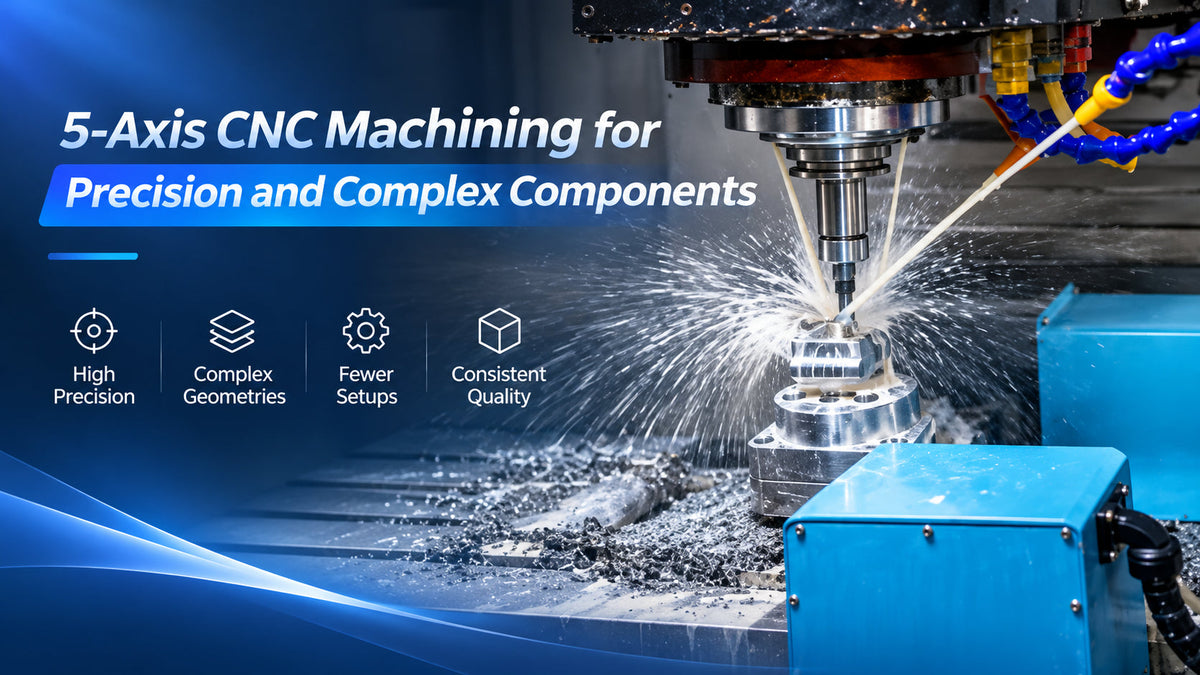
Let's face it: most of us think 5-axis CNC machining is used to machine parts that look complicated. However, sometimes, a simple metal housing with a few angled holes can be more challenging to machine than a large component with an unusual shape.
Compared with 3-axis CNC machining, a 5-axis CNC machine has two additional rotary axes. This gives the cutting tool more freedom to approach the workpiece from different directions. Features that would normally require several setups can often be machined without removing the part from its fixture.
Of course, not every part needs this level of flexibility. Much depends on its geometry, how easily the cutting tool can reach each feature, and how accurately those features need to be positioned.
Founded in 2010, XY-GLOBAL brings over 15 years of experience in one-stop on-demand CNC machining services with capabilities from CNC milling and CNC turning to more advanced 5-axis CNC machining.
Read this blog and let's figure out what parts are 5-axis CNC machining usually produced, its advantages, limitations, common applications, and 5-axis machining services at XY-GLOBAL with our hands-on over the years.

1. What Types of Parts Are Suitable for 5-Axis CNC Machining?
1.1 Parts With Multiple Machining Faces
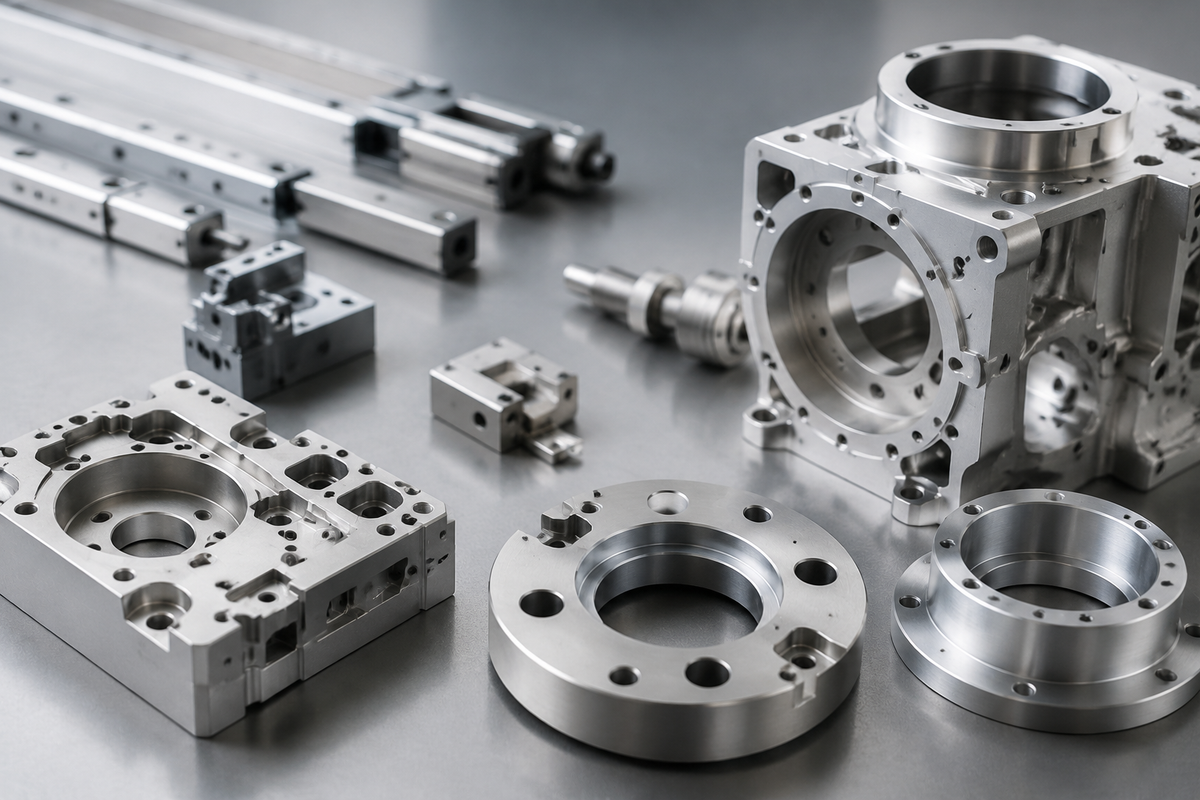
Precision housings, robot joint components and industrial equipment parts often have holes, slots and mounting surfaces on several sides.
On a conventional 3-axis machine, an operator may need to remove and reposition the workpiece several times to reach these features. Each new setup takes time and introduces another opportunity for positioning errors.
A 5-axis CNC machine can rotate the workpiece or change the tool orientation to reach multiple faces while keeping the part in the same fixture.
This is particularly useful for mechanical housings that need to fit accurately with other components during assembly. Even a small difference in the position of a mounting hole or mating surface can cause problems later.
1.2 Parts With Complex Curved Surfaces
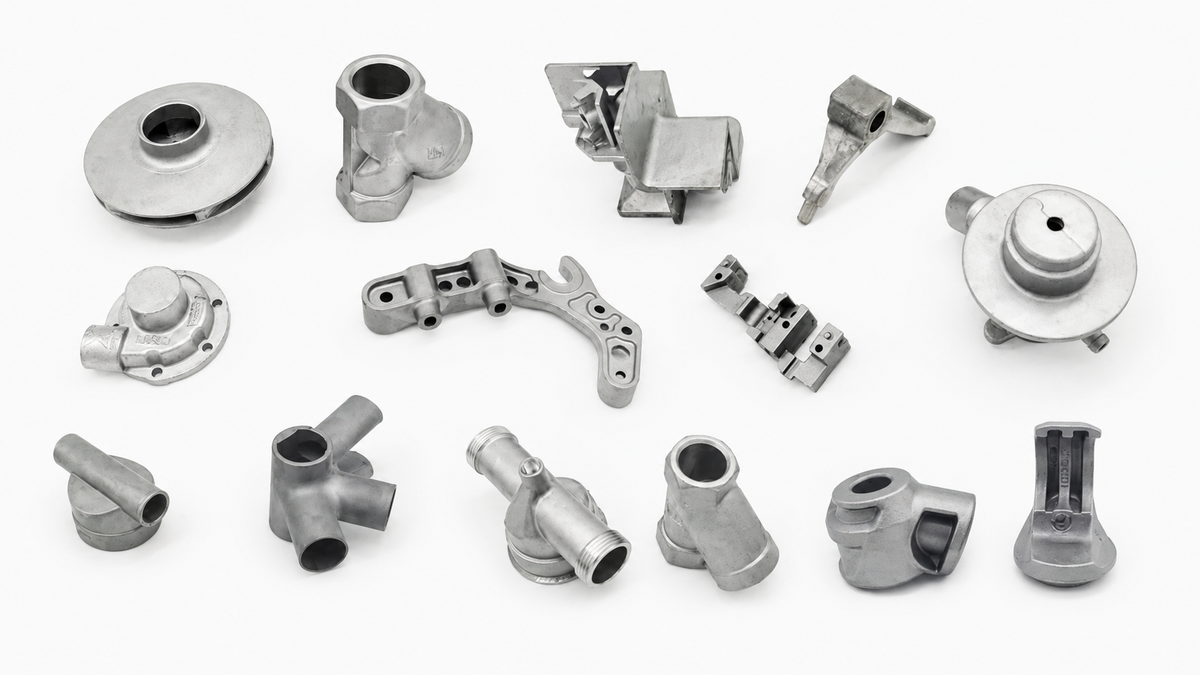
Impellers, turbine blades and complex molds are some of the most common examples of parts suited to 5-axis machining.
The challenge with these parts is that the surface angle changes continuously. A cutting tool approaching from a fixed direction may struggle to reach certain areas, especially where the surrounding geometry limits access.
With simultaneous 5-axis machining, the tool orientation can change as it moves along the surface. This gives the programmer more control over how the tool makes contact with the material.
A well-planned toolpath can also produce a smoother surface and reduce the amount of polishing or other finishing work needed after machining.
1.3 Parts With Angled Holes and Surfaces
Some parts are fairly simple apart from a few features that sit at unusual angles. Fluid manifolds, mounting brackets and custom automation components are good examples.
Machining an angled hole on a 3-axis machine or 4-axis machine often requires a special fixture. If the part has holes at several different angles, the setup becomes more involved.
A 5-axis machine can position the workpiece or cutting tool at the required angle before drilling or milling begins.
In many cases, 3+2 CNC machining is enough. The two rotary axes move into position and remain fixed while the three linear axes perform the cutting. There is no need for all five axes to move at the same time.
1.4 Parts With Deep Cavities or Hard-to-Reach Features
Tool length is a common concern when machining deep cavities.
The further a cutting tool extends from its holder, the more likely it is to bend or vibrate under cutting forces. This can leave visible marks on the machined surface and make it harder to maintain dimensional accuracy.
By approaching the workpiece from a different angle, a 5-axis machine can sometimes reach these areas with a shorter cutting tool.
A shorter tool is generally more rigid, which makes the cutting process more stable.
However, there are still limits to what a 5-axis CNC machining can't reach. Fully enclosed cavities and certain internal undercuts may require special tooling, a different part design or another manufacturing process.
1.5 Thin-Walled and Lightweight Parts
Thin-walled components are widely used in robotics, aerospace and electronic equipment, where reducing weight is often an important part of the design.
These parts can be difficult to machine because the material may move or deform as it is being cut. Clamping pressure can also change the shape of a thin wall, particularly when there is not enough support behind it.
The flexibility of 5-axis CNC machining gives programmers more options when choosing cutting directions and toolpaths. In some situations, it also allows the use of shorter tools.
Still, the machine alone cannot prevent deformation. Proper workholding, suitable cutting parameters and careful planning of roughing and finishing operations remain essential.
1.6 Parts With Tight Geometric Requirements
For some precision parts, the relationship between different features matters just as much as their individual dimensions.
Take the aluminum housing with bearing bores and mounting holes for example. Each feature might meet its own dimensional tolerance, but the housing could still cause assembly problems if those features are not correctly aligned.
When several related features can be machined from the same reference setup, there is less opportunity for errors caused by repositioning the workpiece.
This makes 5-axis CNC machining a useful option for components with demanding positional, perpendicularity or coaxiality requirements.

2. Why Use 5-Axis CNC Machining for These Parts?
The main benefits become easier to understand when we look at what happens during the machining process.
2.1 Fewer Setups and Less Repositioning
Imagine a metal housing that needs machining on several sides. Depending on its design, a conventional 3-axis machining plan might require five setups, while a suitable 5-axis machining plan might need only two.
Here is a simple example of how that difference could affect production time.
| Machining Factor | 3-Axis CNC Machining | 5-Axis CNC Machining |
| Number of setups | 5 | 2 |
| Setup and alignment time per setup | 10 min | 10 min |
| Total setup and alignment time | 50 min | 20 min |
| Reduction in setup and alignment time | — | 60% |
*Actual machining performance, achievable tolerances and surface finishes depend on part geometry, material, tooling, equipment and machining conditions.
In this example, the 5-axis machining plan saves 30 minutes in setup and alignment time.
The benefit can become more noticeable when the same part is produced repeatedly. Fewer setups also mean fewer opportunities for positioning errors.
This does not mean the entire machining cycle will be 60% shorter. Programming, cutting time, tool changes and inspection still need to be taken into account.
2.2 Better Cutting Stability With Shorter Tools
A small change in tool overhang can make a surprisingly large difference to cutting tool deflection.
According to a simplified cantilever beam model, static bending deflection is proportional to the cube of the tool overhang when the cutting force, tool material and cross-section remain the same.
The following table shows how theoretical deflection changes with tool overhang.
| Tool Overhang | Relative Theoretical Deflection |
| 60 mm | 100% |
| 50 mm | 57.30% |
| 40 mm | 28.60% |
Reducing the tool overhang from 60 mm to 40 mm results in approximately 71.4% less theoretical static bending deflection under these conditions.
This helps explain why changing the tool approach angle can be so useful when machining deep cavities and complex surfaces.
A more rigid tool setup can reduce unwanted tool movement and improve surface quality. Actual cutting performance, however, also depends on the tool holder, cutting parameters, machine condition and workpiece material.
2.3 Lower Overall Manufacturing Costs for Complex Parts
Usually, running a 5-axis machine is generally more expensive than running a standard 3-axis machine. The equipment costs more, and programming can take longer.
But the hourly machine rate is only part of the overall cost.
A complex part may require several custom fixtures, repeated setups and additional finishing operations when produced on a 3-axis machine. Some of these steps can be reduced or avoided with a suitable 5-axis machining strategy.
Even with a higher machine rate, the total cost of producing the finished part may be lower.
The savings depend on the design and production quantity, so it is worth looking at the entire manufacturing process rather than simply comparing machining rates.
3. Limitations of 5-Axis CNC Machining
Despite its advantages, 5-axis machining is not always the most practical choice.
The machines themselves are more expensive, as are the software and maintenance required to keep them running accurately. Programming also becomes more demanding, particularly when several axes need to move together during cutting.
Tool access, rotary axis movement and possible collisions must all be considered before machining begins.
For a simple flat plate with standard holes and slots, a 3-axis machine may produce the same result at a lower cost. Parts made up mainly of cylindrical surfaces, bores and threads may be better suited to CNC turning.
Don't use 5-axis CNC machining if the part does not actually need it.
4. Common Applications of 5-Axis CNC Machining
Many industries use 5-axis CNC machining to produce parts that would be difficult or time-consuming to manufacture using conventional methods.
| Industry | Typical 5-Axis CNC Machined Parts |
| Aerospace | Turbine blades, impellers, lightweight structures and complex brackets |
| Medical | Orthopedic implants, surgical instruments and precision equipment components |
| Robotics and Automation | Robot joint housings, robotic arm components and precision mounting bases |
| Automotive | Engine components, complex housings and prototype parts |
| Energy | Turbine components, fluid control parts and complex mechanical structures |
| Optics and Semiconductors | Precision equipment housings, optical mounts and support structures |
| Mold Manufacturing | Complex curved molds, deep cavities and precision mold inserts |
Although these components serve very different purposes, many share similar manufacturing challenges.
They may have difficult-to-reach surfaces, features at different angles or strict requirements for the alignment of several machined features.
Partner with XY-GLOBAL for 5-Axis CNC Machining Services
As a reliable and experienced precision parts supplier and manufacturer certified by ISO 9001:2015 and ISO 13485:2016, XY-GLOBAL has providing custom 5-axis CNC machining services for parts with complex shapes, multiple machining faces and demanding precision requirements.
We support both 3+2 indexed machining and simultaneous 5-axis machining with tight tolerances down to ±0.005 mm. The process we use depends on the geometry of the part and what is required to manufacture it accurately and efficiently.
Our machining services include:
-
Custom metal and engineering plastic components
-
Complex surface and multi-face machining
-
Rapid prototyping and batch production
-
CMM inspection and project-specific quality checks
If you are not sure whether your part needs 5-axis CNC machining, send us your 2D drawings or 3D models. Our engineering team can review your design and recommend a practical manufacturing approach based on your technical requirements.
Final Thoughts
The real value of 5-axis CNC machining lies in the flexibility it offers when manufacturing difficult parts.
If your design includes complex curves, angled features or several machining faces that need to remain accurately aligned, 5-axis machining is worth considering. For simpler components, a conventional machining process may still be the better option.
Ultimately, the right machining method is the one that meets your part requirements without adding unnecessary manufacturing costs.
Frequently Asked Questions
1. Is 5-axis CNC machining more accurate than 3-axis machining?
Not necessarily. Machining accuracy depends on several factors, including machine condition, tooling, workholding and temperature. One of the main advantages of 5-axis machining is that it can reduce repositioning errors when machining features on different sides of a part.
2. What Is the Difference Between 3+2 and Simultaneous 5-Axis CNC Machining?
In 3+2 CNC machining, the two rotary axes position the part or tool at a fixed angle before cutting begins. It is ideal for angled holes and multi-face parts. In simultaneous 5-axis CNC machining, all five axes can move together during cutting, making it more suitable for complex curved surfaces and intricate geometries.
3. Do all complex parts require simultaneous 5-axis machining?
No. Parts with angled holes or multiple flat machining surfaces can often be produced using 3+2 machining. Simultaneous 5-axis machining is more useful for complex curved surfaces that require continuous changes in tool orientation.
4. Is 5-axis CNC machining suitable for small production runs?
Yes, particularly when the parts would otherwise require several setups or special fixtures. For simpler designs, however, conventional 3-axis machining may be more economical.

공유하다:
Aluminum Die Casting Tooling: Design, Cost & Lead Time