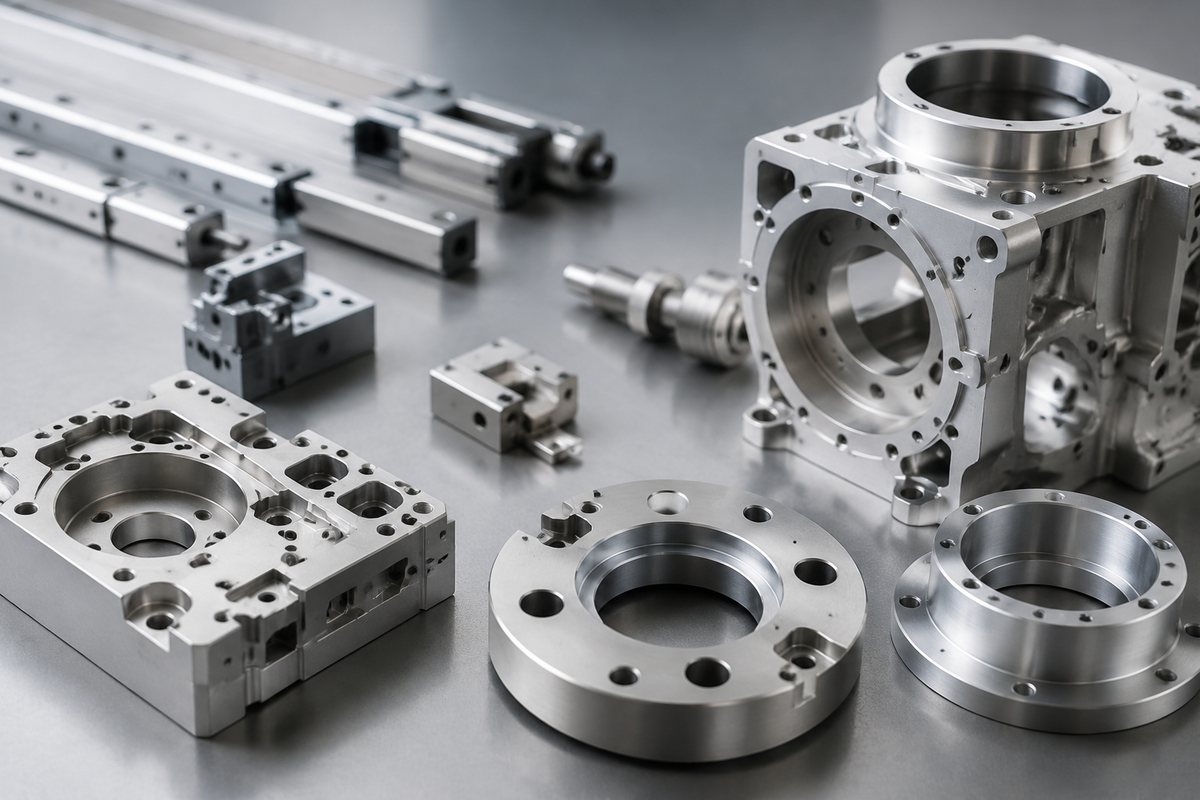
For precision CNC machined components, surface finish is not only an aesthetic requirement. It directly affects part performance, dimensional stability, friction, sealing performance, coating adhesion, and assembly reliability.

Selecting the right machining surface finishes requires balancing functional requirements, material characteristics, machining capability, and production cost.

At XY-GLOBAL, we work with customers across semiconductor, medical, optical, automation, and industrial equipment industries, where surface finish requirements often go beyond standard machining expectations. From precision milling surfaces to secondary finishing processes, the correct surface treatment strategy is critical for achieving consistent part performance.

Custom CNC Machining Surface Finishing Options


What Are Machining Surface Finishes?

Machining surface finishes describe the final surface condition of a CNC machined component after manufacturing processes such as milling, turning, grinding, polishing, blasting, or coating preparation.

A surface finish specification normally includes:

  • Surface roughness value (Ra, Rz)
  • Machining marks requirements
  • Surface texture direction
  • Visual appearance requirements
  • Post-processing requirements

In engineering drawings, surface finish is usually represented by roughness parameters such as:

Surface Finish Parameter Description
Ra Average surface roughness, most commonly used
Rz Maximum height difference between peaks and valleys
Surface texture Direction and pattern of machining marks

For CNC machining, Ra is the most widely used parameter for defining surface quality.


Common CNC Machining Surface Finish Options

Different applications require different levels of surface quality. Choosing a higher surface finish is not always better because it may increase machining time and manufacturing cost.

1. As-Machined Surface Finish

As-machined is the standard CNC machining surface finish without additional finishing operations.

Typical characteristics:

  • Visible tool marks
  • Cost-effective
  • Suitable for functional components
  • Good dimensional control

Typical roughness:

Ra 3.2 μm – 6.3 μm

Common applications:

  • Structural brackets
  • Machine components
  • Internal mechanical parts

For many industrial components, an as-machined surface provides the best balance between performance and cost.

Precision Machined Galvo Scanner Housing


2. Fine Machined Surface Finish

Fine machining uses optimized cutting parameters, sharper tools, smaller step-over distances, and improved machining strategies.

Typical roughness:

Ra 0.8 μm – 1.6 μm

Advantages:

  • Reduced friction
  • Improved appearance
  • Better sealing performance
  • Suitable for precision assemblies

Common applications:

  • Optical equipment components
  • Semiconductor fixtures
  • Medical devices
  • Precision mechanical parts

Achieving Ra 0.8 consistently requires careful control of:

  • Cutting speed
  • Tool wear
  • Material condition
  • Machine rigidity
  • Tool path strategy

3. Grinding Surface Finish

Grinding is used when tighter surface requirements cannot be achieved through standard milling or turning.

Typical roughness:

Ra 0.2 μm – 0.8 μm

Advantages:

  • Excellent flatness
  • High dimensional accuracy
  • Improved surface consistency

Common applications:

  • Precision guide rails
  • Sliding surfaces
  • Bearing components

However, grinding increases manufacturing cost and is usually applied only to critical functional surfaces.


Secondary Machining Surface Finishing Processes

CNC machining is often combined with secondary finishing processes to achieve specific functional requirements.

Sand Blasting / Bead Blasting

Bead blasting creates a uniform matte surface appearance.

Benefits:

  • Removes machining marks
  • Improves cosmetic appearance
  • Provides consistent texture

Applications:

  • Aluminum housings
  • Consumer electronics components
  • Medical equipment parts

Important consideration:

Blasting can slightly affect dimensions, especially on small precision features. Critical dimensions should normally be completed after finishing or properly masked.

CNC Machining Surface Finishing of Sand Blasting


Anodizing

Anodizing is commonly applied to aluminum CNC parts.

Benefits:

  • Improved corrosion resistance
  • Increased surface hardness
  • Enhanced appearance

Common types:

  • Type II anodizing
  • Type III hard anodizing

Engineering considerations:

Anodizing adds a surface layer, which may affect:

  • Tight tolerance holes
  • Thread dimensions
  • Assembly interfaces

Therefore, designers should consider finishing allowance during the machining stage.

Surface Finishing and Anodizing in Optics Manufacturing


Electroless Nickel Plating

Electroless nickel plating provides:

  • High corrosion resistance
  • Uniform coating thickness
  • Improved wear resistance

It is widely used for precision industrial components requiring stable performance.


Polishing

Polishing can achieve extremely smooth surfaces.

Typical applications:

  • Optical components
  • Medical instruments
  • Decorative precision parts

However, polishing may remove material unevenly and should not replace precision machining when dimensional accuracy is critical.


How to Select the Right CNC Machining Surface Finish?

The correct surface finish depends on the function of the part, not simply the appearance requirement.

1. Consider Functional Requirements

Different applications require different surface characteristics.

Requirement Recommended Finish
General mechanical parts Ra 3.2
Precision assembly Ra 1.6 or better
Sliding components Ra 0.8 or better
Optical applications Polishing / special finishing
Coating preparation Bead blasting

2. Consider Material Characteristics

Different materials respond differently during machining.

For example:

Aluminum

Easy to machine but sensitive to:

  • Tool marks
  • Scratches
  • Surface oxidation

Common finishes:

  • CNC fine machining
  • Bead blasting
  • Anodizing

Stainless Steel

Requires careful tool selection because of:

  • Work hardening
  • Higher cutting force
  • Heat generation

Common finishes:

  • Fine milling
  • Grinding
  • Electropolishing

Titanium Alloys

Require controlled machining parameters due to:

  • Low thermal conductivity
  • Tool wear

Surface finishing must be carefully controlled to maintain fatigue performance.

Titanium and Titanium Alloys Used for Medical Devices


Surface Finish vs Machining Cost

A common misunderstanding is that achieving better surface finish only requires changing machining parameters.

In reality, improving surface finish may require:

  • Additional machining passes
  • Lower cutting speed
  • New cutting tools
  • Longer cycle time
  • Secondary processes

For example:

Surface Requirement Manufacturing Impact
Ra 3.2 Standard machining
Ra 1.6 Additional finishing control
Ra 0.8 More precise machining strategy
Ra <0.4 Grinding/polishing may be required

Therefore, specifying unnecessarily tight surface finishes can significantly increase manufacturing costs without improving product performance.


Engineering Considerations When Specifying Surface Finish

For precision CNC parts, customers should define:

1. Critical Surface Identification

Not every surface requires the same finish.

A better drawing practice is:

  • Critical functional surfaces: specific Ra requirement
  • Non-critical surfaces: general machining finish

This reduces unnecessary cost.


2. Surface Finish After Coating

When coatings are required, the final surface condition should be considered.

For example:

  • Aluminum anodizing
  • Powder coating
  • Nickel plating

The final coating thickness and texture may affect:

  • Assembly tolerance
  • Contact surfaces
  • Appearance

3. Measurement and Inspection

Surface finish should be verified using appropriate inspection equipment.

Common methods:

  • Surface roughness tester
  • Profilometer
  • Optical measurement systems

For high-precision components, surface inspection should be included in the quality control plan.


XY-GLOBAL CNC Machining Surface Finish Capability

At XY-GLOBAL, we support customers from prototype development to volume production with comprehensive CNC machining and surface finishing solutions.

Our capabilities include:

  • Precision CNC milling and turning
  • 3/5-axis machining
  • Surface roughness control
  • Sand blasting
  • Anodizing
  • Electroless nickel plating
  • Powder coating
  • Grinding and polishing
  • CMM dimensional inspection

For precision industries such as semiconductor equipment, medical devices, optics, and industrial automation, we help customers select the most suitable machining surface finishes based on part function, tolerance requirements, and production cost.


Conclusion

Choosing the right machining surface finishes is an engineering decision that affects product performance, reliability, and manufacturing cost.

The best surface finish is not always the smoothest one. It is the finish that meets functional requirements while maintaining efficient production.

By combining CNC machining expertise, surface treatment knowledge, and manufacturing experience, XY-GLOBAL helps customers achieve reliable and cost-effective precision components.