


An optical lens is a transparent component used to control the direction of light. It can focus, spread, or shape light and is commonly used in cameras, microscopes, laser systems, machine vision equipment, medical devices, and other optical instruments.
However, the lens itself is only one part of an optical system.
To work correctly, the lens must be accurately positioned and securely held inside a mechanical structure such as a lens barrel, lens housing, optical mount, or camera housing.

Why is the Lens Barrel Important?
A lens barrel is the precision mechanical component used to hold and position one or more optical lenses.
Its main functions include:
-
Holding the lens securely
-
Maintaining the correct optical axis
-
Controlling the distance between lenses
-
Protecting the optical components
-
Connecting the lens assembly to the camera or optical system
-
Maintaining alignment during use
Even a high-quality optical lens may not perform correctly if the lens barrel is poorly manufactured.
For this reason, the dimensional accuracy of the mechanical housing is very important.

Key Requirements for Lens Barrels
Precision lens barrels normally require good control of several features.
Concentricity
The internal lens bore should remain concentric with the main optical axis.
Poor concentricity may cause the lens to shift away from the intended optical center.
Bore Diameter
The lens seating diameter must match the lens size correctly.
If the bore is too large, the lens may move.
If it is too small, assembly may become difficult or create unwanted stress on the lens.
Flatness and Perpendicularity
Lens seating surfaces and mounting faces need to maintain the correct geometric relationship.
This helps prevent lens tilt and optical misalignment.
Thread Accuracy
Lens barrels often use internal or external threads for retaining rings, adapters, focusing mechanisms, or camera interfaces.
Accurate threads are important for smooth assembly and repeatable positioning.

Common Materials for Lens Barrels
Aluminum 6061-T6
Aluminum is one of the most common materials for optical lens barrels because it is:
-
Lightweight
-
Easy to machine
-
Cost-effective
-
Suitable for black anodizing
It is widely used in camera systems, machine vision, laser equipment, and optical instruments.
Aluminum 7075
7075 aluminum can be used when higher strength or stiffness is required.
Stainless Steel
Stainless steel is suitable for applications requiring higher strength, wear resistance, or corrosion resistance.
Brass
Brass is sometimes used for threaded components, adjustment mechanisms, sleeves, and precision inserts.
Why is Black Anodizing Common on Optical Components?
Many aluminum lens barrels and optical housings use black anodizing.
The main reasons are:
-
Reduce unwanted light reflection
-
Improve corrosion resistance
-
Improve surface durability
-
Provide a uniform appearance
For optical applications, internal surfaces may also require a matte finish to help reduce stray light.

CNC Machining for Lens Barrels
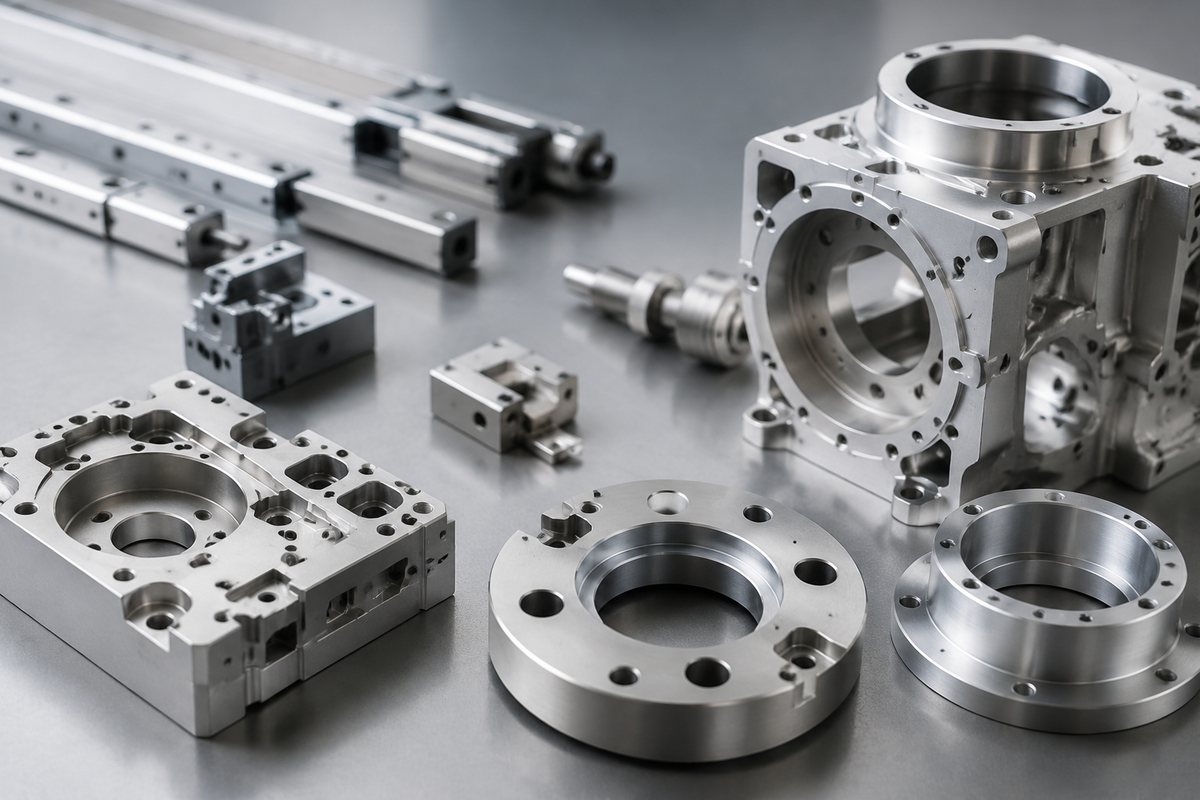
CNC machining is widely used to manufacture custom lens barrels and optical housings.
Typical CNC-machined optical components include:
-
Lens barrels
-
Lens housings
-
Camera housings
-
Optical mounts
-
Laser housings
-
Sensor housings
-
Optical adapters
-
Retaining rings
-
Precision brackets
For these parts, the important point is not only the individual dimension, but also the relationship between the bore, datum surface, mounting holes, and optical axis.
This is why precision machining and inspection are important for optical mechanical components.
Optical Lens and Optomechanical Components Work Together
An optical lens controls the light.
The lens barrel and optical housing control the position of the lens.
Both are necessary for a stable optical system.
For manufacturers of cameras, machine vision systems, laser equipment, medical instruments, or optical inspection equipment, precision mechanical components can directly affect alignment, assembly, and final optical performance.
XY Global supports custom manufacturing of lens barrels, optical housings, camera housings, optical mounts, brackets, adapters, and other precision optomechanical components based on customer drawings.
We support CNC machining, surface treatment, dimensional inspection, and assembly for prototype and production projects.


공유하다:
Low Cost Optical Components Suppliers: How to Reduce Cost Without Sacrificing Precision