


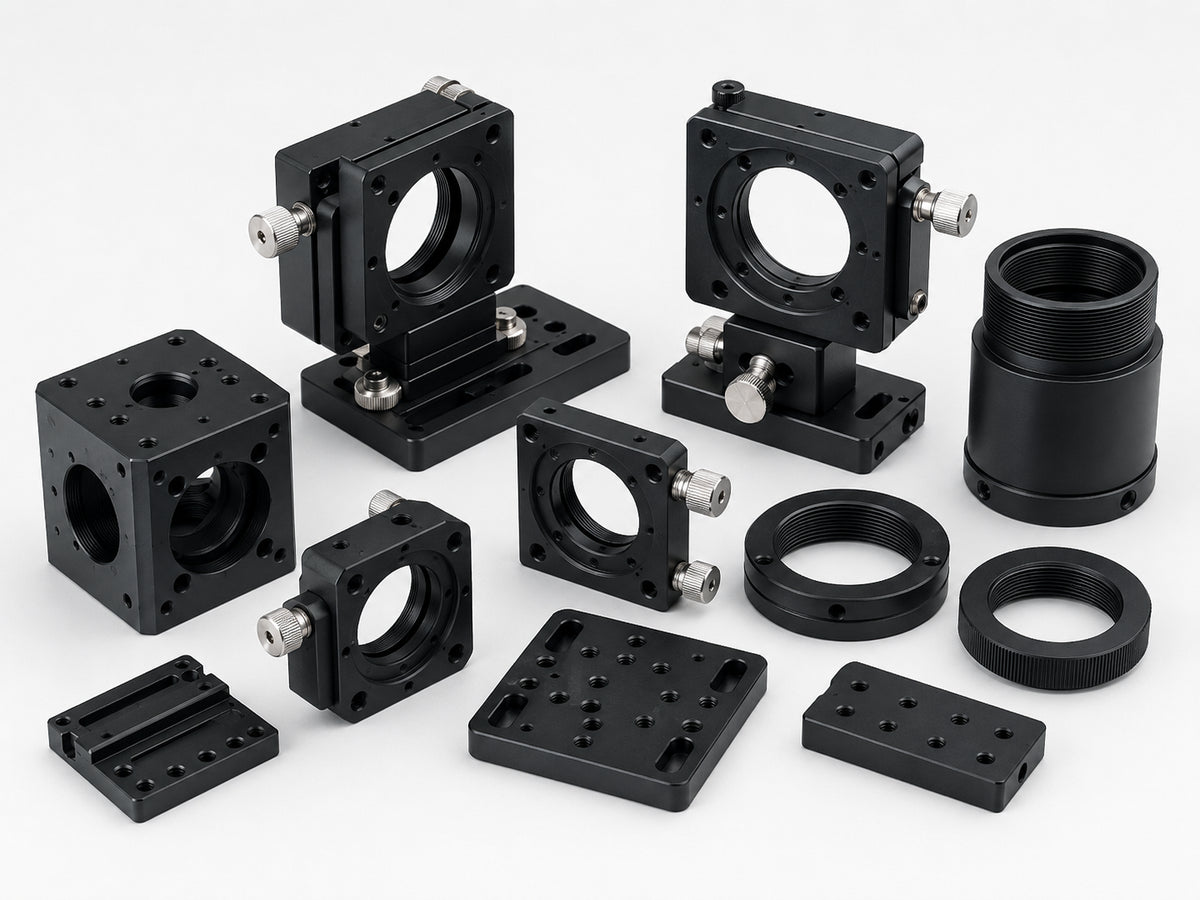
This guide explains which parts matter most, what to look for in materials and tolerances, and how to choose a manufacturing partner that can deliver custom laser parts from prototype through production.
What "Parts for Laser" Actually Covers
The term spans a surprisingly wide range of components. In practice, most sourcing requests fall into four categories:
1. Optomechanical Components
These parts hold, align, and protect the optical path. They are the highest-precision group in any laser system:
- Lens barrels and optical tubes — house focusing and collimating optics with tight concentricity requirements
- Mirror mounts and beam-steering brackets — must hold angular alignment under vibration and thermal cycling
- Focus rings and adjustment mechanisms — require smooth, backlash-free threading for repeatable positioning
- Optical enclosures and housings — protect the beam path from dust, stray light, and mechanical shock
2. Structural and Motion Components
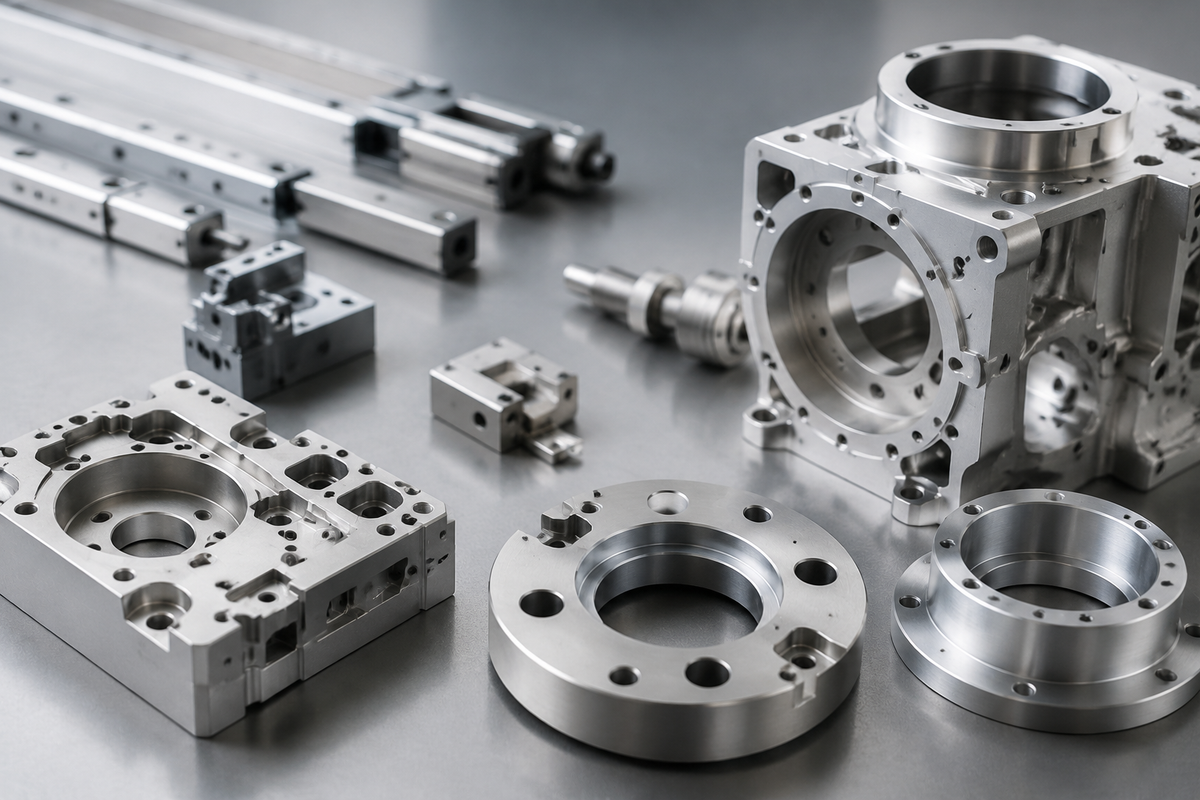
- Precision stages, rails, and mounting frames
- Gantry brackets and base plates for laser cutting and marking machines
- Couplings, shafts, and bearing seats for motion systems
3. Thermal Management Parts
- Heat sinks for laser diodes and pump modules
- Cold plates and thermally conductive housings
- Mounting interfaces that pull heat away from temperature-sensitive optics
4. Spare and Replacement Parts
- Nozzle holders, clamping rings, and sensor mounts for laser cutting heads
- Alignment fixtures and replacement housings for legacy equipment
- Quick-turn reproductions of worn or discontinued components

Why Precision Matters More in Laser Parts Than Almost Anywhere Else
In most machined parts, a deviation of a few microns is invisible. In a laser system, the same deviation shows up on the workpiece:
- Beam pointing errors. A mirror mount misaligned by 10 μm over a 500 mm beam path can translate to a measurable positional error at the focal point — enough to ruin a cutting or marking job.
- Focus shift. If a lens barrel's optical seat is not perpendicular to the bore axis, the focal point moves as the lens is adjusted, creating astigmatism and inconsistent spot size.
- Thermal drift. Poorly matched materials or rough thermal interfaces cause alignment to wander as the laser warms up, which is why dimensional stability matters as much as initial accuracy.
- Vibration sensitivity. Lightweight but insufficiently rigid brackets transmit machine vibration straight into the optical path.
This is why laser equipment parts are typically specified with tolerances far tighter than general industrial components — and why the manufacturer's process control matters as much as the drawing itself.
Materials Commonly Used for Laser Components
Material selection depends on the role of the part:
|
Material |
Typical Use |
Key Advantage |
|
Aluminum 6061 / 7075 |
Housings, mounts, frames |
Lightweight, excellent machinability, anodizable |
|
Stainless steel 304 / 316 |
Adjustment mechanisms, shafts, sensor mounts |
Rigidity, corrosion resistance, thermal stability |
|
Titanium (Ti-6Al-4V) |
Aerospace and medical laser assemblies |
Strength-to-weight ratio, low thermal expansion |
|
Brass / Copper |
Thermal interfaces, RF shielding, prototypes |
High thermal conductivity |
|
Ceramics (alumina, zirconia) |
Insulating sleeves, fiber optic ferrules |
Thermal stability, electrical insulation, wear resistance |
|
Engineering plastics (PEEK, PTFE, Delrin) |
Insulators, light-weight non-critical mounts |
Electrical insulation, low outgassing |
For optomechanical parts that see thermal cycling, matching the coefficient of thermal expansion between mating components is often more important than raw strength. An experienced machining partner should flag these issues during design review rather than after the first failed assembly.

Manufacturing Processes: What to Expect
CNC Milling and Turning
The backbone of laser component manufacturing. Multi-axis CNC machining handles the complex bores, threads, and mounting faces of lens barrels, housings, and brackets. For optical interfaces, look for suppliers holding ±1 μm-class tolerances on critical features with documented inspection.
Surface Finishing
Laser parts frequently require functional finishes, not just cosmetic ones:
- Black anodizing — reduces stray reflections inside optical housings
- Mirror polishing (Ra ≤ 0.1 μm) — for optical seats and precision interfaces
- Hard coating and passivation — for wear and corrosion resistance in industrial environments
Inspection and Verification
Any supplier of parts for laser equipment should be able to show, not just claim, their measurement capability: CMM inspection reports, surface profilometry, and — for optical assemblies — alignment verification. If a quote arrives without any mention of inspection, that is a warning sign.
Custom Parts vs. Off-the-Shelf Spares: Which Do You Need?
Off-the-shelf replacement parts make sense when you are maintaining a standard machine and the OEM component is available at a reasonable price and lead time.
Custom manufacturing becomes the better option when:
- The OEM part is discontinued or has an unacceptable lead time
- You are building new laser equipment and need parts designed around your optical layout
- You need to improve on the original design — better thermal performance, lower weight, or a mounting interface the OEM never offered
- Volumes are low enough that tooling-heavy processes are uneconomical, which is where CNC machining with no minimum order quantity fits well
A capable custom manufacturer can also reverse-engineer worn parts from a sample and return a replacement that matches or exceeds the original specification.
How to Evaluate a Supplier of Laser Parts
Before placing an order, work through this checklist:
- Tolerance capability. Can they hold your tightest callouts — and prove it with inspection reports?
- Optical industry experience. Have they shipped lens barrels, mirror mounts, or laser housings before? Ask for examples.
- DFM feedback. A good partner reviews your drawings for manufacturability before quoting, flagging tolerance stack-ups and unnecessary cost drivers.
- Material and finish range. Aluminum, stainless steel, titanium, brass, ceramics, and engineering plastics should all be on the table, along with anodizing and optical-grade polishing.
- Prototyping speed. Laser development moves fast. Look for prototype lead times measured in days, not weeks, with production starting shortly after design freeze.
- Certifications. ISO 9001 is the baseline; ISO 13485 matters if your laser system is a medical device.
- Scalability. The supplier making your first ten prototypes should also be able to deliver your ten-thousandth production part without a quality cliff.

XY-Global: Precision Manufacturing for Laser Equipment Parts
XY-Global specializes in custom CNC machining for the optics and laser industry, supporting customers from first prototype through volume production:
- ±1 μm ultra-precision machining with CMM-verified inspection on critical features
- Ra ≤ 0.1 μm optical-grade surface finishes, including black anodizing for stray-light control
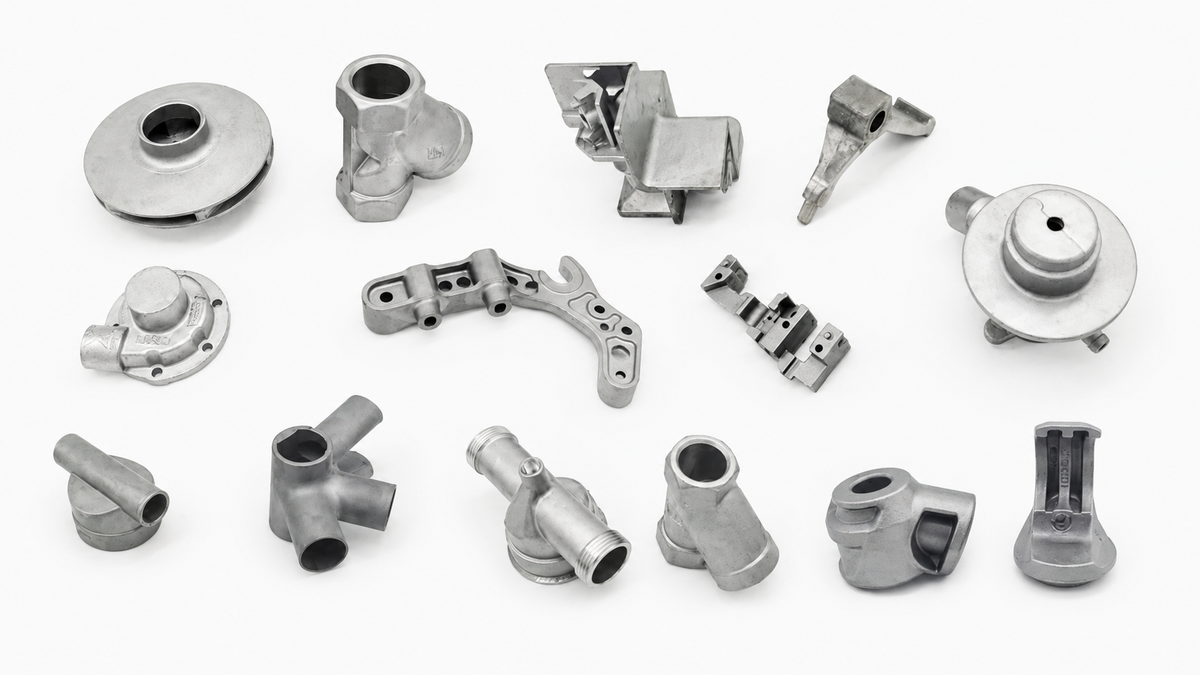
- 15+ years of experience and 100+ advanced machines across CNC milling, turning, 5-axis machining, and die casting
- ISO 9001 and ISO 13485 certified quality systems with full traceability
- No minimum order quantity — prototypes can enter production within one day of design confirmation
We regularly manufacture lens barrels, optical housings, mirror mounts, adjustment rings, heat sinks, and structural components for laser cutting, marking, welding, medical, and measurement systems — in aluminum, stainless steel, titanium, brass, ceramics, and engineering plastics.
Frequently Asked Questions
What are the most commonly replaced parts for laser machines?
On the consumables side: nozzles, protective windows, focus lenses, and ceramic rings. On the mechanical side: mirror mounts, beam alignment brackets, lens barrels, and motion components subject to wear. Custom manufacturers like XY-Global focus on the mechanical and optomechanical side of this list.
Can you manufacture parts for laser equipment from a sample instead of a drawing?
Yes. Reverse engineering from a physical sample is a common request, especially for discontinued OEM parts. The part is measured (typically with CMM), redrawn, prototyped for fit verification, and then put into production.
What tolerance should I specify for laser optomechanical parts?
It depends on the function. General structural features often sit comfortably at ±0.05 mm, while optical seats, bores, and alignment faces frequently require ±0.01 mm or tighter — down to the ±1 μm class for critical interfaces. Over-tolerancing non-critical features is one of the fastest ways to inflate cost, so a DFM review is worthwhile.
What is the typical lead time for custom laser parts?
Prototypes can ship in as little as one to three days after design confirmation at XY-Global. Production lead times scale with quantity and finishing requirements; your quote should always state them explicitly.
Do you support both one-off spares and volume production?
Yes. With 0 MOQ, a single replacement part and a multi-thousand-piece production run follow the same quality process — the same inspection standards apply to the first part and the last.
Get a Quote for Your Laser Parts
Whether you need a single replacement mount, a set of prototype lens barrels, or ongoing production of laser machine components, send us your 2D/3D drawings (or a sample for reverse engineering). You will receive a quotation with free DFM feedback — and production can start within one day of confirmation.

공유하다:
Ceramic Pump Plungers for Medical Metering: Materials, Tolerances and Manufacturing
How CNC Turn-Mill Machining Achieves ±0.005 mm Tolerances in Complex Parts