


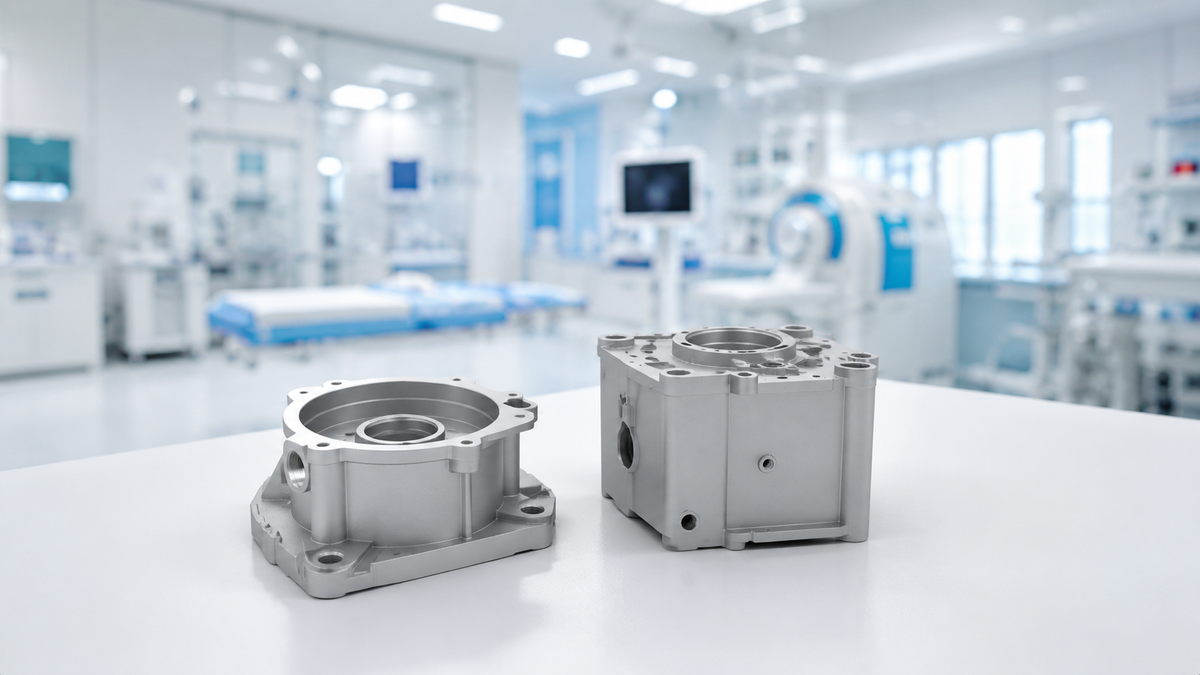
High Pressure Die Casting (HPDC) is an efficient manufacturing process for producing complex metal parts with consistent dimensions and high production efficiency.
This guide explains how the HPDC process works, its key advantages, suitable materials, typical applications, and how XY-GLOBAL supports projects from tooling to mass production.
1. What is High Pressure Die Casting?
High Pressure Die Casting is a manufacturing process that injects molten metal into a steel mold using high speed and high pressure.
The process enables fast production of complex parts with good dimensional repeatability, thin-wall capability, and high production efficiency.
Because of its ability to form thin walls, complex shapes, and stable dimensions, high pressure die casting is widely used in automotive, robotics, industrial equipment, and consumer electronics.

2. High Pressure Die Casting Production Steps
Our high pressure die casting production follows a controlled and standardized workflow to ensure repeatable quality.
1) Mold Design & Tooling
-
Detailed DFM review
-
Gate, runner, and overflow design
-
Cooling channel layout
-
Steel material: H13 / SKD61
High pressure die casting quality begins with a reliable mold.
2) Metal Melting
Aluminum or zinc alloy is melted at a controlled temperature to ensure stable fluidity and prevent defects.
3) High-Pressure Injection
Metal is injected into the mold at:
-
Speed up to 30–80 m/s
-
Pressure 50–120 MPa
This step defines the accuracy and density of high pressure die casting parts.
4) Cooling & Ejection
The part solidifies inside the mold and is then ejected automatically. Proper cooling design ensures uniform wall thickness and reduces warpage.
5) Trimming & CNC Machining
After casting:
-
Gates and flash are removed
-
CNC machining is applied to critical surfaces
-
Surface finishing is done as needed
6) Quality Inspection
We apply:
-
CMM dimensional checking
-
X-ray for internal porosity
-
Leak testing for sealing parts
-
Hardness and material verification
Every batch of high pressure die casting parts goes through this process to maintain consistency.

3. Advantages of High Pressure Die Casting
High Pressure Die Casting provides several clear benefits for mass production projects:
✔ High dimensional consistency
Parts remain stable across large quantities, suitable for assemblies and tight-fit components.
✔ Ideal for complex geometries
Thin walls, ribs, deep cavities, and detailed structures can all be achieved with high pressure die casting.
✔ Smooth surface finish
The steel mold produces cleaner surfaces and reduces the amount of machining required.
✔ Good mechanical performance
With proper alloy selection, tooling design, process control, and post-processing, die-cast parts can achieve reliable mechanical performance for structural applications.
✔ Cost-effective for medium to high volumes
Once tooling is set, high pressure die casting offers a lower cost per piece for large orders.

4. Materials for High Pressure Die Casting
We support the most commonly used alloys:
Aluminum Die Casting Alloys
- ADC12
- A380
- A360
- AlSi9Cu3
- Other alloys based on project requirements
Aluminum alloys offer a strong balance of weight, strength, corrosion resistance, thermal conductivity, and castability.
-
Lightweight
-
Strong mechanical performance
-
Good corrosion resistance
The most popular choice for high pressure die casting in automotive and robotics.
Zinc Alloy
-
Excellent fluidity
-
High dimensional accuracy
-
Suitable for small and intricate parts
Magnesium (on request)
-
Ultra-lightweight
-
Good for electronics and portable devices

5. Applications of High Pressure Die Casting
High pressure die casting is used in many industries that require stable, repeatable production.
Automotive Components
-
Motor housings
-
Brackets
-
Transmission parts
-
Heat dissipation structures
Robotics & Industrial Automation
-
Joint housings
-
Structural supports
-
Gearbox covers
AGV & AMR Components
-
Motor housing
-
Lifting system parts
-
Steering unit shells
-
Lightweight frame structures
Consumer Electronics
-
Thin-wall covers
-
Magnesium housings
-
Heat-sink components
Medical & Laboratory Equipment
-
Device enclosures
-
Precision brackets
-
Lightweight structural pieces
High pressure die casting supports stable mass production across all these fields.

6. High Pressure Die Casting vs Other Processes
| Process | Accuracy | Cost | Complexity | Volume |
|---|---|---|---|---|
| High Pressure Die Casting | High | Medium | High | Medium–High |
| Gravity Casting | Medium | Medium | Medium | Small–Medium |
| Sand Casting | Low | Low | Low | Small |
| CNC Machining | Very High | High | High | Low |
For medium- to high-volume programs involving thousands or tens of thousands of parts, HPDC often provides a competitive total manufacturing cost.
7. Why Choose XY-GLOBAL for High Pressure Die Casting?
✔ Strong tooling and DFM capability
We optimize mold design before production to reduce defects such as porosity and warpage.
✔ Full production line
-
160T–1250T die casting machines
-
Automatic spraying and robotic extraction
-
In-house CNC machining centers
✔ One-stop manufacturing
From high pressure die casting → machining → finishing → assembly → packaging.
✔ Strict quality control
-
X-Ray
-
CMM
-
Leak testing
-
Full traceability
✔ Global service capability
We support DFM review, sample validation, dimensional reports, CMM inspection, X-ray inspection, leak testing, and production quality control based on project requirements.
8. Start Your High Pressure Die Casting Project
Whether you need prototypes, DFM support, or mass production, XY-GLOBAL provides stable and cost-effective high pressure die casting solutions.
Contact us today to discuss your drawings, tolerance requirements, materials, and expected production quantity.
High Pressure Die Casting FAQ
1. What is High Pressure Die Casting used for?
High Pressure Die Casting is mainly used for aluminum and zinc alloy parts that require stable dimensions, thin walls, and mass-production capability. Common applications include motor housings, brackets, gearbox covers, AGV components, and electronic enclosures.
2. What materials can be used in High Pressure Die Casting?
The most commonly used materials are:
-
Aluminum alloys (such as ADC12, A380)
-
Zinc alloys (such as Zamak 3, Zamak 5)
-
Magnesium alloys (optional)
Different alloys provide different levels of strength, weight, and dimensional stability.
3. What are the main advantages of High Pressure Die Casting?
-
Excellent dimensional consistency
-
Good surface finish
-
Suitable for complex structures and thin walls
-
High production efficiency
-
Cost-effective for medium to high volumes
These features make high pressure die casting ideal for industrial and automotive components.
4. What tolerance can be achieved with High Pressure Die Casting?
Typical tolerances are ±0.05 mm to ±0.10 mm, depending on part size and structure.
Critical features can be finished through CNC machining for higher precision.
5. Does High Pressure Die Casting require post-machining?
Yes, many parts need CNC machining for:
-
Hole accuracy
-
Flatness
-
Threads
-
Assembly interfaces
XY-GLOBAL provides full die casting + CNC one-stop service.


공유하다:
Micro Medical Machining: Precision Manufacturing For Small And Complex Medical Components