LiDAR systems are increasingly used across autonomous vehicles, robotics, industrial inspection, surveying, and defense applications. As these systems become more sophisticated, the mechanical components that house and align their optical and electronic elements face tighter dimensional requirements, stricter material specifications, and higher production consistency standards.
CNC machining is the primary manufacturing process for LiDAR mechanical components. It provides the dimensional accuracy, surface finish control, and material flexibility needed to produce parts that perform reliably in demanding sensing environments — from automotive-grade thermal cycling to high-vibration industrial scanning systems.
This article explains what CNC machined LiDAR components are, which parts require precision machining, what tolerance and surface requirements apply, and what to evaluate when selecting a manufacturing partner for custom LiDAR mechanical parts.

What Are CNC Machined LiDAR Components?
LiDAR — Light Detection and Ranging — works by emitting laser pulses and measuring the time it takes for reflected light to return, building a precise 3D map of the surrounding environment. The optical and electronic core of a LiDAR unit includes laser emitters, detectors, rotating or solid-state scanning mechanisms, and processing electronics. All of these elements must be supported, positioned, and protected by precision mechanical structures.
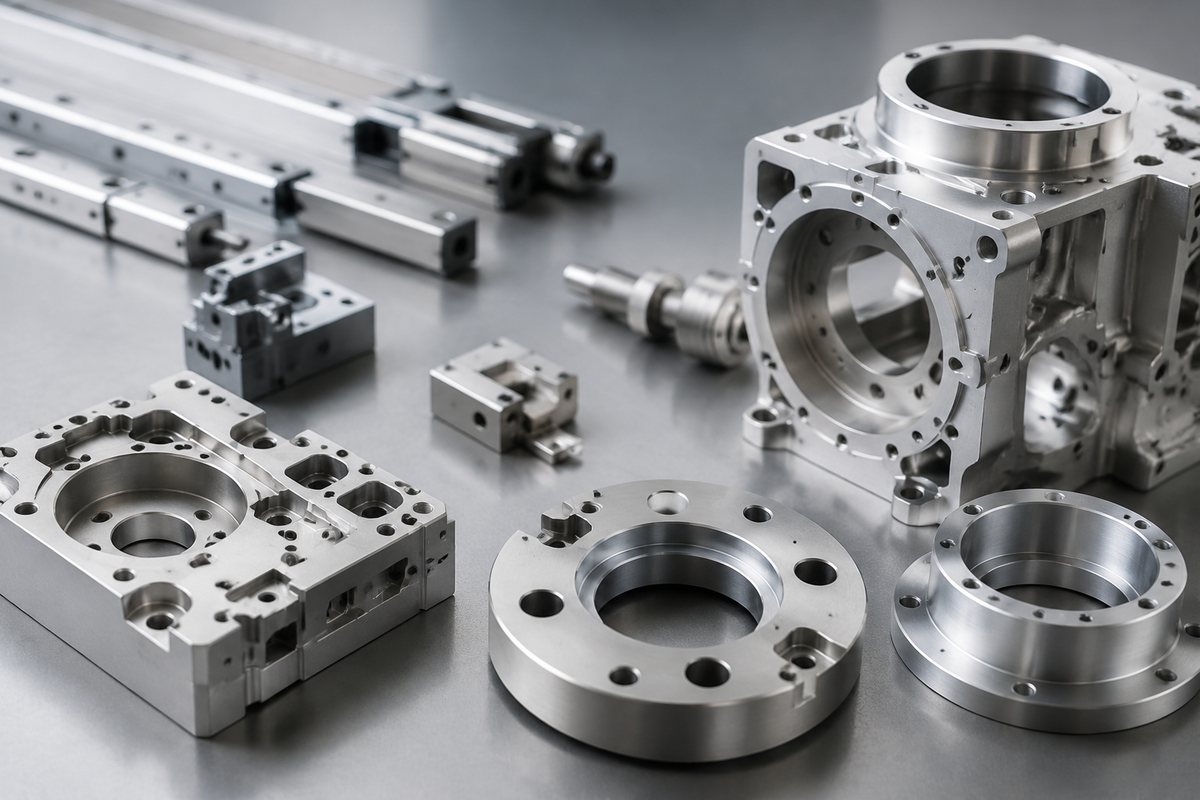
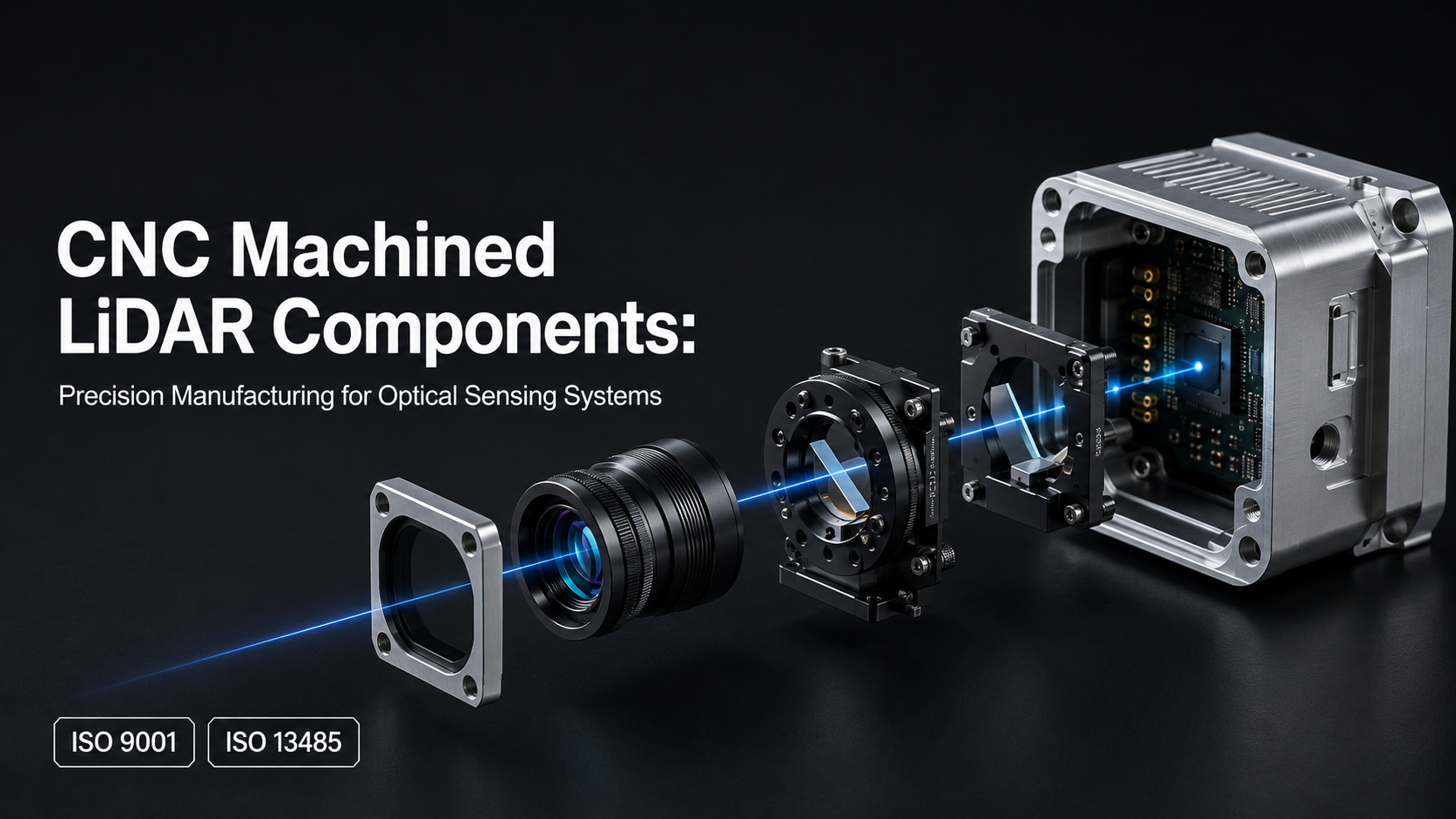
CNC machined LiDAR components are the metal and engineered plastic parts that form this mechanical structure. They include housings and enclosures that protect internal optics and electronics, optical barrels and lens holders that position collimating and receiving optics, mirror mounts and galvo scanner housings that support beam-steering elements, motor housings for rotating scan heads, mounting brackets and flanges that interface with vehicle or instrument platforms, and heat dissipation structures that manage thermal load from laser and detector arrays.
These components are not structural decoration. Their dimensional accuracy, surface finish, material properties, and assembly interfaces directly affect how well the LiDAR system performs — including its range, resolution, reliability, and calibration stability over time.
Key Mechanical Components in a LiDAR System
Optical housings and enclosures are the primary structural components of most LiDAR units. They must maintain dimensional stability across temperature changes, protect internal elements from contamination and mechanical shock, and provide accurate datum surfaces for optical alignment. For automotive LiDAR, enclosures often need to meet IP67 or higher sealing requirements, which places additional demands on mating surface flatness and thread accuracy.
Lens barrels and optical tubes position the transmit and receive optics within the LiDAR optical path. Bore diameter, roundness, coaxiality, and thread pitch must all be controlled to keep lenses centered and spaced correctly. Even small deviations in lens position can affect beam divergence, return signal quality, and measurement accuracy.
Mirror mounts and galvo housings support the scanning elements in rotating or oscillating LiDAR designs. These components require tight angular datum surfaces, accurate hole positions for bearing seats, and surface finishes compatible with black anodizing or low-reflectance coatings to minimize stray light within the optical cavity.
Motor housings and rotating scan heads in mechanical LiDAR designs combine structural, thermal, and rotational requirements. Bore concentricity for bearing fits, coaxiality between input and output datum surfaces, and balanced mass distribution all affect scan stability and long-term rotational performance.
Mounting brackets and flanges connect the LiDAR unit to its installation platform — a vehicle roof, robotic arm, survey pole, or industrial gantry. Their hole position accuracy, flatness, and material stiffness affect both the initial alignment of the LiDAR and its long-term stability under dynamic loads.
Thermal management structures such as heat sinks, heat spreaders, and cooled base plates manage the thermal output of high-power laser arrays and detector circuits. These parts require high thermal conductivity materials, controlled contact surface flatness, and in some cases integrated cooling channels machined to tight tolerances.

Why CNC Machining Is the Right Process for LiDAR Components
LiDAR mechanical components share several characteristics that make CNC machining the preferred manufacturing approach, particularly in prototype, low-volume, and high-precision production contexts.
First, LiDAR components often involve complex geometry — optical cavities, angled surfaces, precise bore patterns, and integrated features — that cannot be produced reliably by simpler processes such as sheet metal fabrication or standard casting without secondary machining. CNC milling and turning can produce these features to the required tolerances in a controlled and repeatable way.
Second, the tolerance requirements for LiDAR optical and mechanical components are typically in the ±5–50 μm range for functional features, with some critical surfaces requiring ±1–5 μm. This level of precision is standard for capable CNC machining operations but is difficult or impossible to achieve with die casting or plastic injection alone.
Third, LiDAR development cycles are fast and iterative. Prototype designs change frequently as optical performance is refined. CNC machining supports this iteration well — a revised drawing can go into production quickly without the tooling lead time and cost associated with casting or stamping dies.
Fourth, many LiDAR programs transition from small prototype batches to low-volume production (hundreds to low thousands of units per year) rather than high-volume mass production. CNC machining is cost-effective at these volumes and can maintain consistent quality from first article through ongoing production without major process changes.
Precision Requirements for CNC Machined LiDAR Components
The dimensional and surface requirements for LiDAR mechanical components vary by component function, but several categories of precision are consistently important across most designs.
| Component | Key Precision Requirement | Why It Matters |
|---|---|---|
| Lens barrel bore | ±1–5 μm diameter, roundness ≤ 3 μm | Controls lens centration and optical alignment |
| Mirror mount datum surfaces | Flatness ≤ 2–5 μm | Determines angular accuracy of beam steering element |
| Bearing seat bore | ±2–5 μm diameter, cylindricity ≤ 3 μm | Affects rotational accuracy and long-term scan stability |
| Housing sealing surface | Flatness ≤ 5 μm, Ra ≤ 0.8 μm | Required for reliable gasket sealing and IP rating |
| Internal optical cavity surfaces | Ra ≤ 0.4–1.6 μm, black anodized | Controls stray light and reduces internal reflections |
| Mounting flange hole positions | Position tolerance ±10–20 μm | Ensures accurate and repeatable system alignment |
Beyond individual feature tolerances, geometric relationships between features — coaxiality between lens barrel bore and housing datum, perpendicularity of mirror mount faces, parallelism of mounting flange surfaces — are often equally critical. These relationship tolerances require careful process planning, appropriate datum selection, and verification with CMM or equivalent inspection equipment.

Material Selection for CNC Machined LiDAR Components
Material selection for LiDAR mechanical components involves balancing thermal expansion, weight, machinability, corrosion resistance, and compatibility with required surface treatments.
Aluminum alloys (6061-T6, 7075-T6) are the most widely used materials for LiDAR housings and structural components. They offer excellent machinability, low weight, good thermal conductivity for heat dissipation, and compatibility with black anodizing for stray light control. The primary limitation is relatively high thermal expansion (CTE ~23 ppm/°C), which must be considered in systems with tight optical alignment requirements across temperature ranges.
Titanium alloys (Grade 5, Ti-6Al-4V) offer significantly lower CTE than aluminum (~8.6 ppm/°C) with high strength and good corrosion resistance. They are used in LiDAR components where dimensional stability across wide temperature ranges is critical — particularly in aerospace, defense, and high-performance autonomous systems. Titanium is more difficult to machine and carries higher material and processing cost.
Invar and Super Invar provide extremely low CTE (≤ 1.5 ppm/°C) and are used in high-stability LiDAR optical mounts for applications where even small thermal dimensional changes would degrade measurement accuracy. These materials are used selectively for the most dimensionally sensitive components rather than the full assembly.
Stainless steel (303, 304, 316L) is used for fasteners, small precision inserts, and components that require higher strength or corrosion resistance than aluminum. Its higher density makes it less suitable for large structural components where weight is a consideration.
Engineering plastics such as PEEK or Delrin may be used for non-structural components, lens spacers, or electrical isolation elements where weight reduction or electrical insulation is required. These materials require specific CNC machining parameters to avoid deformation and achieve acceptable surface quality.
Surface Finish and Coating for LiDAR Housings and Optical Components
Surface finish and coating selection for CNC machined LiDAR components affects both optical performance and environmental protection.
Internal optical cavity surfaces within LiDAR housings must minimize stray light to maintain signal-to-noise ratio. Black anodizing aluminum internal surfaces is the most common approach — it produces a low-reflectance matte black finish that absorbs stray light while also providing corrosion protection. The anodize thickness (typically 15–25 μm) must be accounted for when specifying bore and cavity dimensions.
External housing surfaces require protection against corrosion, UV exposure, and mechanical abrasion for automotive and outdoor applications. Hard anodizing, powder coating, or chromate conversion coating (for aluminum) are commonly used depending on the operating environment and customer specification.
Sealing surfaces and thread forms require specific attention. Anodizing on sealing faces can be masked to maintain controlled flatness and roughness. Thread inserts (Helicoil or solid inserts) are often used in aluminum housings at high-stress fastener locations to improve thread durability after repeated assembly.
Window frames and aperture components that interface with optical elements or protective windows may require tight Ra control on seating surfaces (Ra ≤ 0.4–0.8 μm) to ensure clean, stress-free contact that does not distort the optical element or allow particulate intrusion.
Thermal Management in LiDAR Component Design
Laser emitter arrays in high-performance LiDAR systems generate significant thermal load that must be managed to maintain performance and component lifetime. CNC machined thermal management structures play an important role in this.
Heat sinks and base plates for laser arrays are typically machined from aluminum or copper, with flat contact surfaces (flatness ≤ 5 μm) to minimize thermal interface resistance. Fin arrays, pin fin structures, or internal cooling channels can be machined directly into the component to increase heat dissipation area or support liquid cooling.
Integrated cooling channels require sealed internal passages machined with tight dimensional control. Channel cross-sections, wall thickness, and manifold geometry all affect flow distribution and thermal performance. Leak testing after machining is standard practice for liquid-cooled components.
In solid-state LiDAR designs, thermal management is increasingly integrated into the mechanical structure itself, with the housing doubling as a heat spreader. This places additional demands on material selection, surface flatness at thermal interfaces, and the dimensional stability of the housing under varying thermal load.
From LiDAR Prototype to Production
LiDAR development programs typically involve multiple prototype iterations before the mechanical design is finalized for production. CNC machining supports this process well, but the transition from prototype to production requires deliberate process management.
During prototype phases, speed and flexibility are priorities. DFM review at this stage can identify features that are difficult to machine, tolerances that are unnecessarily tight relative to functional requirements, or surface treatment specifications that will cause dimensional issues after processing. Addressing these issues in prototype is significantly less expensive than discovering them in production.
As the design stabilizes, production process planning becomes important. Fixtures are designed for repeatability rather than flexibility. Inspection plans are formalized with documented methods and accept/reject criteria. Surface treatment and coating processes are qualified and documented. Packaging and shipping requirements are established to protect finished components.
For LiDAR programs that ramp from tens to hundreds of units, production consistency — the ability to deliver the same dimensional result batch after batch — becomes as important as peak accuracy capability. A machining partner should be able to demonstrate how process controls, in-process inspection, and documentation support this consistency.

What to Look for in a CNC Machining Partner for LiDAR Components
Selecting a machining partner for CNC machined LiDAR components requires evaluating capability at multiple levels, not just equipment specifications.
The supplier should have demonstrated experience with optical mechanical components — parts where tolerances, surface finish, and geometric relationships matter in the context of optical system performance, not just dimensional compliance on a drawing. This context matters because it affects how the supplier approaches DFM review, process planning, and inspection.
Multi-axis machining capability (5-axis CNC) is important for LiDAR components with complex geometry, angled features, or multiple precision surfaces that must be machined with minimal setups to control accumulated error.
Surface treatment capability — particularly black anodizing, hard anodizing, and passivation — should either be in-house or managed through qualified partners, with clear dimensional control of treatment thickness and masking.
Inspection capability must match the tolerance requirements. CMM verification for hole positions, coaxiality, and flatness is standard. For sub-5 μm features, more specialized measurement methods may be required — the supplier should be able to discuss this proactively rather than discover limitations after a part is produced.
Finally, communication matters. LiDAR programs move quickly. A supplier who can identify drawing issues before production starts, provide clear lead time and process updates, and scale production as program volumes increase is a more valuable partner than one competing purely on price.
Why XY-GLOBAL for CNC Machined LiDAR Components
XY-GLOBAL provides precision CNC machining services for LiDAR mechanical components, including optical housings, lens barrels, mirror mounts, galvo scanner housings, motor brackets, thermal management structures, and custom mounting interfaces.
Our machining capability includes CNC turning, CNC milling, and 5-axis machining, with dimensional accuracy to ±1 μm and surface finish to Ra ≤ 0.1 μm for optical-grade surfaces. Surface finishing services including black anodizing, hard anodizing, passivation, and bead blasting are available to complete components to final specification.
We hold ISO 9001 certification and support customers from early prototype DFM review through low-volume and series production. Production starts within one day of drawing confirmation, and free prototype support is available for new projects. Inspection documentation including CMM reports and dimensional inspection records can be provided based on project requirements.
Whether your LiDAR program requires a first prototype, a qualified small batch, or a consistent production supply of precision mechanical components, XY-GLOBAL can support your manufacturing needs with the engineering capability and process discipline that optical sensing applications require.
FAQ
What CNC machining processes are used for LiDAR components?
LiDAR mechanical components are typically produced using CNC turning for cylindrical features such as lens barrels and bearing housings, CNC milling for prismatic housings and brackets, and 5-axis machining for components with complex geometry or multiple precision surfaces that must be machined in fewer setups to control positional accuracy. Surface finishing processes such as black anodizing and hard anodizing are applied after machining.
What tolerances are achievable for CNC machined LiDAR housings?
XY-GLOBAL achieves dimensional tolerances to ±1 μm on critical features and surface roughness to Ra ≤ 0.1 μm on optical-grade surfaces. For typical LiDAR housing features such as bearing seats, sealing surfaces, and optical datum surfaces, tolerances in the ±2–10 μm range are standard. Each project is reviewed individually to confirm practical tolerance targets before production begins.
What materials are most commonly used for CNC machined LiDAR components?
Aluminum alloys (6061, 7075) are most common for housings and structural components due to their machinability, weight, and thermal conductivity. Titanium is used where low thermal expansion is required. Stainless steel is used for small precision inserts and high-stress fastener features. Material selection depends on the thermal, mechanical, and optical requirements of each component.
Can XY-GLOBAL support both prototype and production quantities for LiDAR components?
Yes. XY-GLOBAL supports single prototypes through low-volume and series production. We provide DFM review at the prototype stage to identify manufacturing risks early, and manage the transition to production through process optimization, fixture development, and formalized inspection planning.
Is black anodizing available for LiDAR optical housing components?
Yes. Black anodizing is available for aluminum LiDAR housings and internal optical cavity surfaces. Dimensional allowance for anodize build-up is reviewed during DFM to ensure that bore diameters, sealing surfaces, and thread dimensions remain within tolerance after treatment. Selective masking is available for features that must remain bare metal or meet tight post-treatment dimensional requirements.
Conclusion
CNC machined LiDAR components are the mechanical foundation of precision optical sensing systems. From housings and lens barrels to mirror mounts and thermal management structures, these parts must meet demanding dimensional, surface finish, and material requirements to support reliable LiDAR performance in automotive, robotics, industrial, and defense applications.
For engineers and program managers sourcing LiDAR mechanical components, the right machining partner combines optical mechanical process knowledge, multi-axis capability, qualified surface finishing, and the production discipline to scale from prototype to consistent volume supply.
If your LiDAR program requires precision CNC machined components, XY-GLOBAL can support your project from early DFM review through production — with the accuracy, documentation, and engineering communication that optical sensing applications demand.


공유하다:
Optical Precision Manufacturing Services for Custom Optomechanical Components
Optical Precision Manufacturing Services for Custom Optomechanical Parts