


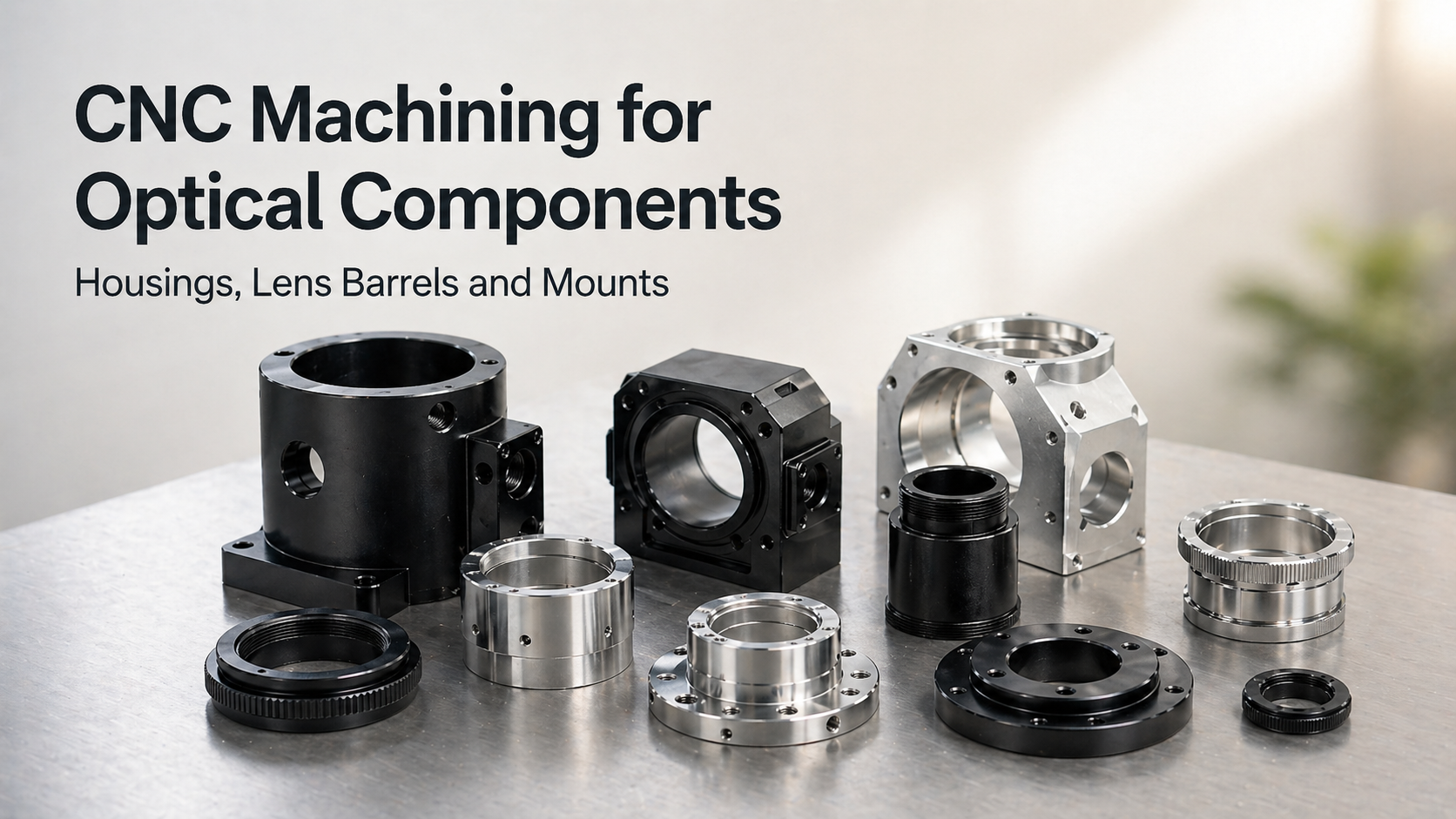
In optical systems, precision does not only come from lenses, mirrors, sensors, or laser modules. The mechanical parts around them also play an important role in system performance. Optical housings, lens barrels, lens mounts, spacer rings, retainer rings, brackets, and adapter components all help position, protect, and support optical elements.
This is why CNC machining for optical components requires more than general metal cutting capability. These parts often need tight tolerances, stable alignment, clean surface finishing, and consistent quality from prototype to production. A small dimensional error, poor thread quality, burr, or coating thickness issue may affect assembly accuracy, optical alignment, or long-term stability.
For manufacturers of imaging systems, laser devices, medical optical equipment, inspection systems, and camera modules, CNC machined optical components are essential structural parts. They help ensure that the optical system can be assembled accurately, maintained reliably, and used consistently in real applications.

What Are CNC Machined Optical Components?
CNC machined optical components are precision mechanical parts used in optical systems. They are not optical lenses themselves, but they are the metal or engineering plastic parts that hold, support, position, or protect optical elements.
These components are often referred to as optomechanical components or optical mechanical parts. Their main function is to help optical elements stay in the correct position during assembly and operation.
Common CNC machined optical components include:
- optical housings
- lens barrels
- lens mounts
- retainer rings
- adapter rings
- laser device housings
- precision mounting plates
In many applications, these parts must provide accurate positioning and stable mechanical support. For example, a lens barrel must hold lenses at the correct spacing and alignment. A lens mount must keep the optical module in a repeatable position. An optical housing must protect internal components while maintaining accurate assembly references.
Because of these requirements, optical components usually involve more detailed machining control than ordinary structural parts. Features such as bores, threads, mounting surfaces, grooves, and positioning shoulders must be carefully machined and inspected.
Common Optical Components Made by CNC Machining
CNC machining is widely used for custom optical components because it can produce complex geometries, tight tolerances, and small to medium production volumes with high flexibility. This is especially useful for optical projects that require prototypes, design validation, or customized parts.
Optical Housings
Optical housings are used to protect and support lenses, sensors, laser modules, imaging units, or electronic components. They are common in imaging systems, inspection equipment, camera modules, laser devices, medical optical instruments, and industrial vision systems.
A good optical housing is not just an outer shell. It often provides mounting references, internal cavities, screw holes, sealing areas, and precision surfaces for assembly. These features must be machined accurately so the housing can protect the internal components and maintain the correct relationship between optical and mechanical parts.
For optical housings, important machining considerations include dimensional stability, surface finish, flatness, thread quality, and appearance consistency. If the housing has thin walls or deep cavities, machining deformation must also be controlled carefully.
Lens Barrels
Lens barrels are among the most important CNC machined optical components. They are used to hold and position one or more lenses inside an optical system. A lens barrel may include internal bores, stepped diameters, fine threads, grooves, shoulders, and retaining features.
The machining quality of a lens barrel can directly affect lens positioning and optical alignment. Bore accuracy, concentricity, roundness, thread quality, and internal surface finish are all important. If the bore is not accurate or the internal features are not concentric, the lens may not sit correctly inside the barrel.
Lens barrels also often require black anodizing or other dark surface treatments to reduce internal reflection. However, surface treatment can affect dimensions, so coating thickness should be considered during design and machining.
For high-precision lens barrels, manufacturers need to pay attention to the machining sequence, tool selection, clamping method, deburring process, and inspection method. These details help ensure that the barrel can meet both mechanical and optical assembly requirements.
Lens Mounts
Lens mounts are used to fix lenses, lens assemblies, or optical modules into a larger system. They are widely used in machine vision equipment, microscopes, laser systems, medical imaging devices, and inspection instruments.
The key function of a lens mount is to provide stable and repeatable positioning. Its mounting surfaces, hole positions, threads, and reference features must be accurate. If the mount is not flat, parallel, or dimensionally stable, it may affect the alignment of the entire optical system.
Lens mounts may look simple, but they often require careful machining. Small errors in hole position, thread fit, or mounting surface flatness can cause assembly issues.
For optical applications, consistency between parts is also important, especially when the customer needs low-volume production or repeated batches.
Besides housings, lens barrels, and lens mounts, CNC machining is also used for spacer rings, retainer rings, adapter rings, brackets, and positioning components. These small parts may seem less critical, but they often control spacing, locking, alignment, or assembly repeatability inside the optical system.
Why Precision Matters in Optical Component Machining
Optical components are different from ordinary mechanical parts because they often affect alignment, repeatability, and system stability. Even when a part does not directly contact the optical path, its machining quality can still influence the final performance of the device.
One key requirement is alignment control. In optical systems, lenses, sensors, laser modules, and mechanical references must be positioned correctly. If the mechanical component has dimensional errors, the optical axis may shift, or the assembly may become unstable.
Another important factor is concentricity. Lens barrels, adapter rings, and circular mounts often need accurate relationships between inner and outer diameters. Poor concentricity may affect how lenses or modules are positioned during assembly.
Flatness and parallelism are also important for mounting surfaces. A mounting face that is not flat may cause tilt or uneven assembly pressure. This can be especially problematic in imaging equipment, laser systems, and inspection devices where optical alignment must remain stable.
Thread quality is another detail that should not be ignored. Optical components often use fine threads, internal threads, locking rings, or adjustment features. Poor thread quality can affect assembly feel, repeatability, and service life.
Burr control is equally important. Burrs, sharp edges, and loose particles may damage optical elements, affect assembly, or contaminate sensitive systems. For this reason, CNC machined optical components usually require careful deburring and visual inspection.
In short, precision optical component machining is not only about meeting drawing dimensions. It is about understanding which features affect optical alignment, assembly quality, and long-term performance.

Materials Used for CNC Machined Optical Components
Material selection has a direct impact on machining performance, weight, stability, surface finishing, and final application. Different optical components may require different materials depending on strength, corrosion resistance, thermal behavior, appearance, and cost.
| Material | Advantages | Common Applications |
|---|---|---|
| Aluminum 6061 / 6063 / 7075 | Lightweight, easy to machine, suitable for anodizing | Optical housings, lens barrels, mounts |
| Stainless Steel 304 / 316 / 420 / 17-4PH | Strong, corrosion-resistant, stable | Brackets, precision mounts, medical optical parts |
| Brass / Copper Alloys | Good machinability and stability | Small rings, connectors, adjustment parts |
| Engineering Plastics | Lightweight, insulating, low friction | Spacers, isolation parts, non-metal optical components |
Aluminum is one of the most common materials for CNC machined optical components. It offers a good balance of weight, machinability, cost, and surface finishing options. Aluminum parts can also be black anodized, which is useful for optical systems that need reduced reflection.
Stainless steel is used when higher strength, corrosion resistance, or wear resistance is required. It is often selected for precision mounts, brackets, medical optical parts, and components used in demanding environments.
Brass and copper alloys are suitable for some small precision parts, adjustment rings, connectors, or components that require good machinability and stable mechanical performance.
Engineering plastics such as POM, PEEK, PTFE, or other special materials may be used when insulation, low friction, weight reduction, or chemical resistance is important. However, plastic optical components require careful design because they may behave differently from metal parts during machining and use.
The right material should be selected based on the component’s function, tolerance requirements, surface finish, operating environment, and production volume.
Surface Finishing for Optical Components
Surface finishing is very important for CNC machined optical components. In many optical applications, finishing is not only for appearance. It can affect reflection control, corrosion resistance, wear resistance, assembly fit, and dimensional stability.
Black anodizing is one of the most common finishes for aluminum optical components. It is widely used for lens barrels, optical housings, and lens mounts. A black anodized surface can help reduce unwanted reflection and improve corrosion resistance. It also gives optical parts a clean and professional appearance.
Bead blasting before anodizing is often used to create a more uniform matte surface. This can improve appearance consistency and reduce visible machining marks. However, bead blasting may slightly change the surface texture, so it should be considered carefully for precision surfaces.
Hard anodizing may be used when the part requires higher wear resistance or better durability. Since hard anodizing usually has a thicker coating than standard anodizing, the coating thickness must be considered in the machining dimensions, especially for holes, threads, and fitting areas.
Electroless nickel plating can provide good corrosion resistance, wear resistance, and relatively uniform coating coverage. It is suitable for some metal optical components that need functional surface protection.
Passivation is commonly used for stainless steel optical components. It helps improve corrosion resistance without significantly changing the part dimensions.
Powder coating or painting may be used for larger optical housings or external covers. However, these coatings are usually thicker than anodizing or passivation. If a part has critical holes, threads, sealing surfaces, or assembly references, the coating thickness must be controlled or masked.
For optical components, surface finishing should be discussed early in the design and quotation stage. This helps avoid problems such as tight fitting after coating, inconsistent appearance, blocked threads, or unexpected dimensional changes.

Why Work with XY-GLOBAL for CNC Machined Optical Components?
XY-GLOBAL supports custom CNC machining for optical housings, lens barrels, lens mounts, spacer rings, retainer rings, brackets, adapter rings, and other optomechanical components.
We work with aluminum, stainless steel, brass, copper alloys, and engineering plastics to support different optical applications. Whether the project requires a prototype, small batch, or low-volume production, our team can help evaluate the machining process, material selection, surface finishing, and inspection requirements.
For optical components, we understand that precision is not only about machining tolerance. It is also about alignment, assembly stability, burr control, surface finish, coating thickness, and repeatability. These details are important for imaging systems, laser devices, inspection equipment, medical optical devices, and industrial optical assemblies.
XY-GLOBAL can provide DFM support before production to help identify potential machining risks. For example, we can review thin-wall structures, deep bores, tight tolerance areas, thread features, coating requirements, and critical assembly surfaces. This helps reduce production risks and improve manufacturability before machining begins.
We also support surface finishing management, including black anodizing, bead blasting, hard anodizing, passivation, plating, powder coating, and other finishing options based on project requirements. For critical dimensions and assembly features, we can help evaluate whether masking or tolerance adjustment is needed before surface treatment.
With precision CNC machining, engineering support, surface finishing coordination, and inspection capability, XY-GLOBAL helps customers turn optical component designs into reliable machined parts.
Conclusion
CNC machining is widely used for optical components such as housings, lens barrels, lens mounts, spacer rings, retainer rings, adapter rings, and brackets. These parts may not be optical lenses, but they play an important role in alignment, assembly stability, protection, and long-term performance.
Successful CNC machining for optical components requires more than basic machining capability. It requires suitable material selection, precision control, surface finishing management, burr control, and inspection support.
For optical systems, small mechanical details can affect the final assembly. This is why working with an experienced CNC machining supplier is important, especially for custom optical parts, prototypes, and low-volume production.
If you need custom CNC machined optical components, you can send us your drawings, 3D files, samples, or project requirements. XY-GLOBAL can help review your design, provide DFM feedback, and support your project from prototype to production.
FAQ
What optical components can be made by CNC machining?
CNC machining can produce optical housings, lens barrels, lens mounts, spacer rings, retainer rings, adapter rings, brackets, camera module housings, laser device housings, and other optomechanical parts.
Why is precision important for optical CNC components?
Precision is important because optical components often affect alignment, concentricity, assembly repeatability, and system stability. Small dimensional errors may influence optical performance, assembly quality, or long-term reliability.
What surface finish is common for optical components?
Black anodizing is common for aluminum optical components because it can reduce reflection and improve corrosion resistance. Other finishes include bead blasting, hard anodizing, electroless nickel plating, passivation, powder coating, and painting.


Share:
CNC Machined Optical Housings: What They Are and Why Precision Matters
A Practical Guide to High Pressure Aluminum Die Casting: From Design to Mass Production