


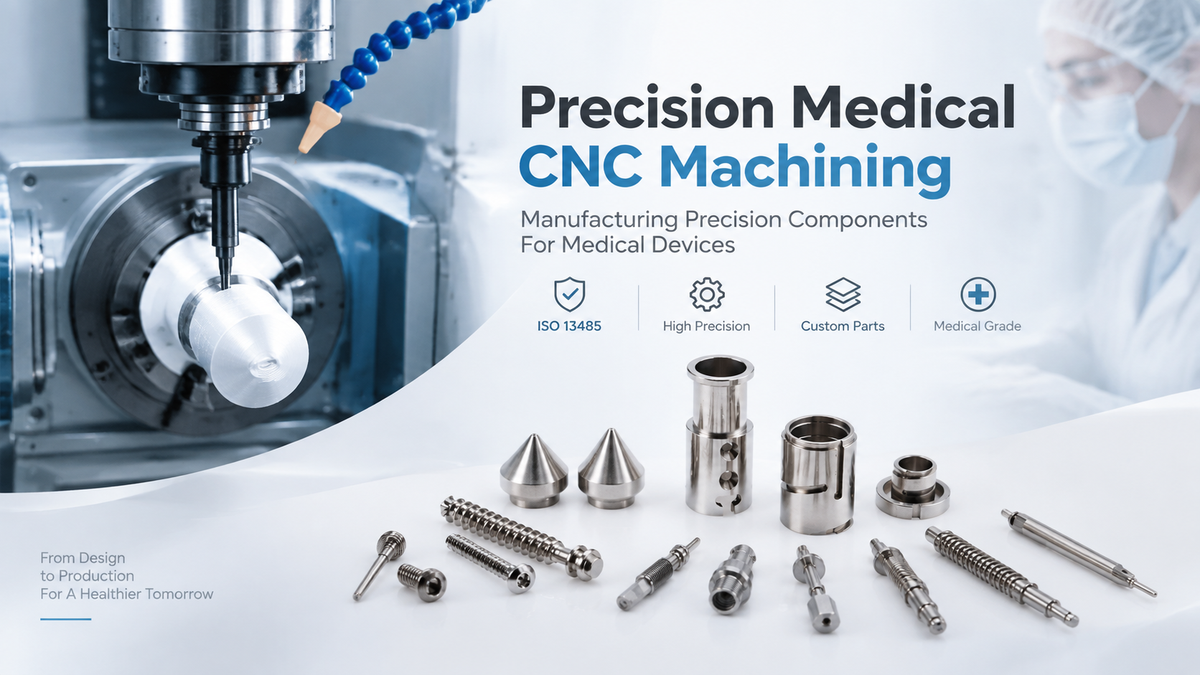
Here is the reality, the global need for precision machining in the medical industry is becoming more important than ever. As medical devices become smaller, more precise, and more complex, manufacturers need components that meet strict requirements for accuracy, reliability, and consistency.
In the medical industry, every component and every tool matters. Even a small deviation can affect product performance, assembly, or patient safety. This is why precision CNC machining has become an important manufacturing method for medical device components.
From prototypes to precision machined medical components, CNC machining can support tight tolerances, complex geometries, stable repeatability, and high-quality surface finishes. As an ISO 13485-certified medical component machining manufacturer with over 15 years of experience, XY-GLOBAL provides precision machining services for medical parts, surgical tools, device housings, and custom medical components.

Why CNC Machining Is Widely Used For Medical Components
Medical components often require a combination of precision, reliability, and design flexibility. Compared with traditional manufacturing methods, CNC machining provides manufacturers with better control over complex geometries, tight tolerances, and customized designs.
One of the biggest advantages of CNC machining is its flexibility. Medical device manufacturers often need prototypes, customized components, or low-volume production parts during product development. CNC machining allows engineers to quickly produce functional parts without investing in expensive molds or dedicated tooling.
Precision is another key reason why CNC machining is widely used in medical manufacturing. Many medical components require accurate features, tight dimensional control, and consistent performance during assembly. Advanced CNC machining processes, including five-axis machining, help produce complex parts with stable quality.
CNC machining also supports a wide range of medical-grade materials, including stainless steel, titanium, aluminum, and engineering plastics. This allows manufacturers to select materials based on strength, corrosion resistance, weight, and application requirements.
For medical device companies, CNC machining is not only a manufacturing process. It is a flexible solution that supports product development, design optimization, and reliable production of precision components.
Why ISO 13485 Is Important for Medical CNC Machining
Medical parts are different from standard industrial components.
A general mechanical part may focus mainly on function and cost. Medical components usually require additional attention to reliability, repeatability, and documentation.
For example, a surgical instrument component may need precise dimensions to ensure proper assembly and movement. A medical equipment housing may require stable tolerances to protect internal electronics and maintain accurate alignment.
This is where ISO 13485 provides value. ISO 13485 is an international quality management standard specifically developed for organizations involved in medical devices and related industries. It ensures every production stage is strictly controlled and traceable.
A supplier operating under this quality framework has defined procedures for handling production changes, inspection requirements, supplier control, and non-conforming parts.
For medical device manufacturers, this reduces uncertainty during supplier evaluation and production transfer.
In other words, ISO 13485 is not just about making a part correctly once.
It is about making the same part correctly again and again.

Medical CNC Machining Applications for Precision Components
Medical CNC machining supports a wide range of applications, from surgical tools to complex medical equipment components.
Unlike standard industrial parts, medical components often require a combination of precision, reliability, surface control, and material performance.
Surgical Instrument Components
Surgical instruments are one of the most common applications for precision medical machining.
Components such as handles, clamps, forceps parts, shafts, cutting mechanisms, and instrument bodies often require tight dimensional control because small variations can affect assembly accuracy and operating performance.
Materials such as stainless steel 316L are commonly selected because of their corrosion resistance, durability, and ability to withstand repeated cleaning and sterilization processes.
For these components, machining quality is not only about dimensions. Edge quality, surface finish, burr control, and consistency between batches are equally important.
Implant Components And Orthopedic Parts
Implant-related components represent one of the most demanding areas of medical manufacturing.
Parts such as bone screws, orthopedic components, fixation parts, and dental components require careful material selection, accurate machining, and strict quality control.
Titanium alloys are widely used because they offer an excellent combination of strength, lightweight properties, and corrosion resistance.
Machining these materials requires experience because titanium generates more heat during cutting and can accelerate tool wear if the process is not properly controlled.
For implant-related applications, suppliers also need to pay close attention to material documentation, surface requirements, and traceability throughout the manufacturing process.
Diagnostic And Medical Equipment Components
Many medical devices used in hospitals and laboratories contain precision-machined components.
Examples include:
-
Diagnostic equipment parts
-
Equipment housings
-
Mechanical brackets
-
Precision mounting components
-
Motion-related components
These parts may not directly contact patients, but they still require reliable machining quality because they influence equipment accuracy, stability, and long-term operation.
CNC machining provides the flexibility needed for these components, especially during product development and customized equipment manufacturing.

Five-Axis CNC Machining For Medical Components
Many modern medical components contain complex surfaces, angled features, and multiple precision interfaces.
Traditional machining methods may require several setups to complete these parts. Every additional setup introduces the possibility of alignment variation.
Five-axis CNC machining helps reduce these limitations by allowing the cutting tool to approach the component from different angles during a single setup.
This provides several advantages for medical machining:
-
Better control of complex geometries
-
Reduced setup time
-
Improved positional accuracy between features
-
More consistent surface quality
For example, orthopedic components, surgical instrument parts, and complex medical mechanisms often benefit from five-axis machining because their critical features must maintain accurate relationships with each other.
For medical manufacturers, this means fewer process interruptions and more consistent part quality.

Medical Micro Machining And Miniature Medical Components
Medical devices are becoming smaller and more sophisticated.
This trend has increased demand for medical micro machining and miniature precision components.
Small medical parts create unique manufacturing challenges.
As component size decreases:
-
Tool selection becomes more critical
-
Vibration control becomes more important
-
Burr prevention becomes more difficult
-
Inspection requirements become more demanding
Medical micro parts manufacturing is commonly used for applications such as:
-
Minimally invasive instruments
-
Diagnostic devices
-
Small mechanical assemblies
-
Precision medical mechanisms
Producing miniature components requires more than simply using smaller tools.
The machining process must consider material behavior, cutting stability, inspection capability, and final application requirements.
For medical manufacturers developing smaller and more advanced devices, having a machining partner with precision capability can significantly reduce development risks.

Materials Used in Medical CNC Machining
Material selection is one of the most important decisions in medical component manufacturing.
The correct material depends on the application, mechanical requirements, sterilization conditions, and whether the component contacts the human body.
Stainless Steel
Stainless steel is widely used in medical CNC machining, especially for surgical instruments and medical components requiring corrosion resistance.
316L stainless steel is a common choice because it provides good corrosion resistance, durability, and compatibility with sterilization environments.
It is often used for:
-
Surgical instrument components
-
Medical fixtures
-
Mechanical medical parts
However, stainless steel machining still requires attention to surface finish and burr control, especially for components with moving interfaces.
Titanium Alloys
Titanium is one of the most important materials in medical manufacturing.
It offers:
-
High strength-to-weight ratio
-
Excellent corrosion resistance
-
Good biocompatibility
Titanium alloys are commonly used for orthopedic and implant-related applications.
However, titanium is more difficult to machine compared with aluminum or stainless steel. Poor cutting conditions can lead to excessive heat generation, tool wear, and reduced surface quality.
Experienced machining suppliers need to carefully manage cutting parameters, tooling selection, and inspection requirements.
Aluminum Alloys
Aluminum is widely used for medical equipment components because it is lightweight, easy to machine, and cost-effective.
Typical applications include:
-
Equipment housings
-
Structural brackets
-
Testing equipment components
Although aluminum is easier to machine than titanium or stainless steel, medical applications still require controlled processes to maintain accuracy and appearance.
PEEK And Engineering Plastics
PEEK and other high-performance plastics are increasingly used in medical applications.
These materials provide:
-
Chemical resistance
-
Lightweight properties
-
Good dimensional stability
They are commonly used in specialized medical components where metal materials are not suitable.
Machining plastics requires careful control because excessive heat or improper tooling can affect dimensional stability.
Design Considerations For Medical CNC Machined Parts
Good medical part design is not only about achieving the required function.
It also needs to consider how the part will actually be manufactured.
Tolerance Requirements
Medical components often include critical dimensions that directly affect assembly or performance.
However, applying extremely tight tolerances to every feature can increase manufacturing difficulty and cost.
A good design approach is to identify critical dimensions and define realistic tolerances based on actual functional requirements.
Tool Accessibility
Complex medical parts may contain deep pockets, narrow channels, or difficult internal features.
During the design stage, engineers should consider whether cutting tools can properly reach these areas.
Improving tool accessibility can reduce machining difficulty and improve consistency.
Surface Finish And Burr Control
Surface quality is especially important for medical components.
Sharp edges, burrs, or poor finishes can affect assembly, cleaning, or product performance.
Design requirements should clearly define:
-
Surface finish requirements
-
Edge conditions
-
Critical contact surfaces
Early communication between designers and machining suppliers can prevent many production issues.
Material And Manufacturing Considerations
Different materials behave differently during machining.
Titanium, stainless steel, aluminum, and engineering plastics all require different machining strategies.
Selecting the right material together with the right manufacturing process helps achieve better performance and more stable production.
Custom Medical CNC Machining For Medical Device Manufacturers
Every medical device project has its own requirements.
Some components need unique geometries. Some require special materials. Others must meet specific dimensional or surface requirements that are different from standard industrial parts.
This is where custom medical CNC machining becomes valuable.
A capable machining partner does more than manufacture parts based on drawings.
They support the engineering process by reviewing designs, identifying manufacturing challenges, and suggesting practical solutions before production begins.
For example, a medical device manufacturer may need a supplier who can handle:
-
Complex component geometries
-
Special material requirements
-
Tight tolerance features
-
Prototype development
-
Production consistency
Medical projects also often involve design changes during development. A supplier who can communicate quickly and adapt manufacturing processes can help shorten development cycles and reduce unnecessary cost.
The goal of custom medical machining is not simply producing one successful part.
It is creating a reliable manufacturing solution that supports the entire product lifecycle. XY-GLOBAL is just the one which supports precision cnc machining for custom medical parts.
How To Choose The Right Medical CNC Machining Partner
Choosing a medical machining supplier requires more than checking equipment lists.
A reliable partner should have experience handling medical manufacturing requirements, including quality control, documentation, and process consistency. Important factors to consider include:
- Quality management system: ISO 13485 certification demonstrates that the company follows a medical-focused quality framework.
- Machining capability: Complex medical components may require multi-axis machining, precision turning, and advanced inspection capability.
- Material experience: The supplier should understand the characteristics and challenges of materials such as titanium, stainless steel, and engineering plastics.
- Communication and engineering support: A good supplier should be able to provide manufacturing feedback and support design improvements before production.
The right partner helps reduce manufacturing risks and creates a more stable supply chain.
Future Trends In Medical CNC Machining
The medical industry continues to move toward smaller, more complex, and more customized devices.
As medical technology develops, CNC machining suppliers are facing new requirements for precision, flexibility, and faster response. Several trends are shaping the future of medical CNC machining.
Increasing Demand For Miniaturized Medical Components
Medical devices are becoming smaller and more sophisticated.
Minimally invasive instruments, compact diagnostic systems, and advanced medical equipment require increasingly precise components.
This trend is driving greater demand for:
-
Medical micro machining
-
High precision CNC machining
-
Complex miniature components
Manufacturers need machining partners who can maintain accuracy even when component size continues to decrease.
More Automation And Digital Manufacturing
Automation is becoming more important in medical manufacturing.
Modern CNC machining environments increasingly combine:
-
Automated production processes
-
Digital inspection systems
-
Data collection
-
Process monitoring
These technologies help improve consistency and provide better production visibility.
For medical manufacturers, digital manufacturing can support better traceability and more reliable quality control.
Faster Product Development And Customization
Medical companies are under increasing pressure to develop new products faster.
Traditional manufacturing methods may require longer preparation times, especially for customized components.
CNC machining provides flexibility because it can support:
-
Rapid prototyping
-
Design verification
-
Low-volume production
-
Engineering changes
This makes CNC machining an important manufacturing option for innovative medical device development.
More Complex Medical Device Designs
Future medical devices will continue to include more complex structures and precision requirements.
Five-axis CNC machining, advanced inspection technology, and improved manufacturing processes will become increasingly important for producing these components.
Suppliers who combine machining capability with engineering support will have a stronger advantage in supporting next-generation medical products.
XY-GLOBAL: Your ISO 13485 CNC Machining Partner For Medical Components
XY-GLOBAL provides precision CNC machining services for medical device manufacturers, supporting projects from prototype development to production manufacturing.
With ISO 13485 certification, XY-GLOBAL follows controlled processes for medical component manufacturing, including material management, production control, and inspection procedures.
Our capabilities include:
-
3-axis, 4-axis, and 5-axis CNC machining
-
Precision milling and turning
-
Complex metal component manufacturing
-
Prototype and low-volume production
-
Dimensional inspection and quality documentation
For medical applications, we work with materials such as stainless steel, aluminum, and titanium alloys to produce precision medical components based on customer drawings and requirements.
Our inspection capability includes advanced measurement equipment such as CMM systems to verify critical dimensions and ensure production consistency.
From initial DFM review to final production, XY-GLOBAL helps medical companies develop reliable manufacturing solutions for precision components.
Frequently Asked Questions (FAQs)
1. What is ISO 13485 machining?
ISO 13485 machining refers to CNC manufacturing performed under a quality management system designed specifically for medical device-related production.
2. What tolerances can medical CNC machining achieve?
The achievable tolerance depends on material, geometry, machining process, and inspection requirements. Precision CNC machining suppliers typically evaluate critical dimensions, GD&T requirements, and production volume before confirming achievable tolerances. At XY-GLOBAL, we support precision machining with advanced inspection equipment including CMM measurement systems.
3. What is the difference between ISO 13485 machining and standard CNC machining?
ISO 13485 machining includes additional quality controls designed for medical device manufacturing, such as material traceability, process control, documentation, and inspection management. Compared with standard CNC machining, it focuses more on consistent quality and controlled production processes.
4. What information should I provide before starting a medical CNC machining project?
To start a medical CNC machining project, customers typically need to provide 3D models, drawings, material requirements, tolerances, surface finish specifications, and expected production volume. Complete technical information helps suppliers evaluate manufacturability and provide accurate solutions.
5. Can XY-GLOBAL help optimize my part design?
Yes. At XY-GLOBAL, we can provide DFM feedback to improve manufacturability, reduce machining challenges, and identify potential issues before production. Early engineering communication helps create more reliable and cost-effective components.
6. What inspection methods are used for medical CNC machined parts?
Common inspection methods include CMM measurement, dimensional inspection, surface finish checks, and First Article Inspection (FAI). The inspection requirements depend on part complexity, tolerance requirements, and medical application needs.
7. How long does it take to manufacture custom medical CNC parts?
The lead time depends on factors such as part complexity, material availability, machining processes, inspection requirements, and production quantity. A reliable custom medical CNC machining partner will evaluate the full project requirements before confirming the delivery schedule.


Aktie:
Carbon Fiber CNC Machining: Process, Design Tips And Common Machining Challenges