


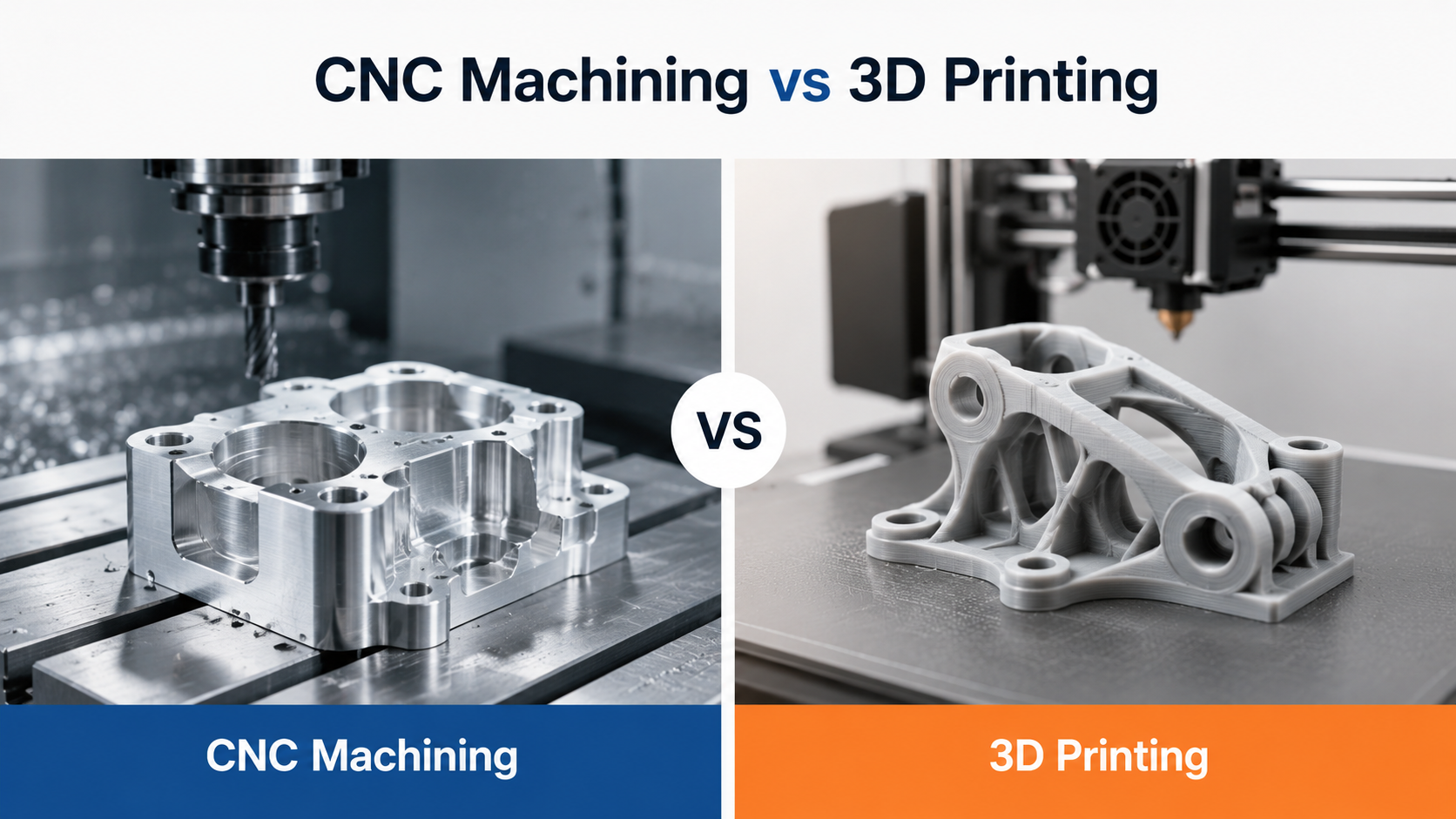
People often ask whether CNC machining or 3D printing is the better option. But the real question is: what has to be true for this part to work? A part may look simple on screen but depend on a few critical features. Other projects may need to accommodate changing designs, or include internal channels and curved structures that cutting tools cannot reach.
In precision prototyping, industrial parts production, and new product development, 3D printing and CNC machining are two of the most widely used manufacturing processes today. They work on completely different principles, and each has its own strengths and trade-offs in accuracy, part complexity, cost efficiency, and material compatibility. In other words, each process is better suited to different part designs, production volumes, and development stages. In this article, we will compare both methods for custom parts from a practical perspective to help with process selection.

What Is CNC Machining?
CNC machining is a subtractive manufacturing process that uses computer-controlled cutting tools to remove material from a solid block, plate, bar, tube, forging, or casting. Depending on the part, the process may involve milling, turning, drilling, tapping, grinding, or multi-axis machining.
For custom parts, CNC machining is often preferred when the design includes tight tolerances and critical functional features, such as bearing seats, press-fit holes, threads, sealing surfaces, and datum-controlled hole patterns. It also supports a wide range of standard metals and engineering plastics, making it easier to match the required material properties.
Its main limitation is tool access. Deep enclosed channels, sharp internal corners, and hidden cavities may be difficult or impossible to machine as a single part.
What Is 3D Printing?
3D printing is an additive manufacturing process that builds parts layer by layer from 3D model data using materials such as resin, nylon, thermoplastic, or metal powder. Because it creates the part directly from a digital file, it is well suited to rapid prototypes, frequent design changes, and highly customized components.
However, 3D printing includes several different technologies, such as FDM, SLA, SLS, MJF, SLM, and DMLS. Their accuracy, strength, surface finish, material properties, and post-processing requirements vary significantly.
For custom parts, 3D printing is especially useful for internal channels, lattice structures, lightweight forms, and complex geometry that cutting tools cannot easily reach.
| Comparison | CNC Machining | 3D Printing |
| Basic process | Removes material from solid stock | Builds parts layer by layer |
| Best for | Precision and functional parts | Rapid prototypes and complex shapes |
| Materials | Wide range of metals and plastics | Depends on the printing process |
| Tight tolerances | Better for tight tolerances and critical features | Critical features may need machining |
| Complex internal geometry | Limited by cutting-tool access | Suitable for internal and complex geometry |
| Mechanical strength | Close to solid stock material properties | Depends on process and build direction |
| Surface finish | Smooth machined surfaces | Often requires further finishing |
| Part size | Limited by machine travel and setup | Limited by build volume |
| Design changes | May require updated programming or fixtures | Usually requires only a file change |
| Holes, fits, and threads | Can be machined directly | Often drilled, tapped, or fitted with inserts afterward |
| Production quantity | More economical as quantity increases | Better suited to low-volume customization |
| Lead time | Fast for simple parts; complex setups take longer | Fast for early prototypes; post-processing adds time |
When to Choose CNC Machining for Custom Parts
CNC machining is normally the stronger option when the component depends on tight tolerances, predictable material properties, accurate fits, controlled surfaces, and repeatable inspection.
A 6061-T6 aluminum mounting bracket is a typical example. The geometry may not look difficult, but the part may include threaded holes, precision mounting locations, flat reference faces, and anodizing. In this case, CNC machining supports the actual functional requirements more directly than 3D printing.
It is also a strong choice for parts that must resist wear, heat, pressure, clamping forces, or repeated loading. When the component needs to behave like the final production material, machining from solid stock reduces uncertainty.
When to Choose 3D Printing for Custom Parts
3D printing becomes more attractive when speed, customization, and geometric freedom are more important than conventional machining efficiency.
An electronics enclosure that is still being revised is a good example. At this stage, the customer may care more about component fit, cable routing, screw positions, assembly space, and appearance than final production material properties. Printing several versions may be more practical than programming and machining every design change.
It is also a strong option for internal channels, lattice structures, organic shapes, lightweight forms, and one-off components where every unit is different.
The key is to match the printing process to the actual requirement. A visual prototype, a functional nylon component, and a metal pressure part should not be evaluated in the same way.

CNC Machining vs 3D Printing by Custom Part Type
Metal Brackets
For a relatively solid metal bracket with accessible geometry, CNC machining is normally the more direct manufacturing route.
It is especially suitable when the component includes precision mounting holes, threads, flat datums, structural loading, or a surface treatment such as anodizing or plating.
Metal 3D printing becomes more relevant when the bracket includes topology-optimized geometry, internal reinforcement, or a shape specifically designed to reduce weight.
Plastic Enclosures
For early enclosure prototypes, 3D printing can shorten the design cycle and make design changes easier.
Engineers can quickly review component fit, cable paths, screw locations, wall thickness, appearance, and assembly sequence. Once the design is stable, CNC machining may be used for final functional prototypes made from POM, ABS, polycarbonate, PEEK, or another specified engineering plastic.
When quantity increases and the design is frozen, injection molding may eventually become the more economical solution.
Jigs and Fixtures
Both processes are useful for manufacturing jigs and fixtures.
3D printing is often selected for lightweight assembly aids, custom ergonomic shapes, inspection nests, protective guides, and fixtures that may change as the product design develops.
CNC machining is better suited to fixtures that need accurate datums, high clamping force, wear resistance, flatness, or long service life.
Many practical factory tools combine both processes. A printed body may provide the custom shape, while machined metal inserts and reference surfaces control accuracy and durability.
Parts With Internal Channels
Internal channels are one of the clearest advantages of additive manufacturing.
Cooling passages, fluid manifolds, air paths, and hollow lightweight structures can sometimes be printed directly into the part. This may reduce assembly and eliminate several joints or seals.
However, printing the geometry does not remove the need for engineering review. The design still needs to consider channel size, support or powder removal, internal roughness, cleaning, pressure drop, leakage, and pressure testing.
External connections, threads, sealing faces, and mounting surfaces may still need CNC machining.
Functional Prototypes
A functional prototype should represent the conditions that the final part will experience.
When the test involves load, friction, wear, heat, pressure, sealing, or dimensional stability, CNC machining from the intended production material is often the safer choice.
When the main purpose is to validate shape, movement, assembly, or packaging space, 3D printing may be sufficient.
The word “prototype” does not automatically mean 3D printing. The correct process depends on what the prototype is expected to prove.
End-Use Production Parts
Both CNC machining and 3D printing can produce final-use components.
The decision should consider material performance, quantity, repeatability, surface requirements, inspection, certification, and long-term reliability.
CNC machining remains widely used for final-use precision parts because it offers predictable materials and established quality-control methods. Additive manufacturing is more attractive when every part is customized or when the geometry cannot be produced efficiently through conventional methods.
How Cost Is Calculated
The cost of CNC machining normally includes programming, setup, material, machining time, finishing, and inspection.
A part becomes more expensive when it needs several setups, complex fixtures, deep cavities, thin walls, long toolpaths, special tools, tight tolerances, or extensive inspection. Expensive material and poor material utilization can also increase the total cost.
The cost of 3D printing is influenced by file preparation, material volume, build time, orientation, support structures, machine packing, post-processing, and inspection.
Large, solid parts can be expensive to print because they consume significant material and build time. Small, hollow, complex parts may be more economical because additive manufacturing does not need to cut away large amounts of stock.
This is why “3D printing is cheaper for low quantities” should be treated as a general trend rather than a fixed rule.
Can CNC Machining and 3D Printing Be Combined?
Yes. In many real projects, combining them produces a better result than forcing one process to do everything.
One common approach is to print the main body and machine the critical interfaces. This works well for integrated manifolds, complex internal channels, lightweight structures, and organic forms. Additive manufacturing creates the geometry, while CNC machining controls the mounting faces, bores, threads, holes, and sealing surfaces.
Another common route is to print early prototypes and machine the final functional versions. Printed parts help the team review overall shape, space, ergonomics, and assembly. Once the design is stable, CNC machining produces the component in the intended engineering material for realistic functional testing.
The processes can also support different parts of the same workflow. A CNC-machined production component may use printed assembly fixtures, inspection nests, protective covers, or handling tools.
CNC machining and 3D printing are not always competitors. In many projects, they solve different problems.
When Neither Process Is the Best Choice
Sometimes the correct answer is neither CNC machining nor 3D printing.
When a plastic design is stable and the expected quantity is high, injection molding may provide a lower unit cost and more consistent cosmetic quality.
For medium- or high-volume aluminum and zinc parts, die casting may be more suitable if the geometry and tooling investment are reasonable.
Thin-wall enclosures, covers, frames, and brackets may be more economical through sheet metal fabrication. For several dozen plastic-like prototypes that need a more consistent appearance, vacuum casting may also be worth considering.
A good manufacturing partner should recommend the process that fits the project, even when it is not the process the customer originally requested.
How XY-GLOBAL Helps Select the Right Process
At XY-GLOBAL, the process review starts with the part requirements rather than a fixed preference for CNC machining or 3D printing.
Our engineering team evaluates the material, geometry, critical dimensions, tool access, surface requirements, quantity, application conditions, and inspection needs. We also consider whether the design may later move into higher-volume production.
For CNC custom parts, our capabilities include precision machining, multi-axis machining, surface finishing, and dimensional inspection.
For projects involving complex structures or rapid design validation, we can also evaluate whether 3D printing, hybrid manufacturing, molding, casting, or another process provides a more practical route.
The goal is not simply to manufacture the drawing exactly as received. It is to identify a process that can deliver the required function, quality, lead time, and cost with fewer manufacturing risks.
Conclusion
CNC machining is the backbone of precision manufacturing, because of its high accuracy, robust mechanical performance, and long-term stability in mass production. However, it faces limitations in design freedom, prototyping speed, and material waste.
By contrast, 3D printing offers rapid prototyping with minimal design restrictions and lower material waste, making it ideal for R&D and complex geometries. Yet, it still lags behind in precision, material strength, and scalability for high-volume end-use parts. Rather than competing, the two technologies complement each other in modern manufacturing.
Choose CNC machining for: High-precision functional parts, metal components, standardized mass production, premium-grade prototypes, extensive surface finishing requirements, and long-lasting load-bearing industrial components.
Choose 3D printing for: Fast product development, complex hollow or organic structures, lightweight thin-walled parts, small-batch testing, and conceptual presentation models.
In many real projects, the best approach is a hybrid one: use 3D printing to quickly test the structure, then use CNC machining to bring the final part into production. This helps improve development speed, ensure product quality, reduce costs, and shorten the overall project timeline.
For an accurate process recommendation, send us your 2D drawing, 3D model, material, quantity, critical tolerances, and application requirements. Our engineering team can review the design and help determine the most practical manufacturing route.


Aktie:
Rührreibschweißen: CNC-gefräste Aluminiumgehäuse und -gehäuse
Spring-Loaded Lens Holder Design: Preload, Centering and Machining Considerations