


Experience is valuable in manufacturing. It teaches us how to identify risks, avoid repeated mistakes, and make better decisions.
But experience can also make us too confident in what we already know.
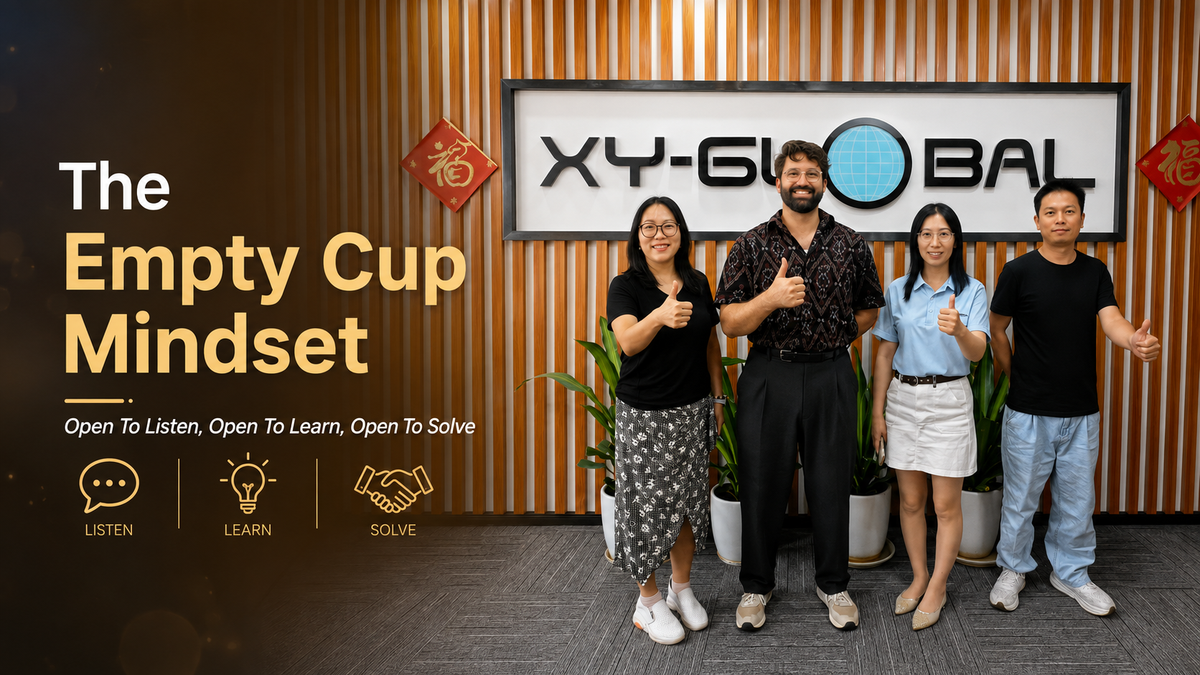
That is why we value what we call the empty cup mindset at XY-GLOBAL.
An empty cup mindset does not mean forgetting what we know.
It does not mean having no opinions, no standards, or no engineering judgment.
It means bringing our experience into every project while still leaving enough room for a different perspective, a new idea, or a better solution.
Recently, we had the opportunity to welcome a customer from Trackman to XY-GLOBAL to discuss a sheet metal tablet bracket used for a golf data recording.
There were drawings to review, manufacturing details to discuss, and several points that both teams wanted to improve.
What stood out along the project and the meeting was the attitude on both sides.
It was the openness on both sides. We were willing to listen to the customer's concerns and the customer was willing to listen to our manufacturing suggestions.
When something needed further consideration, neither side rushed to defend the original idea.
When a better direction appeared, both sides were willing to explore it.
When something had been overlooked, it could be discussed openly rather than hidden behind experience or position.
That, to us, is what an empty cup mindset looks like in a real manufacturing project.

Experience Should Guide Us, Not Limit Us
At XY-GLOBAL, we support customers with CNC machining, sheet metal fabrication, die casting, investment casting, MIM and other manufacturing processes.
Working across different projects gives our engineering team a great deal of practical experience. We understand how materials behave, where tolerance problems may occur, how forming and machining affect dimensions, how surface treatments influence final parts, and what can become difficult when a prototype moves into volume production.
This experience helps us identify risks earlier.
But every product has its own application, priorities and constraints.
Two parts may look almost identical on a drawing but perform very different functions. The same tolerance may be critical on one product and unnecessary on another. A manufacturing method that worked well for a previous project may not be the most efficient choice for the next one.
That is why we do not want experience to become a shortcut to conclusions.
Instead, experience should help us ask better questions.
For this Trackman project, the customer understands how the final device will be used in the golf environment, how users interact with it, and which aspects of the design matter most to the product.
Our role is different. We look at how the sheet metal part can be manufactured reliably, whether certain structures create production risks, how bending or assembly may affect the result, and whether there are opportunities to make production more stable.
Both perspectives are necessary.
A drawing tells us what needs to be produced, but it does not always tell the entire story behind the product.
Understanding that story helps us make better manufacturing decisions.

Being Open Also Means Being Willing To See Our Own Gaps
One of the biggest challenges in manufacturing cooperation is that problems can quickly become discussions about responsibility.
When a dimension is out of tolerance, a structure is difficult to manufacture, or an assembly does not perform as expected, it is easy for both sides to focus first on where the problem came from.
But this rarely improves the product.
An empty cup mindset changes the focus.
Instead of protecting an original assumption, both sides can examine whether it still makes sense. Instead of treating feedback as criticism, it can be treated as additional information. And instead of trying to prove that one side was correct, the discussion can return to the real objective: finding a solution that makes the product better.
This does not mean every suggestion should be accepted.
Manufacturing still requires technical judgment.
Sometimes the customer's proposed solution may create another production risk. Sometimes our original recommendation may need to be reconsidered after we better understand the application. Sometimes the best answer comes from combining ideas from both sides.
The important thing is that the discussion remains open enough for those possibilities to exist.
This becomes even more important during product development.
Early in a project, changing a thickness, radius, tolerance, mounting method or manufacturing sequence may be relatively straightforward. Once tooling has been completed or production has started, the same change may involve much more time and cost.
Open communication therefore has a very practical value.
It allows questions to be raised earlier, risks to be understood earlier, and improvements to be made before they become larger production problems.
An Empty Cup Mindset Is Ultimately About Solving Problems
We believe the relationship between a customer and a manufacturing supplier works best when both sides bring their strengths to the same problem.
The customer brings knowledge of the application, market and product.
The manufacturer brings knowledge of materials, processes and production.
Neither side needs to know everything.
What matters is whether both sides are willing to share what they know and remain open about what they do not yet know.
For XY-GLOBAL, this is also why engineering support is an important part of manufacturing.
Our job is not simply to receive a drawing and reproduce it exactly without thinking about the process behind it. When we see a potential manufacturing issue, we should raise it. When we think a structure can be improved, we should explain why. And when the customer's application knowledge shows us that our original thinking needs to change, we should be equally willing to adjust.
That is the practical meaning of an empty cup mindset.
It is not about being passive.
It is about being open enough to keep improving.
Keeping Enough Room For A Better Idea
Manufacturing will always involve experience, judgment and technical standards.
Those things matter.
But good engineering also requires curiosity, humility and the willingness to reconsider an answer when new information appears.
We want to bring our experience into every project, but not allow that experience to close our minds.
We want to offer our recommendations, but still listen carefully to the customer's perspective.
We want to identify problems early, but focus more on solving them than assigning them.
And we want every discussion, every adjustment and every lesson learned to move the product one step closer to successful production.
At XY-GLOBAL, we believe experience makes the cup stronger.
An open mind keeps enough space inside it. Space for another perspective. Space for another possibility. Space for a better solution.
That is the empty cup mindset we want to bring to every customer project.


Share:
Team Trip to Guangzhou: Packing Summer into Fruit Baskets and Paddling Together
From Stone To Diamond: Building Better Products Through Continuous Iteration