


What optical assemblies really mean
When buyers search for optical assemblies, they are usually not only looking for lenses or housings. In most cases, they want to understand how multiple precision components work together inside one optical system, and how assembly quality affects final performance.
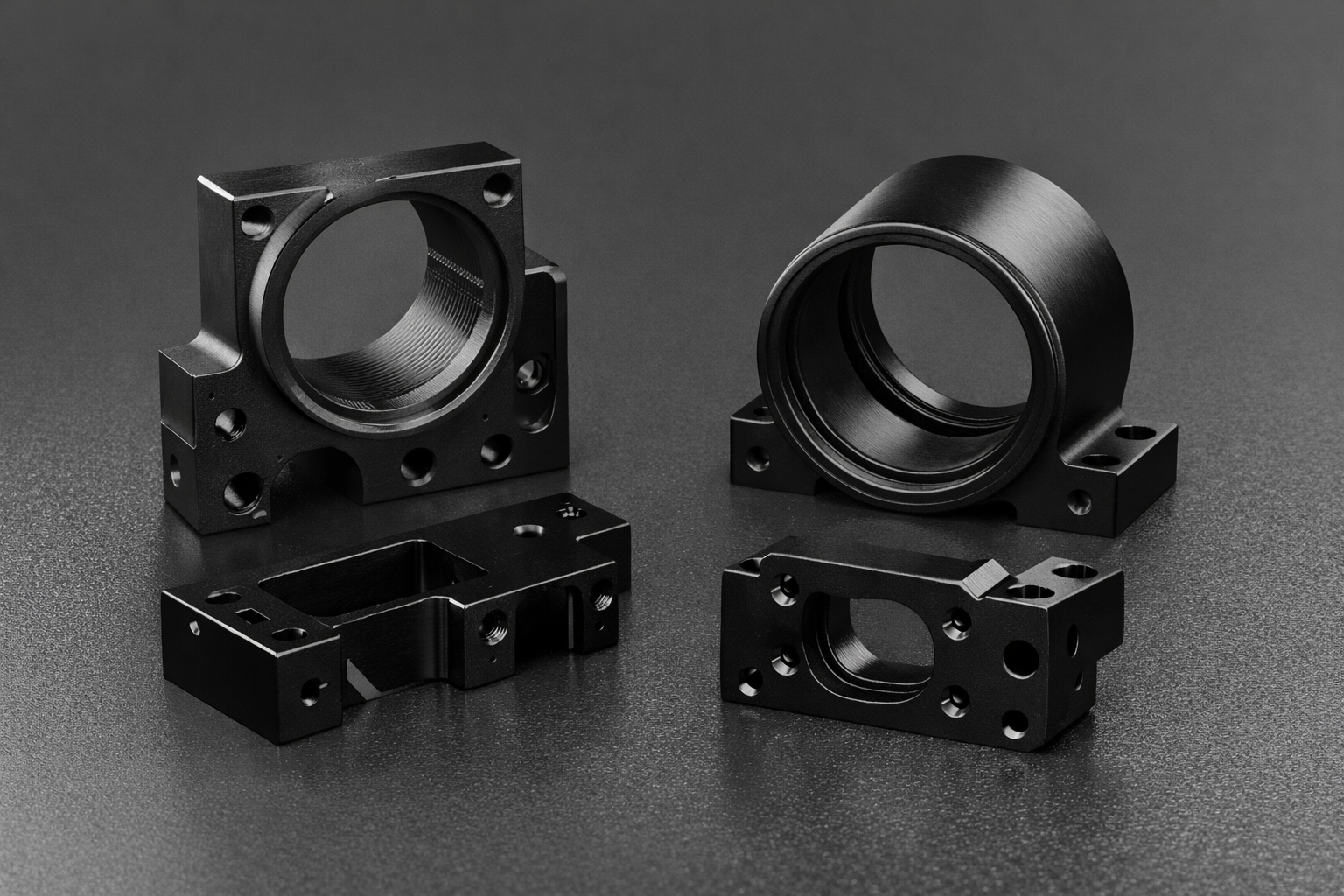
Optical assemblies usually include several parts such as lens housings, spacers, mounts, retaining rings, brackets, adjustment parts, and sometimes bonded or aligned subassemblies. These parts must work together with stable positioning, controlled tolerance, and clean surface quality. If one part is slightly off, the whole optical system may suffer from tilt, decenter, focus shift, light leakage, or unstable imaging.
Why precision matters in optical assemblies
In optical assemblies, machining tolerance is not just a drawing requirement. It directly affects alignment and repeatability.
For example, if a lens barrel has poor concentricity, the optical axis may shift. If a mounting face is not flat enough, the lens may tilt after assembly. In many precision optical projects, buyers pay close attention to features such as:
- tight diameter tolerance
- concentricity
- flatness
- perpendicularity
- surface finish on contact areas
Depending on the application, some optical components may require tolerance around ±0.01 mm, while critical features may need tighter control. Surface finish may also matter, especially on sealing, locating, or contact surfaces.

Common parts used in optical assemblies
A complete optical assembly often includes more than one type of precision part. Some of the most common examples are lens barrels, optical mounts, sensor housings, alignment rings, spacers, and structural support parts.
For imaging equipment, a lens housing may require stable internal dimensions and good coaxial control. In laser systems, the mount may need precise positioning and thermal stability. In medical or inspection devices, the assembly may include miniature metal parts, ceramic insulating parts, and thin-wall structural components working together in a limited space.
This is why manufacturing for optical assemblies is usually not just about one single process. It often combines precision machining, surface treatment, inspection, and controlled assembly.
Materials often used for optical assemblies
Material choice plays a big role in optical assemblies, especially when the system must work under temperature change, vibration, humidity, or long service cycles.
Common materials include:
- Aluminum 6061 / 7075 for lightweight housings and mounts
- Stainless steel 303 / 304 / 316L for strength and corrosion resistance
- Brass for stable machining and fine threads
- Titanium for demanding medical or lightweight structural use
- Engineering plastics for insulation or low-weight applications
- Technical ceramics for wear resistance, insulation, or thermal performance
For example, aluminum is often used for optical housings because it is light and easy to machine, while stainless steel may be preferred when higher strength or corrosion resistance is required. In some advanced systems, ceramic components are added when thermal stability or electrical insulation becomes critical.
Manufacturing challenges in optical assemblies
The difficulty of optical assemblies is usually not the shape alone. The real challenge is keeping dimensional stability across multiple related parts.
A single part may look simple, but once it becomes part of an assembly, the tolerance stack-up becomes much more important. A small error in one spacer, one thread, or one locating shoulder can affect the final optical path.
Typical challenges include:
- maintaining concentricity between inner and outer diameters
- controlling thread quality without damaging alignment
- keeping thin-wall structures stable during machining
- reducing burrs and contamination before assembly
- managing coating or anodizing thickness on critical fits
This is why DFM review is useful at an early stage. In many optical assemblies, a slight adjustment to wall thickness, thread design, shoulder width, or tolerance distribution can improve manufacturability and reduce assembly risk.
A simple example of optical assemblies in practice
Take a lens barrel assembly as a simple example. The product includes a main housing, two spacers, one retaining ring, and one mounting flange. At first glance, each part is not very complex. However, once assembled, the internal diameter, shoulder position, thread accuracy, and contact surface flatness all affect lens alignment.
If the main housing is machined with unstable concentricity, the lens center may shift. If the spacer thickness changes by too much, the focal distance may no longer match the design target. If the retaining ring creates uneven pressure, tilt may appear after tightening.

In this kind of optical assembly, the machining quality of each part directly affects final imaging consistency. That is why optical parts are often inspected not only by size, but also by coaxiality, flatness, and fit condition.
Surface treatment and cleanliness are also important
For many optical assemblies, machining is only one part of the job. Surface treatment and cleanliness also matter.
Black anodizing is often used on aluminum optical parts to reduce stray light. Fine blasting or controlled finishing may be used to improve appearance or contact stability. At the same time, burr control and cleaning are important because dust, oil, or loose particles inside the assembly may affect lens performance or sensor reliability.
In some projects, the part is dimensionally correct but still unsuitable for use because the surface treatment is uneven or internal cleanliness is not good enough. This is especially important in imaging, laser, and medical optical devices.
Choosing the right manufacturing partner for optical assemblies
A good supplier for optical assemblies should understand more than basic machining. They should also understand how precision parts behave in assembly.
Buyers usually need support in areas such as:
- tolerance review for mating features
- material suggestion based on application
- surface treatment recommendation
- burr and contamination control
- inspection planning for critical dimensions
- prototype to production consistency
The best result usually comes when design, machining, finishing, and assembly requirements are reviewed together from the beginning. For optical assemblies, this often saves more time than simply pushing for the lowest unit price.

Conclusion
High-quality optical assemblies depend on more than good-looking parts. They require controlled machining, suitable materials, reliable surface treatment, and stable assembly logic.
Whether the application is imaging equipment, laser systems, medical optics, or precision industrial devices, the key is the same: each part must fit the optical system, not just the drawing. When tolerances, materials, and assembly needs are reviewed early, optical assemblies become easier to produce, inspect, and scale.
FAQ
What are optical assemblies?
Optical assemblies are groups of precision components used together in an optical system, such as lens housings, spacers, mounts, retaining rings, and support parts.
Why are tolerances important in optical assemblies?
Because small dimensional errors can affect alignment, focus, concentricity, and final optical performance.
What materials are commonly used in optical assemblies?
Common materials include aluminum, stainless steel, brass, titanium, engineering plastics, and technical ceramics, depending on the application.
What manufacturing process is commonly used for optical assemblies?
CNC machining is one of the most common methods, especially for precision housings, mounts, spacers, and structural optical parts.


Share:
Zero-Point Clamping Systems: Make 1 + 1 > 2 in CNC Machining
CNC Machined Optical Housings: What They Are and Why Precision Matters