


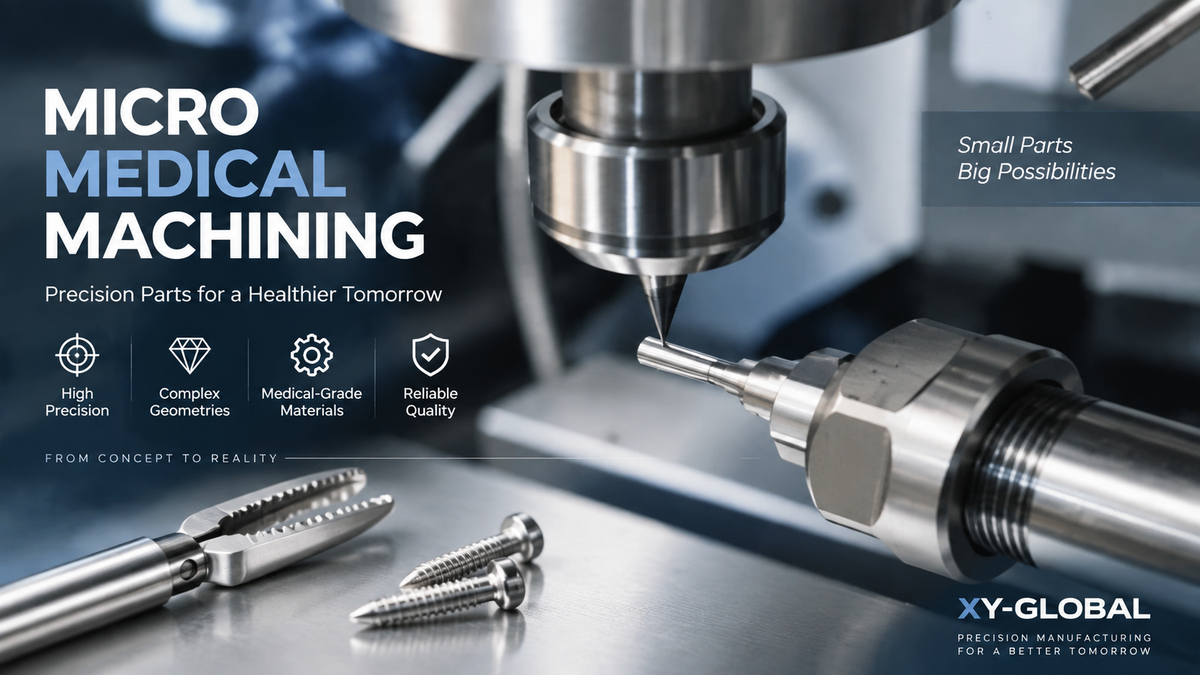
Medical devices are getting smaller.
From minimally invasive surgical instruments to diagnostic systems and wearable medical devices, engineers are constantly looking for ways to reduce size while improving performance.
But making a smaller component does not simply mean using a smaller tool.
At the micro scale, small details become big challenges. A tiny burr can affect assembly. A few microns of dimensional variation can change how a component fits or functions. A small machining error may become a serious issue when the part is used in a critical medical application.
This is where micro medical machining becomes important.
For micro machining, the goal is not only to make a small medical part in millimeters, but to make a small part that works reliably in a demanding medical application.

What Is Micro Medical Machining?
Micro medical machining refers to the manufacturing of very small and high-precision components used in medical devices.
These parts usually require:
-
Small features
-
Tight tolerances
-
Complex geometries
-
Excellent surface finishes
-
High repeatability
The process can include CNC milling, micro turning, drilling, EDM, laser machining, and other precision manufacturing methods.
Unlike standard machining, micro machining requires much tighter control over factors such as tool size, tool wear, vibration, and inspection accuracy.
Unlike conventional machining, micro machining focuses on producing extremely small and precise features with consistent quality. It requires much tighter control over factors such as tool size, tool wear, vibration, and inspection accuracy.
A component that looks simple on a drawing may become challenging once the feature size is reduced.
For example, machining a small medical bracket is not simply a smaller version of machining a large bracket. A 1 mm hole, a thin wall, or a small groove can completely change the machining approach.
Why Medical Devices Need Micro Machining?
The demand for micro machining for medical devices continues to grow because medical equipment is becoming smaller, more precise, and more specialized.
Minimally invasive procedures are one major driver.
Smaller surgical tools allow doctors to access areas of the body through smaller openings. However, reducing the size of a device also means every mechanical component inside it must work within tighter limits.
A small surgical mechanism may contain tiny moving parts, precision shafts, miniature joints, and small locking structures. Each component needs to move smoothly and fit accurately. The same challenge appears in diagnostic and wearable medical devices. As manufacturers try to reduce product size, they need smaller components without sacrificing strength, reliability, or performance.
Micro machining is commonly used when medical devices require:
-
Miniaturized structures
-
Precise movement
-
Small internal features
-
Tight assembly tolerances
-
Lightweight designs
Common Medical Components Made With Micro Machining
Micro machining is used in many areas of medical manufacturing. The applications are not limited to one type of device.
The common factor is that these components require small dimensions, complex geometries, or tight control.

Surgical Instrument Components
Surgical instruments are one of the most common applications for micro medical machining.
Many surgical tools contain small mechanical parts that must move smoothly and maintain accurate positioning.
Examples include:
-
Micro forceps components
-
Surgical scissors parts
-
Endoscopic instrument components
-
Small hinges and joints
-
Precision shafts
-
Locking mechanisms
For these parts, surface finish and dimensional accuracy are especially important. A small machining error can affect movement, assembly, or the overall user experience of the instrument.
Endoscopic And Minimally Invasive Device Components
Modern minimally invasive devices often require very small internal components.
Typical examples include:
-
Micro tubes
-
Guide components
-
Connectors
-
Small sleeves
-
Precision tips
-
Fluid control components
These parts may require extremely small features while maintaining consistent geometry.
In many cases, the challenge is not producing one prototype. The challenge is producing many identical parts with the same quality.
Medical Robotics And Robotic Surgical Components
Medical robotics is another area where micro precision components are becoming increasingly important.
Robotic systems require compact mechanical structures that can deliver accurate movement.
Micro machined components may include:
-
Miniature transmission parts
-
Small brackets
-
Precision joints
-
Structural supports
-
Motion-related components
The requirements are similar to traditional precision engineering: accuracy, repeatability, and reliable assembly.
Implant And Orthopedic Components
Some medical implants and orthopedic devices also require precision machining.
Common materials such as titanium and stainless steel are widely used because they provide strength, corrosion resistance, and biocompatibility.
Examples include:
-
Small fixation components
-
Dental components
-
Orthopedic hardware
-
Custom medical parts
For these applications, machining quality is directly related to product performance.
Micro Components For Sensors And Diagnostic Devices
Medical sensors and diagnostic equipment continue to become smaller.
Micro machined components can be used for:
-
Sensor housings
-
Precision fixtures
-
Connection parts
-
Miniature structural components
These parts may not always be visible in the final product, but they play an important role in maintaining device accuracy and reliability.
Materials Used In Medical Micro Machining
aterial selection is one of the first considerations when developing medical micro components.
The material needs to meet the requirements of the application, including mechanical strength, corrosion resistance, sterilization conditions, and biocompatibility.
Different materials also create different machining challenges.
For example, titanium offers excellent strength-to-weight performance but requires careful machining because of its low thermal conductivity. Stainless steel provides good corrosion resistance but may require specific tooling and cutting strategies depending on the grade.
Common materials used in medical micro machining include:
| Material | Key Characteristics | Typical Applications |
| Stainless Steel 316L | Excellent corrosion resistance, widely used in medical applications | Surgical instruments, medical components |
| Titanium Ti-6Al-4V | Lightweight, strong, biocompatible | Implants, orthopedic components |
| 17-4PH Stainless Steel | High strength and good hardness | Surgical and mechanical components |
| Cobalt-Chrome Alloys | High strength, excellent wear resistance | Orthopedic implants, dental components, load-bearing medical parts |
| Nitinol | Shape memory and superelastic properties | Minimally invasive devices |
| PEEK | Lightweight, chemical resistance, electrical insulation | Medical housings and special components |
| Ceramic Materials | High wear resistance and chemical stability | Specialized medical applications |
Choosing the right material is not only about performance.
It also affects machinability, production cost, inspection requirements, and long-term reliability.
Advantages And Limitations Of Micro Medical Machining
Micro medical machining provides excellent precision and flexibility for small and complex medical components. However, it also has limitations depending on the material, design complexity, and production requirements.
Advantages Of Micro Medical Machining
- High Precision For Critical Medical Components: Micro machining can produce very small features, tight tolerances, and complex structures required for medical device components.
- Complex Geometries Without Large Tooling Investment: Unlike molding processes, CNC micro machining does not require expensive tooling at the early development stage, making it suitable for prototypes and low-volume production.
- Better Surface Quality And Feature Control: Properly optimized micro machining provides better control over small features, surface finish, and dimensional consistency, which are important for medical applications.
- Suitable For Complex And High-Value Medical Parts: Micro machining is ideal for small, technically demanding components where precision, reliability, and performance are more important than achieving the lowest unit cost.
Limitations And Challenges Of Micro Medical Machining
- Higher Manufacturing Cost: Micro machining requires specialized equipment, precision tooling, and strict inspection, which can increase costs compared with conventional machining.
- Tool Wear Becomes More Critical: At the micro scale, small changes in tool condition can affect feature accuracy, surface quality, and production consistency.
- Material And Design Limitations: Extremely thin walls, deep small features, or difficult-to-machine materials may create additional challenges. Proper DFM review is important before production.
Common Micro Machining Processes For Medical Components
Different medical parts require different manufacturing methods.
There is no single process that works for every application. The best choice depends on the part geometry, material, tolerance requirement, and production volume.
| Process | Typical Applications | Key Advantages |
| Micro CNC Milling | Small complex components, pockets, slots, precision surfaces | Flexible, suitable for prototypes and low-volume production |
| Micro Turning | Small shafts, pins, cylindrical components | Good for round precision parts |
| EDM | Hard materials and complex small features | Excellent accuracy for difficult geometries |
| Laser Machining | Micro holes, thin materials, special structures | Non-contact processing |
| Metal Injection Molding | High-volume small metal components | Suitable for complex shapes and mass production |
CNC Micro Machining Vs MIM For Medical Components
For small medical metal parts, CNC machining and MIM (Metal Injection Molding) are both commonly considered options.
The right choice depends mainly on production volume, complexity, and development stage.
| CNC Micro Machining | Medical MIM | |
| Best suited for | Prototype, low and medium volume production | Medium and high volume production |
| Initial investment | Lower | Higher due to tooling |
| Design flexibility | Very high | Limited by mold design |
| Dimensional control | Excellent for precision features | Stable for repeated production |
| Material utilization | Machining removes material | Near-net-shape process |
For early-stage medical device development, CNC machining is often preferred because engineers may still need to adjust designs after testing.
Once the design becomes stable and production quantities increase, MIM can become an attractive option for certain small and complex metal components.
A capable manufacturing partner should understand both processes and help select the most suitable solution instead of forcing one process for every project.
Design Considerations For Micro Medical Parts
Good design plays a major role in successful micro machining.
At small scales, manufacturing limitations become more important. Features that are easy to create on larger parts may become difficult when reduced in size.
During the design stage, engineers should consider:
-
Whether the feature size is realistic for available tooling
-
Whether the part can be securely fixtured during machining
-
Whether inspection equipment can measure the required features
-
Whether the tolerance is necessary for the final function
For example, adding an extremely small groove or deep narrow cavity may increase machining difficulty without improving product performance.
Early DFM review can help identify these issues before production begins.

Quality Control For Micro Medical Machining
Precision is only one part of medical manufacturing. For micro medical components, consistent quality and process control are equally important. A component may be only a few millimeters in size, but every detail needs to be controlled throughout the entire manufacturing process.
Material Traceability And Process Control
Medical manufacturers need confidence that every component is produced from verified materials and controlled processes.
Material traceability helps track important information throughout production, including material certificates, supplier records, machining history, and inspection results. This allows manufacturers to quickly identify and review the production history of a part when needed.
For micro medical machining, process control is especially important because small changes in tooling condition, machining parameters, or material behavior can affect final part quality. A stable process helps ensure repeatability from prototype batches to long-term production.
ISO 13485 Quality Management System
For medical device components, manufacturing capability is not only about machining accuracy. It is also about having a reliable quality management system.
ISO 13485 is an important standard for medical device manufacturing organizations. It focuses on risk management, documentation control, process consistency, and continuous improvement throughout the product lifecycle.
Working with an ISO 13485-certified supplier helps medical companies reduce manufacturing risks and ensure that production processes meet the requirements expected in the medical industry.
Precision Inspection And Verification
Micro medical components often contain small features that require accurate measurement methods.
Depending on part requirements, inspection may include:
-
CMM dimensional inspection
-
Optical measurement
-
Surface roughness testing
-
Critical feature verification
-
First Article Inspection (FAI)
For complex micro components, inspection planning should be considered during the design stage. The ability to measure a feature accurately is just as important as the ability to machine it.
Consistency From Prototype To Production
Medical device development often involves multiple stages, from initial prototypes to repeated production.
A reliable manufacturing partner should maintain consistent quality throughout the transition. The machining process, inspection methods, and documentation system need to remain stable as production volume increases.
This is especially important for micro medical parts because small variations that may be acceptable in general mechanical components can affect the function and reliability of medical devices.
Partner with XY-GLOBAL For Micro Medical Machined Parts
With over 15 years of precision machining experience, XY-GLOBAL provides reliable manufacturing solutions for medical components with ISO 13485-certified processes.
Our capabilities include precision CNC machining, 5-axis machining, medical-grade material processing, material traceability, and CMM dimensional inspection. We support customers with quality documentation and controlled manufacturing processes throughout the development and production stages.
We also support custom micro machining for complex precision medical parts based on drawings and application requirements.
Whether a project requires CNC prototypes, low-volume production, or a transition to higher-volume manufacturing, XY-GLOBAL helps customers select the right manufacturing approach for their medical applications.
Need precision micro medical components? Contact XY-GLOBAL today to discuss your project requirements and find the right manufacturing solution.
For more information on medical parts machining, please explore the blog posts below:
Frequently Asked Questions(FAQs) for Micro Medical Machining
1. What is the difference between micro machining and precision machining?
Precision machining focuses on achieving tight tolerances, while micro machining focuses more on extremely small features and miniature components. Many micro machined parts also require precision machining capabilities.
2. Why are medical micro parts difficult to manufacture?
Because small features amplify manufacturing challenges. Tool wear, vibration, burr formation, dimensional variation, and inspection become much more critical at micro scale.
3. When should I choose MIM instead of CNC machining for medical parts?
MIM is often considered when the design is stable and production volume is high. CNC machining is usually better for prototypes, design changes, and lower-volume precision components.
4. What tolerances can be achieved in medical micro machining?
The achievable tolerance depends on the material, part geometry, machine capability, tooling, and inspection method. Critical features require evaluation based on the complete design.
5. What information is needed for a micro medical machining quote?
Manufacturers usually need the CAD drawing, material requirement, expected quantity, tolerance requirements, surface finish requirements, and application information.


Share:
Medical CNC Machining Under ISO 13485: Manufacturing Precision Components For Medical Devices