


Finding low cost optical components suppliers sounds simple until a low-priced component causes an alignment problem, coating issue, assembly failure, or another round of machining.
For optical equipment manufacturers, the lowest unit price is rarely the same as the lowest total cost.
A lens mount that costs $8 instead of $12 does not save money if its bore is out of position, the anodizing changes the mating dimension, or the mounting surface is not flat enough to hold the optical axis. The same problem applies to camera housings, laser mounts, optical brackets, lens barrels, sensor enclosures and other precision optomechanical parts.
The better sourcing strategy is therefore not simply:
“Who has the cheapest price?”
It is:
“Which supplier can manufacture the required optical component reliably at the lowest practical total cost?”
This guide explains how to evaluate low-cost optical component manufacturers, what actually drives cost, where specifications can be optimized, and which requirements should never be compromised.
What are Optical Components?
The term “optical components” covers a broad range of products.
Some are actual optical elements:
-
Lenses
-
Mirrors
-
Prisms
-
Optical windows
-
Filters
-
Beam splitters
-
Sapphire windows
-
Infrared optical elements
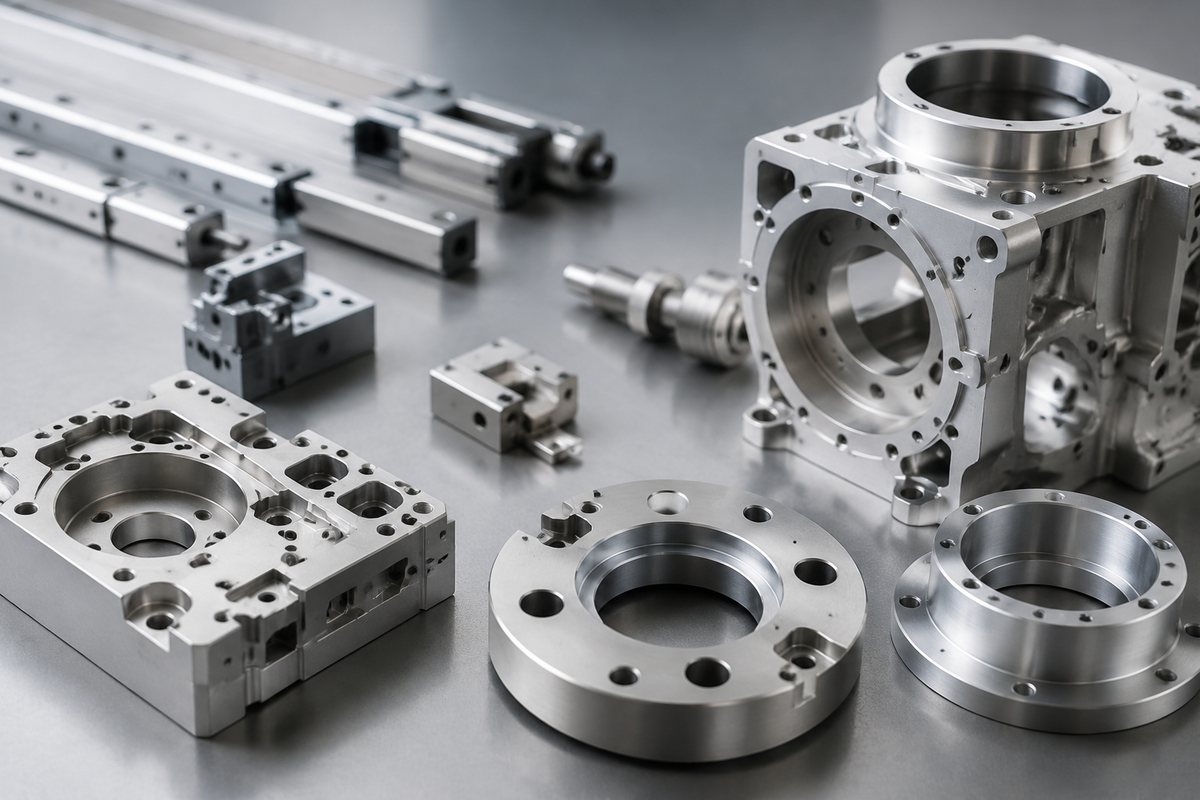
Others are optomechanical components used to position, protect and align those optical elements:
-
Lens mounts
-
Lens barrels
-
Optical housings
-
Camera housings
-
Mirror mounts
-
Laser mounts
-
Optical base plates
-
Optical brackets
-
Adjustment blocks
-
Sensor housings
-
Retaining rings
-
Optical adapters
-
Telescope components
-
Precision positioning parts
For many OEM optical systems, these mechanical components are just as important as the optics themselves.
A high-quality lens cannot compensate for a lens barrel with poor concentricity. A precision laser cannot maintain alignment if its mounting surfaces move relative to one another. A machine vision camera may also perform inconsistently when the sensor housing does not maintain the required geometric relationship between the sensor and lens.
That is why selecting the right optical components supplier requires more than comparing quotations.

Why are Some Optical Components So Expensive?
The raw material is often only a small part of the final component cost.
For precision optical hardware, pricing is mainly influenced by several manufacturing factors.
| Cost Factor | Why It Affects Price |
|---|---|
| Tight tolerances | More machining, slower feeds and additional inspection |
| Complex geometry | May require 4-axis or 5-axis CNC machining |
| Multiple setups | Each repositioning adds labor and tolerance risk |
| High surface finish | Requires optimized cutting or secondary finishing |
| Tight geometric tolerances | Flatness, parallelism, concentricity and position require controlled machining |
| Special materials | Titanium, copper and specialty stainless steels can increase machining cost |
| Small quantities | Programming and setup costs are distributed over fewer parts |
| Surface treatment | Anodizing, plating and painting introduce additional operations |
| Inspection | CMM and detailed dimensional reports increase quality-control time |
| Assembly requirements | Additional fitting, cleaning and verification are required |
This explains why two components that look nearly identical can have very different manufacturing costs.
A simple aluminum bracket with ±0.10 mm tolerances is fundamentally different from an optical mount requiring tight datum relationships, precision bores and controlled flatness.

What Does “Low Cost” Really Mean for Optical Components?
A useful way to define low cost is:
The minimum manufacturing cost that still allows the component to meet its functional requirements consistently.
That distinction matters.
Reducing a tolerance from ±0.01 mm to ±0.005 mm may substantially increase machining and inspection costs. But if ±0.01 mm is genuinely required for optical alignment, relaxing the tolerance simply creates a cheaper defective component.
On the other hand, specifying ±0.005 mm on every dimension of a housing when only two locating features affect alignment creates unnecessary cost.
Good optical component suppliers therefore do more than manufacture a drawing. They identify which features actually control function.
These often include:
-
Optical centerline
-
Lens seating diameter
-
Sensor mounting plane
-
Datum surfaces
-
Locating holes
-
Bore concentricity
-
Mounting face flatness
-
Hole position
-
Thread position
-
Parallelism between critical surfaces
Everything else should be dimensioned according to its actual functional requirement.
This is one of the most effective ways to reduce component cost without reducing performance.
8 Ways to Reduce the Cost of Custom Optical Components
1. Apply Tight Tolerances Only to Critical Features
Over-tolerancing is one of the most common reasons custom optical components become expensive.
Consider a CNC-machined optical housing with 30 dimensions.
Perhaps only five dimensions directly control:
-
Lens position
-
Sensor position
-
Optical alignment
-
Assembly repeatability
Those five dimensions may require tight control.
The remaining dimensions may only define external shape or provide clearance.
Applying the same tolerance to all 30 dimensions forces the manufacturer to machine, measure and document features that do not improve optical performance.
A better drawing clearly separates:
Critical-to-function dimensions
from
General machining dimensions.
For example:
-
Precision lens bore: tight tolerance
-
Datum-to-bore position: tight tolerance
-
Optical mounting face: controlled flatness
-
Outer housing profile: standard CNC tolerance
-
Non-functional clearance pocket: relaxed tolerance
This can significantly reduce both machining and inspection time.

2. Use Aluminum Where the Application Allows It
Aluminum alloys such as 6061-T6 are widely used for optical mechanical components because they combine:
-
Low weight
-
Good machinability
-
Good dimensional stability
-
Reasonable strength
-
Excellent anodizing compatibility
-
Competitive material cost
Typical applications include:
-
Lens housings
-
Camera housings
-
Optical mounts
-
Laser brackets
-
Base plates
-
Instrument enclosures
-
Telescope accessories
Stainless steel can provide higher strength and wear resistance, but machining is generally slower and material costs may be higher.
Material selection should therefore be based on the actual application rather than choosing the strongest material available.

3. Reduce the Number of CNC Setups
Every time a part is removed, rotated and relocated, manufacturing time increases.
Multiple setups also create additional opportunities for positional errors between features.
A well-designed optical component allows critical features to be machined in the same setup whenever possible.
For example, machining:
-
A reference face
-
Precision bore
-
Locating holes
in one setup can improve both accuracy and manufacturing efficiency.
This is where early DFM analysis can make a major difference.
4. Avoid Unnecessary Deep Pockets
Deep cavities are common in optical housings, but they can be surprisingly expensive.
A deep narrow pocket may require:
-
Long-reach cutting tools
-
Lower cutting speeds
-
Multiple machining passes
-
Additional chip evacuation
-
Greater tool deflection control
If the cavity does not need to be extremely deep, increasing internal clearance or modifying the geometry can reduce machining time substantially.
5. Use Standard Threads and Tool Sizes
Non-standard threads, extremely small corner radii and unusual hole sizes can require special tooling.
Whenever the design allows, use readily available:
-
Metric threads
-
UNC/UNF threads
-
Standard drills
-
Standard end mills
-
Standard reamers
This is a small design decision that can reduce cost and lead time.
6. Design Around Surface Treatment
Optical mechanical components frequently require black anodizing to reduce reflections and improve corrosion resistance.
However, surface treatment adds material to or changes the surface condition of the component.
This becomes important around:
-
Precision fits
-
Threaded holes
-
Lens seating areas
-
Bearing interfaces
-
Datum surfaces
-
Ground surfaces
Designers should decide which surfaces need coating and which should be masked.
Do not manufacture the component first and think about coating afterwards.
For precision assemblies, the post-treatment condition should be considered from the beginning of the tolerance stack.
7. Combine Components When It Makes Manufacturing Sense
An optical assembly made from six separate brackets may sometimes be redesigned as two or three CNC-machined components.
This can reduce:
-
Fasteners
-
Assembly labor
-
Alignment procedures
-
Tolerance stack-up
-
Inventory management
But consolidation is not always cheaper.
One extremely complicated 5-axis component may cost more than several simple parts.
A capable supplier should compare both possibilities rather than automatically recommending one-piece construction.
8. Optimize Batch Size
Prototype prices can look expensive because CNC programming, tooling preparation and machine setup are divided across only a few parts.
For example, a supplier may spend several hours preparing a process whether the order quantity is:
-
2 pcs
-
20 pcs
-
200 pcs
The setup cost per component therefore falls as quantity increases.
When requesting quotations, consider asking for several quantity breaks such as:
| Quantity | Purpose |
|---|---|
| 5–10 pcs | Engineering prototype |
| 50 pcs | Pilot production |
| 100 pcs | Initial production |
| 500 pcs | Volume comparison |
This gives purchasing teams a much clearer picture of future production cost.
Cheap Optical Components vs Cost-Optimized Optical Components
There is an important difference.
Cheap component
The supplier reduces price primarily by reducing manufacturing effort.
Possible consequences include:
-
Less inspection
-
Inconsistent raw material
-
Poor process control
-
Uncontrolled subcontracting
-
Incorrect surface treatment
-
Dimensional variation
-
Limited traceability
Cost-optimized component
The supplier reduces unnecessary manufacturing cost while maintaining functional requirements.
Typical methods include:
-
Better fixture design
-
Fewer machining setups
-
Optimized cutting parameters
-
Appropriate material selection
-
Standard tooling
-
Critical-feature inspection
-
Improved tolerance allocation
-
Batch production optimization
For engineering products, the second approach is considerably safer.
Critical Tolerances for Optical Mechanical Components
Optical components frequently depend more on geometric relationships than on individual linear dimensions.
Several requirements deserve particular attention.
Concentricity and Coaxiality
Lens barrels, camera housings and cylindrical optical assemblies may require multiple diameters to share a common axis.
Misalignment can affect:
-
Lens positioning
-
Image quality
-
Beam alignment
-
Assembly repeatability
The manufacturing process should therefore establish critical diameters from appropriate datums rather than treating each diameter independently.
Flatness
Mounting surfaces influence the orientation of the complete optical assembly.
Poor flatness can cause:
-
Tilt
-
Stress during assembly
-
Uneven contact
-
Alignment drift
Precision optical base plates and mounting surfaces may therefore require controlled flatness rather than only thickness tolerance.
Parallelism and Perpendicularity
The relationship between two surfaces can be more important than the dimensions of either surface individually.
Examples include:
-
Sensor plane relative to lens axis
-
Optical mount relative to machine base
-
Mirror surface mounting interface
-
Camera housing interfaces
Hole Position
Optical systems often use dowel pins or precision locating holes to establish repeatable assembly.
For these features, positional tolerance relative to the datum system can be more meaningful than simple ± coordinate dimensions.
Surface Finishes for Optical Components
Surface finish affects much more than appearance.
Black Anodizing
Common for aluminum optical hardware.
Benefits can include:
-
Corrosion resistance
-
Reduced surface reflection
-
Improved appearance
-
Increased surface hardness
Optical equipment frequently uses matte or low-reflectivity black surfaces where stray light is undesirable.
Hard Anodizing
Used where greater wear resistance is required.
The designer should account for coating thickness when tight fits are involved.
Electroless Nickel Plating
Can provide:
-
Corrosion resistance
-
Wear resistance
-
Uniform coating
-
Functional surface protection
It may be useful for certain precision components where dimensional consistency of the coating is important.
Bead Blasting
Often applied before anodizing to achieve a uniform matte appearance.
However, critical precision surfaces should be identified before blasting.
What Should a Low Cost Optical Components Supplier Be Able to Inspect?
Precision manufacturing without suitable inspection capability creates unnecessary risk.
Depending on the component, inspection equipment may include:
-
CMM
-
Optical measurement systems
-
Height gauges
-
Micrometers
-
Bore gauges
-
Surface roughness testers
-
Thread gauges
-
Profile measurement equipment
A good supplier should also understand which dimensions need inspection rather than measuring everything with the same method.
For critical projects, buyers can request:
-
Dimensional inspection reports
-
First article inspection
-
Material certificates
-
Surface treatment certificates
-
CMM reports
-
Critical dimension records
This is particularly important before moving from prototype to production.
Prototype First, Then Reduce Cost
One of the safest ways to source optical mechanical components is to separate development into stages.
Stage 1: Prototype
Manufacture a small quantity to verify:
-
Geometry
-
Assembly
-
Optical alignment
-
Surface treatment
-
Functional performance
Stage 2: Design Feedback
Review manufacturing difficulty and identify:
-
Unnecessary tolerances
-
Difficult machining features
-
Expensive materials
-
Complicated setups
Stage 3: Pilot Production
Produce a moderate quantity and verify:
-
Process capability
-
Repeatability
-
Inspection method
-
Assembly consistency
Stage 4: Production Optimization
Once the design is stable, optimize:
-
Fixtures
-
Tool paths
-
Batch size
-
Inspection frequency
-
Material purchasing
-
Secondary operations
Trying to achieve the lowest possible price before the design is stable can create more cost later.
China vs Local Optical Components Suppliers
There is no universal answer to which sourcing region is better.
The decision depends on the project.
Local suppliers may offer advantages when:
-
Engineering changes are frequent
-
Same-day communication is essential
-
Extremely short logistics lead times are required
-
Local regulatory requirements dominate
International suppliers, particularly experienced manufacturing companies in China, can be attractive when:
-
CNC machining represents a large percentage of product cost
-
Multiple processes are required
-
Production volume is increasing
-
Cost competitiveness matters
-
Parts require machining plus surface treatment and assembly
The correct comparison should therefore include more than the quoted unit price.
Calculate:
Part price + tooling + inspection + logistics + rejection risk + assembly cost + engineering support.
That gives a more realistic total sourcing cost.
How to Compare Low Cost Optical Components Suppliers
When evaluating several suppliers, use a technical scorecard instead of comparing price alone.
| Requirement | Questions to Ask |
|---|---|
| CNC capability | 3-axis, 4-axis or 5-axis? |
| Tolerance capability | Can critical dimensions be consistently maintained? |
| Materials | Aluminum, stainless steel, brass, copper and engineering plastics? |
| Inspection | Is CMM inspection available? |
| Surface treatment | Is anodizing/plating controlled? |
| Prototype support | Can small quantities be produced? |
| Production capability | Can the same process scale? |
| DFM support | Will engineers review difficult features? |
| Quality system | Is the supplier ISO certified? |
| Traceability | Can material and inspection records be provided? |
| Assembly | Can mechanical subassemblies be supplied? |
| Communication | Are engineering questions answered clearly? |
A slightly higher quotation from a technically stronger supplier can often produce a lower total project cost.
Warning Signs When Choosing a Low-Cost Supplier
Be cautious if a supplier:
Quotes complicated drawings unusually quickly
A complex optical component should normally require drawing review before reliable pricing.
Says every tolerance is “no problem”
Precision manufacturing always has process limits.
Experienced manufacturers typically ask which dimensions are critical.
Cannot explain its inspection method
If a supplier cannot explain how a feature will be verified, its manufacturing claim should be questioned.
Gives the same price regardless of tolerance
A ±0.1 mm component and a ±0.005 mm component generally do not have identical manufacturing requirements.
Ignores post-treatment dimensions
Anodizing, plating and other finishes can affect precision interfaces.
Has no prototype-to-production strategy
A process that works for 5 components may not be suitable for 5,000.
What Information Should You Send for an Accurate Optical Component Quote?
A complete RFQ helps suppliers quote faster and more accurately.
Ideally send:
1. 2D Drawing
Include:
-
Dimensions
-
Datums
-
Tolerances
-
Surface finish
-
Threads
-
Surface treatment
-
Critical characteristics
2. 3D Model
Recommended formats include:
-
STEP
-
STP
-
X_T
-
IGES
3. Material
For example:
-
Aluminum 6061-T6
-
Aluminum 7075
-
SS304
-
SS316L
-
Brass
-
Copper
4. Quantity
Include both prototype quantity and expected production quantity if possible.
Example:
-
Prototype: 10 pcs
-
Pilot run: 100 pcs
-
Annual demand: 2,000 pcs
5. Application
Explain whether the component is used for:
-
Laser equipment
-
Machine vision
-
Medical imaging
-
Telescope
-
Optical measurement
-
Semiconductor equipment
-
Scientific instrument
-
Camera systems
Understanding the application helps the supplier identify critical manufacturing risks.
Applications of Precision Optical Mechanical Components
Machine Vision
Typical components include:
-
Camera housings
-
Lens mounts
-
Sensor brackets
-
Lighting housings
-
Positioning adapters
Important requirements often include dimensional stability and repeatable optical alignment.
Laser Systems
Common components include:
-
Laser mounts
-
Beam alignment brackets
-
Optical bases
-
Mirror holders
-
Heat sinks
-
Precision housings
Thermal management, rigidity and low-reflectivity surfaces may be particularly important.
Medical and Laboratory Equipment
Applications include:
-
Imaging systems
-
Diagnostic equipment
-
Analytical instruments
-
Laboratory optical systems
These projects can require tighter documentation, traceability and quality management.
Semiconductor Equipment
Precision positioning is particularly important in optical inspection and measurement systems used in semiconductor manufacturing.
Components may require close control of:
-
Flatness
-
Hole position
-
Parallelism
-
Datum relationships
-
Surface finish
Telescopes and Imaging Equipment
Typical machined components include:
-
Lens barrels
-
Adapters
-
Mounting rings
-
Camera interfaces
-
Structural housings
Weight reduction is often another important design consideration.
Why One-Stop Manufacturing Can Reduce Optical Component Cost
Managing five different suppliers for one optical assembly creates hidden costs.
One company performs CNC machining.
Another provides anodizing.
A third manufactures sheet metal.
A fourth produces molded components.
A fifth performs assembly.
Every transfer creates additional:
-
Logistics
-
Communication
-
Quality responsibility
-
Scheduling
-
Inspection
-
Inventory
For more complex products, consolidating several manufacturing processes with one supplier can simplify the supply chain.
At XY Global, we support custom manufacturing processes including:
-
CNC machining
-
Die casting
-
Metal injection molding
-
Ceramic injection molding
-
Plastic manufacturing
-
Sheet metal manufacturing
-
Surface treatment
-
Precision inspection
-
Mechanical assembly
Our manufacturing facilities operate under ISO 9001 and ISO 13485 quality management systems, supporting prototype development and low- to medium-volume production for precision components.
For optical equipment projects, our focus is primarily on custom optomechanical and structural components, including mounts, housings, brackets, adapters, barrels and other precision metal parts manufactured according to customer drawings.
How XY Global Helps Reduce Optical Component Cost
Low-cost manufacturing should begin with engineering, not simply a lower hourly machining rate.
When reviewing an optical component project, several questions should be considered:
-
Which dimensions actually control optical alignment?
-
Can several features be machined in one setup?
-
Is the specified material necessary?
-
Are any tolerances unnecessarily tight?
-
Can difficult internal geometry be simplified?
-
Should surfaces be masked before anodizing?
-
Can multiple parts be combined?
-
Can one complicated part be divided into simpler components?
-
Which dimensions need CMM inspection?
-
How will the process change when quantity increases?
These decisions can have more influence on final cost than negotiating a few percentage points from the unit price.
A Practical Example
Consider an aluminum optical sensor housing.
The original drawing specifies:
-
±0.01 mm general tolerance
-
Multiple deep internal pockets
-
Tight tolerances on every hole
-
Full black anodizing
-
Several precision internal surfaces
The quotation is higher than expected.
After engineering review, the requirements are divided into functional and non-functional features.
The revised design might use:
-
Tight tolerances only on the sensor datum and lens interface
-
Standard tolerances on external dimensions
-
Simplified internal pockets
-
Standard hole sizes
-
Anodizing masks on precision interfaces
-
CMM inspection only for critical characteristics
The optical performance has not been reduced.
The manufacturing process has simply stopped spending money on requirements that do not affect optical performance.
That is the difference between cheap manufacturing and cost-effective precision manufacturing.
FAQ
How can I get a lower price for custom optical components?
Provide both prototype and production quantities, identify critical dimensions, allow DFM review and avoid applying tight tolerances to non-functional features. Material selection and machining setup can also have a major effect on cost.
What information should I send to an optical components supplier?
Send a 2D drawing, preferably a STEP model, material specification, surface treatment, quantity and application. Clearly identify dimensions that affect optical alignment or assembly.
Can optical mounts and housings be produced in small quantities?
Yes. CNC machining is particularly suitable for prototypes and low-volume optical mechanical components because dedicated production tooling is usually unnecessary.
Which material is most cost-effective for optical mounts?
Aluminum 6061-T6 is frequently a practical choice because of its machinability, low weight and compatibility with anodizing. However, material selection should always depend on structural, thermal and environmental requirements.
Should I choose the optical components supplier with the lowest quotation?
Not necessarily. Compare manufacturing capability, inspection, quality systems, surface treatment control and production scalability. A slightly lower unit price can become more expensive if components require rework or create assembly problems.
Choosing the Right Low Cost Optical Components Supplier
The goal of sourcing low cost optical components suppliers should not be to find the cheapest machine shop.
The goal is to build a manufacturing process that removes unnecessary cost while protecting the features that determine optical performance.
For custom optomechanical components, pay particular attention to:
-
Datum structure
-
Optical alignment features
-
Precision bores
-
Flatness
-
Parallelism
-
Hole position
-
Material stability
-
Post-treatment dimensions
-
Inspection methods
Then optimize everything else.
A supplier that understands this distinction can usually provide more value than one that simply offers the lowest initial quotation.
If you are developing custom optical mounts, lens housings, camera housings, optical brackets, base plates, adapters or other precision optomechanical components, XY Global can review your drawings and evaluate machining, tolerance, surface treatment and inspection requirements before production.


Share:
Zero-Point Clamping System Guide: How It Works, How to Choose, and When It Pays Off
What is Optical Lens?