


Are you concerned that a medical plastic part may meet the drawing but still create problems in production because of inconsistent molding, incomplete traceability, uncontrolled changes, or unstable inspection results?
This is where ISO 13485 injection molding becomes important. Medical injection molding is not just about filling a mold with plastic.
For medical device projects, molding the geometry is only one part of the job—the manufacturing process also needs to be controlled, documented, and repeatable.
At XY-GLOBAL, we support medical plastic projects from DFM and tooling to injection molding, inspection, and production control. Read this guide to understand the key points you should know about medical injection molding. With more than 15 years of injection molding experience, XY-GLOBAL combines practical manufacturing experience with controlled production processes to help customers turn medical plastic designs into consistent, production-ready parts.

Why Injection Molding Widely Used for Medical Components?
Injection molding fits medical manufacturing well because many medical products need a difficult combination: complex geometry, low weight, repeatability, clean surfaces, and economical production at scale.
Once the mold and process are established, the same component can be produced repeatedly with short cycle times. This is one reason medical plastic injection molding is widely used for diagnostic products, disposable devices, drug delivery systems, surgical equipment, laboratory products, and medical electronics.
The process also allows many functions to be built directly into the plastic part.
Instead of machining or assembling several separate pieces, a molded component can include ribs, snap fits, bosses, fluid channels, clips, locating features, sealing surfaces, and cable guides in one design.
That can reduce assembly work and part count.
Material choice is another advantage. Medical manufacturers can choose from standard polymers such as PP and PC or higher-performance materials such as PEI, PPS, and PEEK, depending on the product.
For higher volumes, cost is usually one of the strongest reasons to move to injection molding.
CNC machining may make more sense when a design is still changing or only a small number of parts are required. Once the geometry is stable and demand increases, injection molding for medical devices can reduce the cost per part significantly.
This is why medical products often move through more than one manufacturing process during development.
A project might begin with CNC-machined or 3D-printed prototypes, move to bridge tooling for validation, and only then enter full production molding.
What ISO 13485 Means for Injection Molding
Medical parts are a matter of life and death. They usually require greater focus on reliability, repeatability, traceability, and documentation.
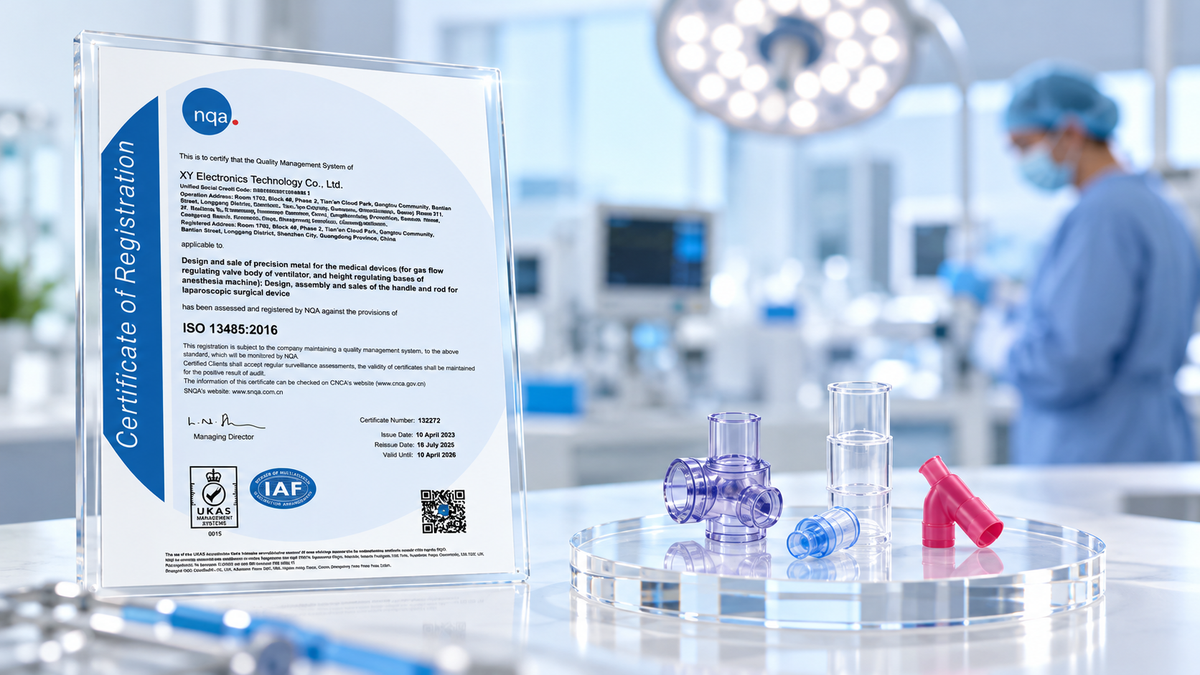
This is where ISO 13485 provides value. It is an international quality management standard developed for organizations involved in medical devices and related manufacturing. However, for buyers, the important question is not simply whether a supplier has the certificate, but what the system changes in day-to-day production.
The answer is process discipline.
Under an ISO 13485 quality system, drawings, specifications, work instructions, inspection documents, and production records are controlled. Changes cannot simply be made on the shop floor because they appear convenient.
If a resin grade changes, a mold is modified, or a critical process parameter is adjusted, the effect on the product may need to be evaluated and documented.
Material traceability is another important part.
A supplier working under this framework should also have defined procedures for production changes, inspection requirements, supplier control, non-conforming parts, and corrective actions.
For medical device manufacturers, this reduces uncertainty during supplier qualification, product transfer, and ongoing production.
In simple terms, ISO 13485 is not just about making a medical plastic part correctly once. It is about having a controlled system that helps make the same part correctly, consistently, and traceably from batch to batch.

Common Medical Injection Molding Technologies
Standard thermoplastic injection molding covers a large part of medical plastic production, but many devices need more specialized molding methods.
The right process depends on what the part has to do.
Overmolding
Overmolding combines two materials into one finished part.
A rigid plastic substrate may first be molded and then covered in selected areas with a softer material such as TPE.
This is useful for medical products that need a soft grip, sealing surface, impact protection, or more comfortable contact with the user.
Overmolding can also reduce assembly work because the soft component does not need to be manufactured and installed separately.
Insert molding
With insert molding, another component is placed into the mold before plastic is injected around it.
The insert may be a metal pin, thread, electrical contact, bushing, magnet, or other functional element.
This process is common where a medical device needs both plastic insulation and a strong metal interface.
It can be used for electrical connectors, sensor components, threaded mounting features, and some surgical instrument parts.
Insert molding can reduce the need for later press fitting or adhesive assembly. However, the insert must be positioned consistently, and molding pressure must not move or damage it.
Two-shot and multi-shot molding
Two-shot molding uses more than one material or resin in one coordinated molding process.
A common combination is a rigid plastic body with a softer sealing or grip feature.
It can also be used for color coding.
This is useful in medical products where different colors help distinguish sizes, functions, or device types.
Compared with conventional overmolding, two-shot molding can provide higher automation and repeatability at high production volumes. The trade-off is more complex tooling and equipment.
Liquid silicone rubber molding
Liquid silicone rubber, or LSR molding, is widely used for flexible medical components.
Examples include seals, valves, flexible interfaces, respiratory components, and wearable medical parts.
Silicone performs well where flexibility, temperature resistance, and repeated sterilization are important.
LSR requires different processing equipment from standard thermoplastic injection molding. Tool sealing, flash control, material dosing, and temperature management also become more important.
Not every plastic injection molding supplier has this capability, so it should be confirmed early if silicone is part of the device design.
Thin-wall molding
Medical diagnostic products and cartridges often contain thin plastic sections.
Thin-wall molding helps reduce weight and material use, but it creates tighter processing requirements.
Molten resin needs to fill the cavity quickly before it cools.
Gate position, venting, injection speed, mold temperature, and material flow properties all become more sensitive.
A wall that is easy to mold at 2 mm thickness may behave very differently at 0.5 mm.
This is one reason DFM and mold flow review are especially useful for thin medical plastic components.
Multi-cavity molding
High-volume medical products often use multi-cavity tooling.
Instead of molding one component per cycle, the mold produces several identical components at the same time.
The benefit is obvious: output increases. The challenge is keeping every cavity consistent.
Cavity 1 should not produce a slightly different part from cavity 8.
Runner balance, temperature, cooling, venting, tool wear, and inspection planning all need to account for cavity-to-cavity variation.
Micro Injection Molding for Medical Components
As medical devices become smaller, micro injection molding is increasingly used for components with tiny holes, thin flow channels, micro-textures, miniature clips, and other fine features.
Compared with conventional molding, micro molding requires much tighter control over shot volume, melt temperature, mold accuracy, gate design, and venting. At this scale, even a small process variation can lead to short shots, flash, dimensional changes, or incomplete micro features.
Tooling also becomes more demanding. Depending on the geometry, micro features may require precision EDM, micro machining, laser processing, or very controlled polishing.
Inspection is another challenge. Many features are too small for conventional gauges, so optical measurement, vision systems, or microscopes may be needed to verify critical dimensions.
For medical applications, successful micro injection molding therefore depends on the entire production process, from molding, tooling, and part handling to inspection, and process consistency.

Common Plastic Materials for Injection Molding Medical
There is no single "medical plastic."
Different devices place very different demands on the material.
A disposable diagnostic part may need low cost and chemical resistance. A reusable component may need to withstand repeated heat or chemical sterilization. A housing may need transparency and impact resistance.
The following materials are common starting points:
| Material | Useful Properties | Typical Medical Uses |
| PP | Chemical resistance, low density, good cost efficiency | Disposable components, containers, lab parts |
| PC | Strength, impact resistance, transparency | Device housings, diagnostic components |
| POM | Dimensional stability, low friction, wear resistance | Precision mechanisms, moving parts |
| PE | Chemical resistance, toughness | Containers, disposable and fluid-related parts |
| PEI | High heat resistance and sterilization resistance | Reusable medical components |
| PPS | Heat and chemical resistance, dimensional stability | High-performance device parts |
| PEEK | High strength, chemical resistance, high-temperature performance | Demanding medical and laboratory components |
| TPE / TPU | Flexibility and soft-touch properties | Seals, grips, wearable components |
Material selection should also consider the actual sterilization method.
Gamma radiation, ethylene oxide, autoclave steam, and chemical sterilization can affect plastics differently.
The resin should also come from a stable supply source.
Changing to an "equivalent" material later may not be as simple as it sounds if the product has already been validated with a specific grade.
For medical production, long-term material availability can be just as important as initial material price.
Where Medical Injection Molding is Used
The application range is broad, which is one reason medical injection molding has such a large role in healthcare manufacturing.
Diagnostics and IVD
Common parts include diagnostic cartridges, test housings, microfluidic components, reagent-related parts, and point-of-care devices.
These products may require thin walls, fine internal channels, transparent materials, or tight assembly features.
Drug delivery
Injection molded plastics are used in inhalers, injectors, dosage systems, housings, caps, and device interfaces.
Material compatibility and repeatability are particularly important where the molded part interacts with a drug delivery mechanism.
Surgical and procedural products
Handles, housings, clips, connectors, instrument components, and disposable accessories are common examples.
Some of these parts use overmolding or insert molding to combine multiple functions.
Wearable medical devices
Wearable products often require lightweight housings, sensor covers, soft-touch surfaces, and components designed for long contact with the user.
Laboratory products
Injection molding is widely used for trays, cartridges, containers, holders, pipetting-related components, and other disposable laboratory products.
Medical equipment
Larger diagnostic and monitoring systems also use molded housings, internal brackets, covers, connectors, and other plastic components.
From DFM to Production: How a Medical Injection Molding Project Works
A reliable medical molding project starts well before the injection molding machine begins running.
The first stage is usually a design and manufacturability review.
Engineers look at wall thickness, draft angles, undercuts, ribs, bosses, gate locations, tolerance requirements, material choice, and assembly interfaces. Some design issues that look minor in CAD can become expensive once a mold has been built.
A sharp internal feature may be difficult to tool. An unnecessarily thick section may create sink marks. A badly positioned gate may leave a weld line across a functional area.
Fixing these problems before tooling is much easier.
Mold flow and tooling development
For more demanding parts, mold flow analysis can help predict how the material will fill the cavity.
The analysis may show possible weld lines, air traps, pressure imbalance, incomplete filling, or areas likely to warp after cooling.
This information can be used to adjust the gate, runner, cooling system, or part design before steel is cut.
The tooling stage then turns the approved design into a production mold.
Depending on volume, material, part size, and required mold life, the tool may use different steels, inserts, cooling layouts, hot runners, or multi-cavity configurations.
The first molded parts are rarely the end of the process.
Trial runs are used to check dimensions, appearance, filling behavior, ejection, shrinkage, and assembly fit. The mold or process may need further adjustment before production is released.
This is normal.
Medical molding is not about trying to avoid every tooling adjustment. It is about making those adjustments in a controlled way and documenting what changed.
Design Considerations for Medical Injection Molded Parts
Injection molding works best when the part is designed for the process.
That does not mean every wall must be simple or every shape must be easy. Medical products can still be complex. But the geometry should reflect how molten plastic fills, cools, shrinks, and leaves the mold.
Wall thickness is one of the first areas to check: Large changes in thickness can lead to uneven cooling, sink marks, internal stress, and warpage. A more uniform wall is usually easier to control.
Ribs are often a better way to add stiffness than simply making a wall thicker.
Draft that can make a large difference: Vertical surfaces normally need enough draft to release from the tool without excessive drag or surface damage.
Gate location also deserves early attention: A gate influences how the cavity fills and where weld lines appear. Putting a weld line across a sealing surface, snap feature, optical area, or other critical region can create unnecessary risk.
Tolerance should also be applied carefully: Medical parts can require tight dimensions, but making every dimension extremely tight increases tool cost, inspection time, and production risk.
The better approach is to identify CTQ features — the dimensions that actually control assembly, sealing, motion, fluid flow, or device performance.
When Injection Molding Isn't the Best Process for Medical Parts
Though plastic injection molding has major advantages, but it is suitable for all medical components. So it's important to choose according to the specific needs.
If a company needs five prototypes next week and expects the design to change three more times, building a production mold may not make sense.
CNC machining or 3D printing may be faster and cheaper at that stage.
| Project situation | Process that may make more sense |
| Early plastic prototype, design still changing | CNC machining or 3D printing |
| Low-volume plastic production | CNC, bridge tooling or injection molding depending on quantity |
| Stable plastic design with growing volume | Injection molding |
| Very small, complex metal component at volume | MIM |
| Precision metal mechanism | CNC machining |
| Large metal enclosure | Sheet metal fabrication |
| High-volume die-cast metal housing | Die casting |
This is one advantage of working with a multi-process manufacturer. And luckily, XY-GLOBAL is exactly the kind of one-stop solution provider with various manufacturing and secondary processes.
How to Choose an ISO 13485 Injection Molding Supplier
A supplier should be evaluated on more than machine size and mold price.
Start by checking the ISO 13485 certificate carefully.
Make sure the certificate is current and understand what site and activities are covered.
Then look at relevant manufacturing experience.
A supplier that has molded large consumer housings may be very good at injection molding, but that does not automatically mean it has experience with a thin-wall IVD cartridge, a microfluidic feature, or a high-performance medical polymer.
Tooling capability also matters.
Ask who designs the mold, who builds it, how mold changes are controlled, and how tool maintenance is recorded.
For medical production, the relationship between tooling and molding should be clear.
Validation and quality support are just as important.
The supplier should be able to explain how it controls materials, production records, nonconforming parts, engineering changes, and inspection.
For projects that need IQ/OQ/PQ or other validation support, this should be discussed before tooling begins.
Finally, look at scale.
Some suppliers are excellent at making samples but struggle when production increases.
Others are set up for mass production but are not flexible during product development.
For many medical device companies, the best partner is one that can support design review, prototypes, tooling, validation, and repeat production without forcing the project to change suppliers at every stage.
XY-GLOBAL: Trusted Manufacturer for ISO 13485 Medical Injection Molding
Founded in 2010, XY-GLOBAL has more than 15 years of injection molding and precision manufacturing experience. We are certified to ISO 9001:2015 and ISO 13485:2016, providing a controlled quality framework for medical production.
For medical plastic components, our team can support DFM review, material selection, mold development, injection molding, inspection, and production control. We work with customers from early design evaluation through mass production, helping identify manufacturability issues before they become costly tooling or production problems. We also
Our goal is not simply to produce parts that meet the drawing once, but to maintain consistent quality and traceability from batch to batch. Plus, we also support medical manufacturing with CNC machining, die casting, MIM, sheet metal fabrication, etc.
If you are developing a medical plastic component, send us your 2D/3D drawings, material requirements, and expected quantity. Our team can review the project and provide DFM feedback and a suitable molding solution.
Conclusion
Injection molding works well for medical devices because it can combine repeatability, complex geometry, material flexibility, and efficient production at scale.
But medical molding needs more control than ordinary plastic production. From molds to stable production, everything needs to be under strict control.
ISO 13485 provides a quality framework for managing those requirements.
For product teams, the best time to address them is before tooling begins.
A good supplier should not simply accept the drawing and build a mold. It should help identify manufacturing risks, choose a realistic process, plan the tooling around expected volume, and support the project as it moves from development into repeat production.
If you are developing a medical plastic component, send us your 2D/3D drawings, material requirements, expected quantity, and other project details. Our team can review the design, provide DFM feedback, and manufacture the parts with consistent quality from prototype to production.
FAQs for ISO 13485 Plastic Injection Molding
1. Can I make prototypes before paying for an injection mold?
Yes. CNC machining or 3D printing can be useful for checking dimensions, assembly, and basic function while the design is still changing. Once the geometry becomes stable, tooling can begin.
2. How long does a medical injection mold take to build?
It depends on mold size, part complexity, cavity count, mold steel, runner system, and validation requirements. A simple single-cavity tool can be much faster than a high-volume multi-cavity mold, so lead time should be confirmed after DFM.
3. Can an existing mold be transferred to XY-GLOBAL?
In many cases, yes. The mold should first be inspected for condition, dimensions, cooling, runner design, wear, maintenance history, and compatibility with the available molding equipment.
4. What inspection documents can be provided?
Documentation depends on project requirements and can be agreed before production. Typical examples include dimensional inspection reports, first-article reports, material certificates, batch inspection records, and other agreed quality documentation.
5. What happens if my design changes after the mold is built?
The tool is reviewed first to see whether the change can be made through an insert or local modification. Larger changes may require more extensive rework or a new tool. For medical projects, the related drawing and process changes should also follow the applicable change-control procedure.
6. Can molded parts be assembled or processed after molding?
Yes. Depending on the project, secondary work may include assembly, ultrasonic welding, printing, marking, inspection, or custom packaging. These requirements are better discussed before mold design because they can affect the molded geometry.


Share:
Ductile Cast Iron CNC Machined Parts: Material Grades, Machining Process and Tolerance Control
Which CNC File Types Should You Send for an Accurate Quote?