


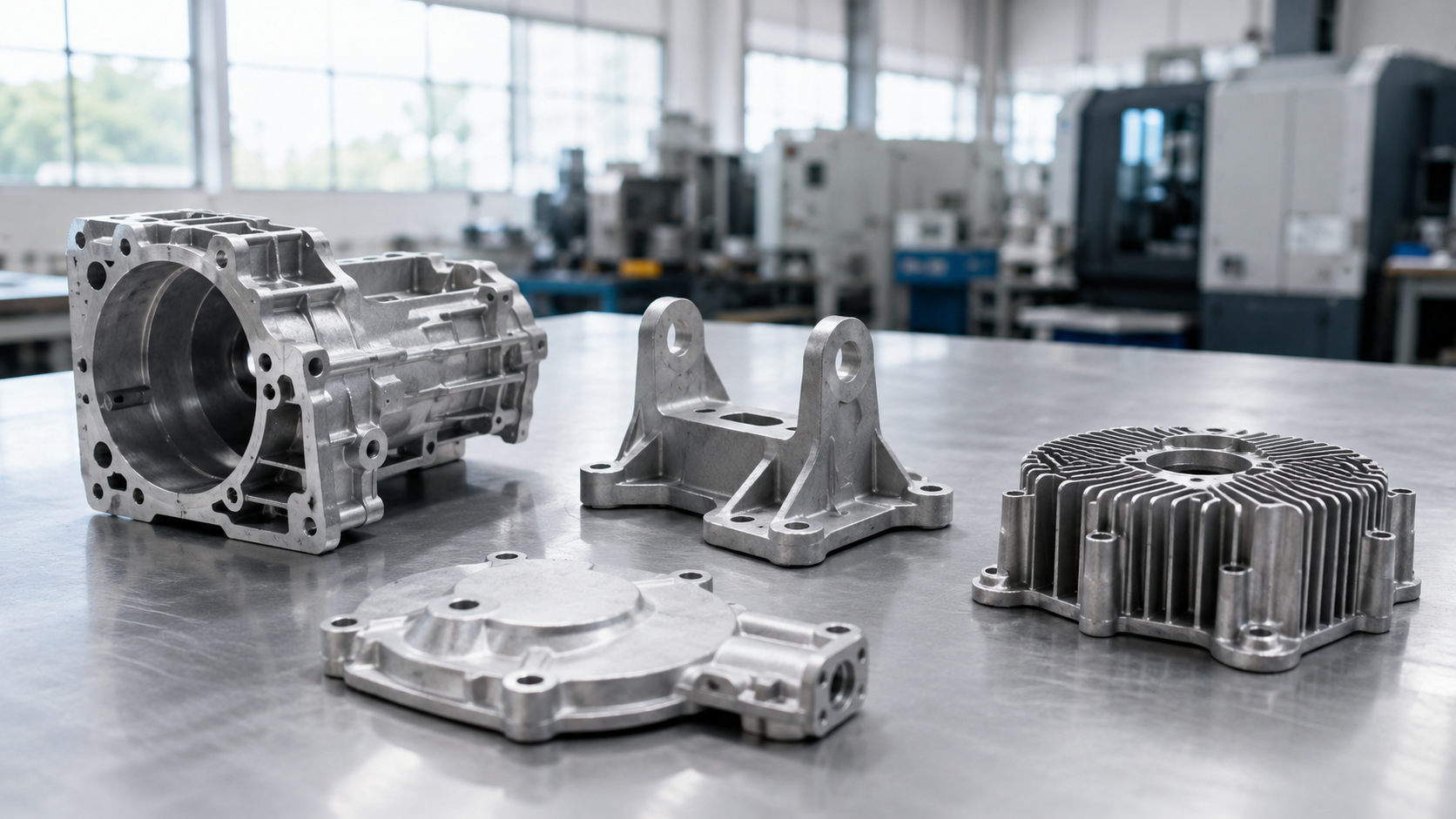
Custom aluminum die casting is a practical manufacturing choice when a product requires complex geometry, stable repeatability, lightweight strength, and cost-efficient volume production. It is widely used for housings, brackets, covers, motor parts, heat dissipation structures, optical mounts, and mechanical components.
Unlike CNC machining, aluminum die casting can form near-net-shape parts with thin walls, ribs, bosses, mounting features, and complex external profiles in one molding process. For medium-to-high volume projects, this can reduce machining time, material waste, and unit cost.
However, a good die cast part does not start from the casting machine. It starts from the drawing.
Wall thickness, draft angle, ribs, bosses, parting line, ejector marks, machining allowance, and surface finishing requirements all affect the final quality and cost.
At XY-GLOBAL, we support custom aluminum die casting parts from DFM review and mold design to casting, CNC post-machining, surface finishing, inspection, and shipment.

When Is Aluminum Die Casting the Right Choice?
Aluminum die casting is suitable when the part needs a balance of strength, weight, shape complexity, and production efficiency.
It is often selected for parts that would be too expensive to machine completely from solid aluminum, especially when the annual demand reaches thousands of pieces or more. Once the die casting mold is completed, the process can produce parts with consistent shape, repeatable dimensions, and lower unit cost compared with full CNC machining.
Typical suitable parts include:
| Part Type | Why Die Casting Works |
|---|---|
| Housings and enclosures | Complex shape, thin walls, mounting features, and surface finishing needs |
| Brackets and supports | Good strength-to-weight ratio and repeatable batch production |
| Motor covers and end caps | Stable geometry, mounting holes, and post-machined interfaces |
| Optical mounts and frames | Lightweight structure with CNC-machined critical surfaces |
| Heat dissipation parts | Integrated fins, ribs, and larger surface area |
| Automotive and robotic components | Strength, production efficiency, and cost control |
For low-volume prototypes, CNC machining may be faster and more flexible. For parts that require high repeatability and lower unit cost at scale, aluminum die casting is usually more suitable.
Common Aluminum Die Casting Alloys
Material selection affects castability, strength, corrosion resistance, machinability, and surface finishing results. The most common aluminum die casting alloys are not always the same as CNC machining alloys such as 6061 or 7075.
| Alloy | Main Features | Common Applications |
|---|---|---|
| ADC12 | Good castability, stable flow, suitable for complex shapes | Housings, covers, brackets, industrial parts |
| A380 | Common die casting alloy with good mechanical properties | Automotive parts, electronic housings, mechanical components |
| A383 | Better die filling performance than A380 in some complex molds | Thin-wall parts, complex housings |
| AlSi9Cu3 | Good casting performance and strength | Structural parts, machinery components |
| 6061 Aluminum | Common for CNC machining, not typical for high-pressure die casting | Machined prototypes, CNC post-machined parts |
For most custom aluminum die casting projects, ADC12, A380, and similar Al-Si alloys are commonly used because they offer good fluidity, stable mold filling, and practical mechanical performance.
If the part needs high cosmetic requirements, corrosion resistance, painting, powder coating, or CNC post-machining, material selection should be reviewed together with the finishing process.
 Key Design Factors Before Mold Making
Die casting quality is strongly affected by part design. A small design issue can lead to porosity, shrinkage, flash, warpage, poor surface quality, or higher machining cost.
Before mold making, XY-GLOBAL reviews the drawing and 3D model to check the following areas.
| Design Area | Recommendation |
|---|---|
| Wall thickness | Keep wall thickness as uniform as possible. Sudden thick-to-thin transitions increase shrinkage and porosity risk. |
| Ribs | Use ribs to improve strength instead of increasing the entire wall thickness. |
| Draft angle | Add draft where possible to help part ejection and reduce mold wear. |
| Internal corners | Add radii to improve metal flow and reduce stress concentration. |
| Bosses | Avoid overly thick bosses. Thick bosses may cause shrinkage or internal porosity. |
| Parting line | Confirm early because it affects appearance, flash position, and machining requirements. |
| Ejector marks | Avoid placing ejector marks on cosmetic or sealing surfaces. |
| Critical surfaces | Mark areas that require CNC machining after casting. |
| Threaded holes | Functional threads are usually created by tapping or inserts after casting. |
| Surface finish | Confirm painting, powder coating, plating, or conversion coating requirements before tooling. |
A well-designed die cast part can reduce tooling modification, improve production stability, and lower total cost.
Tolerance, Surface Finish, and CNC Post-Machining
Die casting can produce consistent near-net-shape parts, but not every dimension should be treated as a precision machined feature.
As-cast tolerances depend on part size, alloy, mold design, shrinkage behavior, and feature location. General die cast dimensions usually have wider tolerance than CNC machined features. For critical mounting faces, bearing seats, sealing surfaces, threaded holes, or precise hole positions, CNC post-machining is normally required.
| Feature Type | Typical Process |
|---|---|
| External shape | Formed by die casting |
| Ribs and bosses | Formed by die casting |
| Mounting face | CNC machining if flatness or precision is required |
| Threaded holes | Drilling and tapping after casting |
| Bearing seat | CNC boring or finishing |
| Sealing surface | CNC machining to control flatness and roughness |
| Critical hole position | CNC drilling or reaming |
| Cosmetic surface | Casting surface plus polishing, blasting, painting, or coating |
For many die cast aluminum parts, a practical process is:
Die casting for the main shape + CNC machining for critical interfaces + surface finishing for protection or appearance.
This approach keeps the cost advantage of die casting while improving precision where it matters.
From Mold Design to Mass Production
A stable aluminum die casting project requires more than a mold. It requires a controlled process from design review to production validation.
At XY-GLOBAL, a typical project follows this workflow:
| Step | What We Review |
|---|---|
| Drawing and 3D model review | Geometry, tolerance, wall thickness, draft, ribs, bosses, critical surfaces |
| DFM feedback | Mold feasibility, parting line, ejector marks, machining allowance, finishing risk |
| Mold design | Gate, runner, venting, cooling, ejection, shrinkage compensation |
| Tooling production | Mold machining, electrode work, fitting, polishing, trial preparation |
| T0 / trial samples | Initial casting quality, dimensions, surface defects, machining areas |
| CNC post-machining | Critical holes, mounting faces, threads, sealing surfaces |
| Surface finishing | Painting, powder coating, conversion coating, blasting, or other treatments |
| Inspection | Dimensional checks, surface inspection, CMM if needed |
| Batch production | Process control, defect control, packaging, and shipment |
For new projects, trial samples are important because they help verify mold performance, shrinkage, parting line quality, machining allowance, and surface finishing results before mass production.

What to Provide Before Requesting a Quote
A complete RFQ helps reduce back-and-forth communication and improves quotation accuracy.
| Information | Why It Matters |
|---|---|
| 2D drawing | Defines dimensions, tolerance, threads, surface finish, and inspection requirements |
| 3D model | Helps review geometry, mold feasibility, tool access, and parting line |
| Annual volume | Determines whether die casting is cost-effective compared with CNC machining |
| Aluminum alloy | Affects casting performance, strength, machining, and finishing |
| Surface finish | Determines painting, powder coating, blasting, conversion coating, or plating needs |
| Critical dimensions | Helps identify areas that need CNC post-machining |
| Application environment | Helps review strength, corrosion, heat, sealing, and assembly requirements |
| Cosmetic standard | Important for visible housings or customer-facing products |
| Inspection requirements | Helps plan CMM, FAI, visual inspection, and batch quality control |
If the part is still in the design stage, XY-GLOBAL can review the drawing and provide DFM suggestions before mold making.
Work With XY-GLOBAL for Custom Aluminum Die Casting Parts
Custom aluminum die casting is not only about producing a metal shape. It is about designing a manufacturable part, building a stable mold, controlling casting defects, machining critical features, and finishing the part according to real application requirements.
XY-GLOBAL supports aluminum die casting projects for housings, brackets, covers, structural parts, optical mounts, robotic components, medical equipment parts, and industrial assemblies.
Our team can help with DFM review, mold design, die casting production, CNC post-machining, surface finishing, inspection, and shipment from Shenzhen, China.
If you are developing a new aluminum die cast component or improving an existing part, send us your drawing, 3D model, material requirement, quantity, and surface finish standard. Our engineering team will review the project and provide practical manufacturing feedback.


Share:
CNC Laser Optics Components: Precision Machining for Optical Systems
CNC Optical Part Prototype for Precision Optical Device Development