


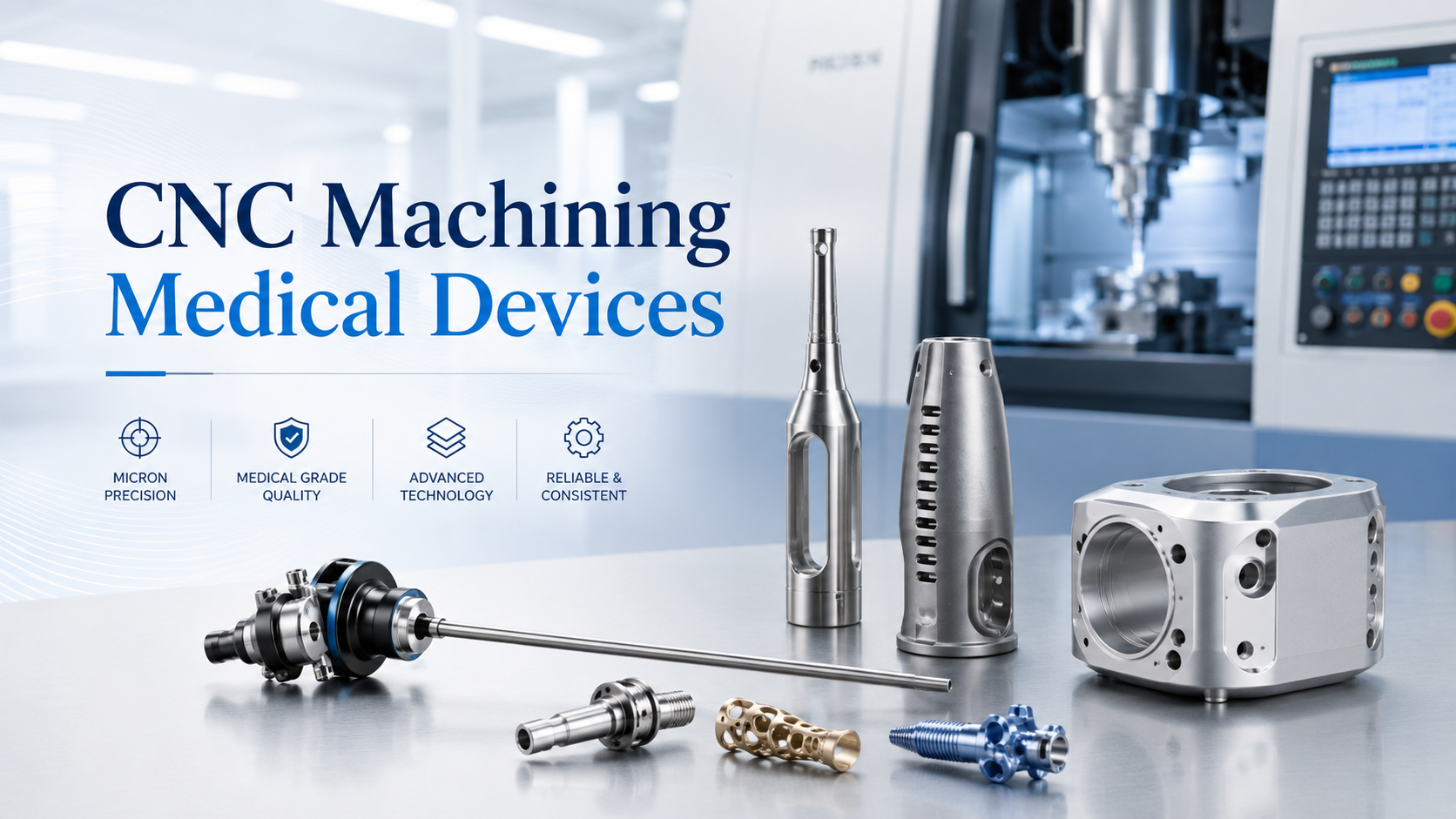
In medical device manufacturing, even the smallest details—such as burrs, thread quality, surface finish, and dimensional stability—can impact assembly, testing, and overall product performance. That’s where CNC machining comes in. A reliable way to produce small, complex medical parts with high precision and consistent quality.
With over 15 years of experience in CNC machining, XY-GLOBAL delivers high-precision medical components and custom solutions to meet strict industry requirements, delivering accurate, reliable, and high-quality parts you can depend on.

Why CNC Machining Is Used in Medical Device Manufacturing
CNC machining is widely used in medical device manufacturing because it allows us to produce precise, repeatable parts from both metals and engineering plastics.
Medical components often require accurate holes, smooth edges, flat mounting surfaces, clean finishes, and stable dimensions. With CNC machining, we can keep all these features under control and maintain good consistency—especially for prototypes, small batches, and high-precision metal parts.
It’s also very flexible during product development. Most medical projects go through several design changes before reaching the final version. Since CNC machining doesn’t require hard tooling, we can quickly support R&D samples, functional prototypes, EVT/DVT builds, as well as small-to-medium volume production.
For parts with multiple precision features or hard-to-reach areas, 5-axis CNC machining helps us reduce repeated setups and improve access during machining. This is especially important for small medical components, where even a slight change in setup can affect alignment, positioning, or surface consistency.

CNC Machining Medical Devices: Common Applications & Parts
CNC machining is used a lot in making medical devices. We can make all kinds of parts — from surgery tools to testing equipment and electronic parts.
Surgery and Minimally Invasive Systems
This covers small surgery devices, endoscope systems, surgery robots, implant parts, and needle systems. We usually make small metal parts, handles, connectors, lens holders, sleeves, joint pieces, and other precise parts.
Medical Equipment and Testing Systems
This includes testing machines, medical imaging systems, and lab equipment. Common parts we make are mounts, brackets, frames, housings, positioning plates, and optical-mechanical parts.
Wearable and Medical Electronics
This covers wearable medical devices and medical electronic products. We mainly make small cases, covers, sensor housings, heat sinks, and shielded housings.
At XY-GLOBAL, we have lots of experience making precise medical device parts, including minimally invasive surgical device parts, endoscope system parts, surgical robot components, implant-related parts, and puncture needl parts.
These parts need very tight tolerances and consistent quality in large batches - and that's exactly what we're best at.
For example, in one project, a customer asked us to make parts for a puncture needle system using stainless steel. The challenge was drilling micro-holes with a tight tolerance of ±0.01mm and ensuring all edges were 100% burr-free. We optimized our CNC process to achieve a stable surface finish and provided full inspection reports before shipping. The customer was impressed that every part in the batch met the high-precision requirements perfectly.
Materials for Medical Device CNC Machining
| Material | Key Characteristics | Typical Parts |
| Stainless Steel | Very strong and doesn't rust easily | Surgical instruments, structural parts, corrosion-resistant components |
| Titanium | Super light, strong, and safe for the body | Lightweight, high-strength, implant-related or performance-critical parts |
| Aluminum | Lightweight, easy to machine, and great for anodizing | Medical equipment housings, covers, brackets, non-implant parts |
| PEEK & Plastics | Excellent chemical resistance, lightweight, and insulating | High-performance plastic parts with chemical resistance |
| Brass & Copper | High electrical conductivity and natural antimicrobial propertie | Electrical or functional components when needed |
Critical Features to Control in Medical CNC Parts
Medical CNC nachined parts usually need more than just basic accuracy. The key is to figure out which features really matter for assembly, function, cleaning, and long-term use.
These are often called “ critical-to-quality features” (CTQ). Common examples include locating holes, threaded holes, sealing surfaces, bearing holes, mating surfaces, flat mounting areas, alignment (like coaxiality and perpendicularity), and surface finish.
Not every dimension needs to be super tight. Making everything too precise can increase cost, machining time, and inspection difficulty. A good manufacturing review helps decide which features need high precision and which can use standard tolerances.
For important features, XY-GLOBAL can achieve tolerances as tight as ±0.001 mm, depending on the part design, material, and machining process. For high-precision medical or optical parts, we can also provide CMM inspection, first article inspection, and detailed inspection reports based on customer needs.
Surface Finish and Burr Control for Medical CNC Parts
Surface finish and burr control are very important in medical CNC machining. Even small burrs, sharp edges, tool marks, or leftover particles can affect assembly, handling, cleaning, and overall performance.
When we machine medical CNC parts, we often include finishing steps like deburring, edge breaking, polishing, bead blasting, passivation, anodizing, or electropolishing, depending on the material and how the part will be used.
We always suggest confirming these requirements before production, because surface finishing can affect dimensions, appearance, masking areas, and even inspection standards. For example, anodizing can change coating thickness on aluminum parts, while stainless steel parts may need passivation to improve corrosion resistance.
At XY-GLOBAL, we review surface finish, burr control, and cleaning requirements together with the drawings, materials, tolerances, and inspection plans. This helps us avoid issues during assembly, testing, and final use.
Custom Medical Device CNC Machining from Prototype to Production
Custom medical device CNC machining often starts with a customer drawing, 3D model, or early-stage product design. At this stage, the part may still need design changes, material confirmation, tolerance review, or surface finish planning.
CNC machining is useful for medical device development because it allows engineers to test real metal or plastic parts without mold investment. This makes it suitable for prototypes, functional samples, small batches, and design validation.
For custom medical CNC parts, the key is not only to machine the shape. The supplier should also review critical features such as holes, threads, sealing surfaces, mounting faces, thin walls, burr-sensitive edges, and surface finish requirements.
At XY-GLOBAL, we support custom CNC machined parts for medical devices, medical equipment, endoscope-related systems, minimally invasive surgical components, surgical robot parts, puncture needle-related components, wearable medical products, and precision assemblies.
When the design becomes stable, we can help move the project from prototype machining to small-batch or production preparation. This may include DFM review, CNC machining, 5-axis machining when needed, surface finishing, CMM inspection, first article inspection, and dimensional reports based on customer requirements.
How to Choose a CNC Machining Supplier for Medical Devices
When choosing a CNC machining supplier for medical devices, price shouldn’t be the only factor. A reliable supplier should understand medical part requirements, not just general machining. It’s helpful to evaluate them from these four key areas:
Medical quality system
The supplier should have a proper quality system, such as ISO 9001 or ISO 13485. This helps ensure controlled processes and consistent quality, especially for medical-related parts and repeat production.
Engineering review ability
A good supplier should be able to review drawings before production, understand critical features (CTQ), and identify potential risks early. Clear DFM feedback at this stage helps prevent problems, not just fix them later.
Machining and finishing capability
The supplier should be able to handle precision parts, including small and complex components. Support for 5-axis CNC machining and various surface treatments is important, as well as the ability to maintain stable quality from prototype to batch production.
Inspection and communication support
They should be able to provide inspection reports, such as dimensional or CMM reports, and communicate clearly throughout the project. This ensures better quality control, traceability, and smoother project progress.
Why XY-GLOBAL Rocks for Custom Medical CNC Machining?
XY-GLOBAL operates under ISO 9001:2015 and ISO 13485:2016 quality management systems, supporting controlled and reliable manufacturing for custom medical parts. Based on different designs and application needs, we provide flexible machining solutions. For critical features, we can achieve CNC machining tolerances down to ±0.001 mm, depending on part design, material, geometry, machining process, and inspection method.
With more than 40 sets of 5-axis CNC machines, we are able to handle complex, custom medical parts that require multi-face machining, curved surfaces, angled features, fine details, and tight dimensional control.
We also support DFM review, surface finishing, CMM inspection, first article inspection, and detailed dimensional reports based on customer requirements. From prototyping to batch production, we focus on delivering customized solutions while maintaining stable quality and clear communication throughout the process.

Conclusion: Making Medical CNC Parts Ready for Real Use


Share:
Custom Optical Design: Why Precision Opto-Mechanical Parts Matter
Precision CNC Machined Housings for Custom Components