


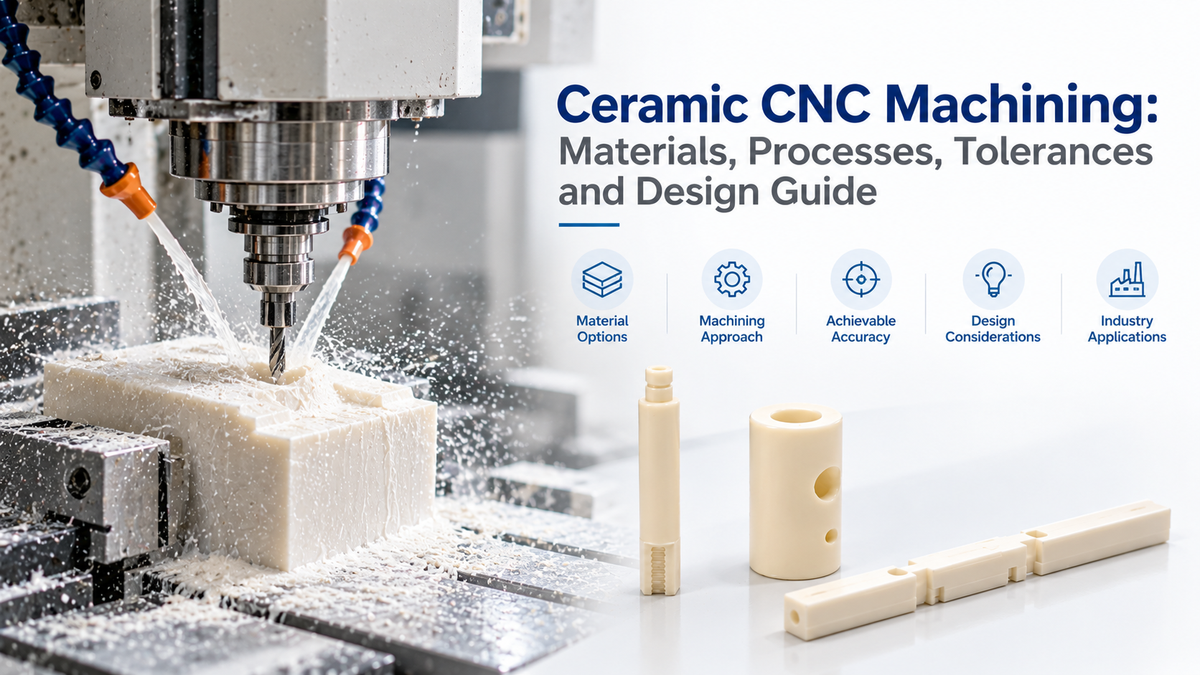
Here is the thing: ceramic parts are being used more often in applications where metals and plastics start reaching their limits. However, ceramics are naturally hard and brittle, which makes them more difficult to manufacture and more vulnerable to chipping or cracking during machining.
Ceramic CNC machining is one of the most practical ways to produce precise and complex ceramic parts.
In this blog post, we will focus on how ceramic CNC machining works, which ceramic materials can be machined, what tolerances and surface finishes are realistic, and what engineers should consider when designing ceramic parts.

What Is Ceramic CNC Machining?
Ceramic CNC machining is a subtractive manufacturing process used to shape technical ceramics with computer-controlled equipment.
Depending on the material state and the feature being produced, the actual manufacturing method may include CNC milling, drilling, diamond grinding, slicing, lapping, or polishing. It is particularly useful to produce ceramic components below:
-
prototypes and low-to-medium production quantities;
-
ceramic parts with complex or custom geometry;
-
precision bores, datum surfaces, sealing surfaces, and locating features;
-
parts that need tighter dimensions than an as-sintered process can reliably provide;
-
applications where tooling investment for CIM or pressing is not justified.
Ceramic CNC machining can also be combined with molded or pressed ceramic production. A part may be formed close to its final shape first, then selectively ground or machined after sintering only where tighter tolerances are required.

Green, Bisque and Fully Sintered Ceramic Machining
One of the most important decisions in cnc machining for ceramics is when the material should be machined.
There are generally three stages where material removal may take place:
-
the green state;
-
a partially sintered or bisque state;
-
the fully sintered state.
Each one involves a different balance between machining cost and dimensional certainty. You can read the comparison table for an overview.
| Factor | Green Ceramic | Bisque (Pre-Sintered) | Fully Sintered Ceramic |
| Material hardness | Low | Medium | Very high |
| Material removal | Fast | Relatively fast | Slow |
| Typical tooling | Conventional / carbide | Carbide / abrasive | Diamond tools and wheels |
| Tool wear | Low | Moderate | High |
| Dimensional certainty | Low | Medium | High |
| Sintering shrinkage afterward | Yes | Yes | No |
| Best suited for | Bulk removal, rough profiles, pockets | Holes, profiles, semi-finished features | Critical fits, datums, bores and surfaces |
Green Machining
Green ceramic contains powder and binder but has not yet reached full density.
Because it is much softer, large pockets, profiles, holes, and other features can often be produced relatively quickly.
The trade-off is shrinkage.
Ceramic components may contract significantly during sintering, and the exact amount depends on material composition, powder characteristics, forming conditions, furnace process, and part geometry. Published shrinkage values can be useful as a rough reference, but final tooling and machining compensation should be based on validated process data rather than a generic number.
This makes green machining excellent for removing bulk material but less suitable for features that require final micron-level dimensional control.
Bisque Machining
Bisque or partially sintered ceramic sits between the two extremes.
It is stronger than a green body, making it easier to handle and more suitable for features that could be damaged during green machining, while still being much easier to machine than fully sintered material.
This stage can be useful for holes, channels, cross-features, and other geometry that would be difficult or expensive to produce later.
Hard Machining After Sintering
After full sintering, the material has reached its final density and hardness.
Now the dimensions are much more stable, but machining becomes slower and more expensive.
Diamond grinding, lapping, and polishing are commonly used for critical features such as:
-
locating datums;
-
precision bores;
-
sealing surfaces;
-
controlled thickness;
-
flatness;
-
parallelism;
-
tight outside diameters;
-
fine surface-finish requirements.
A practical ceramic manufacturing strategy is therefore to remove as much non-critical material as possible before full sintering, then reserve expensive hard machining for surfaces that actually affect function.
Common Ceramic CNC Machining Processes
Ceramic CNC machining covers several different manufacturing operations.
The correct process depends on whether the goal is to generate geometry, produce holes, control flatness, or achieve a very fine final surface.
CNC Milling
CNC milling can produce pockets, profiles, slots, contours, and other three-dimensional features.
It is particularly useful in the green or machinable state. For fully sintered technical ceramics, diamond-coated or abrasive tools may be required, and material removal must be carefully controlled.
Complex parts may also benefit from 4-axis or 5-axis machining because fewer setups can reduce cumulative datum errors and provide better access to angled or multi-sided features.
Ceramic Drilling
Holes are among the most challenging features in hard ceramics.
Diamond core drills and other abrasive tools are commonly used for fully sintered material. The biggest risks are often found at entry and exit edges, where brittle fracture can cause breakout.
Small holes, deep holes, and high depth-to-diameter ratios require even more attention to tooling, flushing, tool condition, and workpiece support.
Precision Grinding
For fully sintered advanced ceramics, grinding is often the most important precision process.
Diamond wheels gradually remove small amounts of material while controlling geometry, size, and surface integrity.
Surface grinding is commonly used for:
-
flat surfaces;
-
controlled thickness;
-
parallelism;
-
sealing surfaces;
-
datum faces.
Cylindrical grinding may be used for shafts, sleeves, outside diameters, and precision bores.
Fully sintered ceramics are commonly ground using controlled coolant delivery to remove swarf and stabilize temperature at the grinding zone. By contrast, green machining may be performed dry because water can affect the binder system.

Lapping
Lapping is generally used when the requirement moves beyond basic size control into very high flatness and fine surface quality.
It is useful for sealing surfaces, mating surfaces, semiconductor components, and other areas where contact performance depends on surface form.
Polishing
Polishing further reduces surface roughness and can be used where friction, sealing, cleanliness, optical behavior, or surface defects are critical.
Not every ceramic part needs polishing.
In fact, specifying a mirror finish on every surface can increase cost significantly without improving function.
The better approach is to identify the surfaces that truly require it.
Ceramic Materials for CNC Machining
A wide range of advanced ceramics can be CNC machined, but the right material depends on what the part actually needs to do.
The table below gives a practical comparison of the most common ceramic materials used in CNC machining.
| Ceramic Material | Typical Density | Hardness | Fracture Toughness | Thermal Conductivity | Machining Characteristics |
| Alumina 96–99.5% | ~3.7–3.9 g/cm³ | Up to ~1,440 HV for high-purity grades | ~3.5–4.5 MPa·m½ | ~24–30 W/m·K | Widely available; predictable diamond-grinding behavior |
| Zirconia 3Y-TZP | ~6.0–6.1 g/cm³ | ~1,200–1,350 HV | ~9–10 MPa·m½ | ~2–3 W/m·K | High toughness; better suited to thin sections and sharp edges |
| Silicon Nitride | ~3.2 g/cm³ | ~1,450–1,650 HV | ~6–7.5 MPa·m½ | ~20–30 W/m·K | Strong and tough with good thermal-shock resistance |
| Silicon Carbide | ~3.10–3.20 g/cm³ | ~2,400–2,800 HV | ~3.5–4.5 MPa·m½ | ~110–150 W/m·K | Extremely hard; slow grinding and high tool wear |
| Aluminum Nitride | ~3.26 g/cm³ | ~1,000–1,200 HV | ~2.5–3.0 MPa·m½ | ~140–180 W/m·K | Excellent thermal conductivity but relatively brittle |
| Macor | ~2.52 g/cm³ | ~250 Knoop (100 g) | ~1.5 MPa·m½ | ~1.46 W/m·K | Machinable with conventional carbide tools |
| Cordierite | ~2.0–2.6 g/cm³ | Mohs ~7; grade dependent | ~2 MPa·m½ | ~1.3–3.0 W/m·K | Very low thermal expansion and strong thermal-shock resistance |
(Typical room-temperature values; actual properties vary by grade and application. Confirm material selection and tolerances with a drawing review.)
Alumina CNC Machining
Alumina is one of the most widely used advanced ceramics.
It offers good electrical insulation, wear resistance, chemical stability, and high-temperature performance while remaining more economical than many specialized ceramic materials.
High-purity alumina is hard and abrasive, so fully sintered alumina normally requires diamond grinding for critical dimensions.
For many industrial ceramic parts, alumina offers a good balance between performance, availability, and manufacturing cost.
Zirconia CNC Machining
Zirconia is notable for its relatively high fracture toughness.
Compared with alumina, it is often more tolerant of thin walls, edges, and features that would be vulnerable to brittle fracture in less tough ceramics.
Its low thermal conductivity, however, means heat generated during grinding is removed less efficiently. Light finishing passes and stable cooling therefore become particularly important.
Zirconia is commonly considered for medical components, wear parts, precision structural components, and applications where toughness matters.
Silicon Carbide CNC Machining
Silicon carbide is extremely hard, wear resistant, thermally stable, and highly conductive compared with many other ceramics.
Those properties are useful in semiconductor, precision equipment, and high-temperature environments.
They also make SiC one of the more difficult ceramics to finish.
Material removal rates are lower, diamond wheel wear is higher, and finishing cost can become a major part of the component price.
Silicon Nitride CNC Machining
Silicon nitride combines relatively high strength, toughness, wear resistance, and thermal-shock performance.
It is used for bearings, rollers, high-speed mechanical components, and high-temperature applications.
Although still hard, its toughness can provide advantages in components exposed to mechanical shock or cyclic loads.
Aluminum Nitride CNC Machining
Aluminum nitride is often selected because it can combine electrical insulation with high thermal conductivity.
That makes it particularly important for semiconductor and power-electronics applications.
Machining requires care around edges and unsupported sections because fracture toughness is relatively low.
Machinable Glass Ceramics
Materials such as Macor behave quite differently.
They are intentionally formulated for machinability and can often be milled, drilled, and turned using conventional carbide tools.
They do not provide the same extreme hardness as alumina or SiC, but they can be a practical option for prototypes, electrical insulation, vacuum components, fixtures, and low-volume precision parts where conventional machinability has high value.
Cordierite CNC Machining
Cordierite is different from the high-hardness structural ceramics above.
Its key advantage is its very low coefficient of thermal expansion, which gives it strong dimensional stability during repeated heating and cooling.
Typical cordierite ceramic can have a coefficient of thermal expansion around 1.5–2.0 × 10⁻⁶/°C, although properties vary with formulation and process.
This makes cordierite useful for:
-
kiln components;
-
thermal fixtures;
-
heat-resistant supports;
-
insulating structures;
-
equipment exposed to thermal cycling.
When cordierite parts need custom geometry or precision mounting features, CNC machining and grinding may be used after forming or sintering.
At XY-GLOBAL, we also support advanced ceramic materials not mentioned above. If you have any need, feel free to ask us.
Applications of CNC-Machined Ceramic Parts
Technical ceramics are found in industries where conventional materials cannot easily provide the required combination of electrical, thermal, chemical, and wear performance.
Semiconductor Equipment
Ceramics are widely used in semiconductor manufacturing because many grades provide electrical insulation, thermal stability, cleanliness, wear resistance, or controlled thermal behavior.
Typical components can include:
-
precision fixtures;
-
insulating structures;
-
wafer-handling components;
-
supports;
-
vacuum-related parts;
-
thermal-management components.
Aluminum nitride and silicon carbide are particularly important where thermal behavior matters.
Medical Devices
Zirconia, alumina, and other ceramics can be used for wear-resistant or electrically insulating medical components.
Precision machining can be useful when components require small features, controlled mating surfaces, or complex geometry.
Optical and Photonics Equipment
Ceramics can provide dimensional stability and stiffness for precision optical equipment.
Machined components may include mounts, spacers, insulating elements, and precision structural components.
Aerospace and High-Temperature Equipment
Advanced ceramics can maintain useful properties under temperatures or chemical environments that are difficult for many conventional materials.
Applications include insulating components, wear parts, supports, and high-temperature structural elements.
Industrial Automation
Ceramic components are also used for:
-
guides;
-
sleeves;
-
wear plates;
-
nozzles;
-
fixtures;
-
electrical insulation;
-
high-wear moving components.
Design Considerations for Ceramic CNC Machining
A good ceramic part often starts with a good drawing.
Design decisions that are almost irrelevant for an aluminum part can make a major difference in ceramic CNC machining.
Avoid Unnecessary Sharp Internal Corners
Sharp corners concentrate stress.
That matters in brittle materials because cracks can initiate around these locations during machining, assembly, or service.
Where the function allows it, internal radii are preferable to perfectly sharp internal corners.
Add Edge Breaks Where Possible
Ceramic edges are vulnerable during machining, cleaning, inspection, transport, and assembly.
A small chamfer or radius can greatly reduce the chance of accidental chipping without changing the function of the component.
This is especially useful around:
-
outside edges;
-
hole entrances;
-
mounting surfaces;
-
thin projections.
Be Careful With Thin Walls
Thin ceramic walls are possible, but risk increases as thickness decreases and unsupported length increases.
Material also matters.
A zirconia wall may behave differently from a comparable alumina or aluminum-nitride feature because fracture toughness differs.
Instead of using one universal “minimum wall thickness,” engineers should evaluate:
-
wall length;
-
support condition;
-
ceramic grade;
-
machining direction;
-
surrounding geometry;
-
final loading.
Deep and Small Holes Need Extra Attention
Small holes combine several difficult conditions in one feature.
Tool access is limited, coolant or debris evacuation becomes harder, and breakout at the exit edge can damage the component.
Very deep holes also increase tooling and cycle-time requirements.
If the hole does not need to be deep, small, and tight-tolerance at the same time, relaxing one of those requirements can reduce manufacturing risk significantly.
Do Not Tighten Every Dimension
Here is the thing: tight tolerances should be functional.
A drawing with ±0.01 mm applied to every dimension does not automatically produce a better ceramic component. It usually produces a more expensive one.
Separate the drawing into:
-
locating dimensions;
-
sealing dimensions;
-
mating features;
-
cosmetic or non-critical geometry.
Tighten only what matters.
This allows expensive post-sinter grinding to focus on the surfaces that actually determine assembly or performance.
Specify Surface Finish by Function
The same idea applies to roughness.
Do not request mirror polishing simply because ceramic can be polished.
Instead, identify whether the surface is used for:
-
sealing;
-
sliding contact;
-
optical function;
-
wafer handling;
-
vacuum performance;
-
cosmetic appearance.
That makes the specification much easier to manufacture and quote.
Consider Tool Access
Complex geometry may require 4-axis or 5-axis machining, but even multi-axis equipment cannot ignore tool diameter, wheel shape, fixture clearance, and approach direction.
Features that cannot physically be reached will either need a redesign or a different manufacturing process.
A DFM review before production is therefore particularly useful for ceramic components.
Common Ceramic CNC Machining Problems
The most common problems are rarely random. They usually relate to brittleness, tooling condition, support, or process control.
| Problem | Typical Cause | Common Engineering Response |
| Edge chipping | Brittle fracture or unsupported edge | Improve edge support, tool path and edge geometry |
| Cracking | Excessive mechanical or thermal stress | Reduce machining load and review sequence |
| Tool wear | High material hardness | Use suitable diamond tooling and controlled dressing |
| Hole breakout | Unsupported exit edge | Improve support and drilling strategy |
| Poor flatness | Uneven stock removal or support | Controlled grinding and lapping |
| Surface defects | Worn tooling, vibration or excessive removal | Improve rigidity and finishing conditions |
| Dimensional drift | Tool wear, setup or process variation | More frequent inspection and compensation |
One issue that deserves particular attention is subsurface damage.
A ceramic surface can appear acceptable visually while still containing microcracks below the surface. These defects may later affect strength or service life, especially in highly loaded parts.
This is why precision ceramic machining is not only about achieving a number on a CMM report. Surface integrity and machining strategy also matter.
Ceramic CNC Machining vs Other Ceramic Manufacturing Methods
The right one depends largely on geometry, quantity, tooling budget, and final precision.
| Process | Tooling Investment | Geometry Flexibility | Typical Volume | Final Precision | Best Fit |
| Ceramic CNC Machining | Low | High | Prototype to medium | High | Custom precision parts |
| Ceramic Injection Molding | High | Very high | Medium to high | Good; critical areas may need finishing | Complex repeated parts |
| Pressing + Sintering | Medium | Moderate | High | Mainly controlled by forming and shrinkage | Simple repeated shapes |
| Ceramic Additive Manufacturing | Low–Medium | Very high | Low | Often requires finishing | Complex internal geometry and prototypes |
CNC machining and ceramic injection molding are not always competing processes.
They can also complement each other.
For example, ceramic injection molding may create a complex near-net-shape ceramic component in volume, while CNC grinding is used afterward on a precision bore, sealing face, or locating datum.
For lower quantities, CNC machining may avoid tooling investment entirely.
What Affects the Cost of Machining Ceramic Parts?
Ceramic machining cost mainly depends on the material, part geometry, machining stage, tolerance, surface finish, and quantity. Fully sintered materials such as silicon carbide or high-purity alumina generally require slower material removal and more diamond tooling, while thin walls, deep holes, tight tolerances, and polished surfaces add machining time and inspection requirements. For higher volumes, near-net-shape processes such as ceramic injection molding or pressing may reduce overall cost by limiting the amount of hard machining required.
Conclusion
Ceramic CNC machining is not simply CNC machining performed on a harder material.
Ceramic behavior changes how the entire process has to be planned—from material selection and machining stage to tooling, workholding, tolerance, surface finish, and inspection.
The most economical approach is often to do the heavy shaping while the ceramic is easier to process, then reserve post-sinter grinding and finishing for the surfaces that truly need precision.
For engineers, that means the drawing matters just as much as the machine.
Appropriate edge design, realistic tolerances, accessible geometry, and functional surface-finish requirements can reduce machining risk and cost without compromising performance.
Custom Ceramic CNC Machining Services at XY-GLOBAL
Founded in 2010, XY-GLOBAL stands as a trusted one-stop on-demand ceramic parts manufacturer from diverse ceramic materials with high precision, reliable performance, and consistent quliaty.
From early DFM review through precision machining and final inspection, we support custom ceramic components and offer considerate after-sales support if needed. We also boast ISO 9001:2015 and ISO 13485:2016 certifications to ensure high quality under control. If you need CNC machined ceramic prototypes or more final ceramic parts, simply send us your 2D/3D drawings, ceramic material, quantity, tolerances, and critical surface requirements. Our engineering team can review the design, recommend a practical manufacturing route for your application, and help turn your design into reality.
Frequently Asked Questions About Ceramic CNC Machining
1. What tolerances and surface finishes can you achieve?
For selected critical features, tolerances can reach micron level up to ±1 μm for special features, with mirror finishes down to Ra 0.01 μm through precision grinding, lapping, and polishing. Final capability depends on material and geometry.
2. What surface finishing options are available?
At XY-GLOBAL, we support precision grinding, lapping, polishing, coating, metallization, and other secondary processes based on the application.
3. What is the typical lead time?
Lead time depends on material, geometry, tolerance, quantity, and finishing requirements. Most projects are confirmed after drawing reviews. Fast prototypes within one week.
4. How do you inspect ceramic parts?
We use equipment such as CMM, optical measuring systems, surface roughness testers, micrometers, and other precision gauges. Inspection reports can be provided when required.
5. Do you provide DFM support and NDA protection?
Yes. Our engineering team provides DFM review before production, and we can sign an NDA to protect your drawings and project information.
6. What should I provide for a quotation?
Please send your 2D/3D drawings, ceramic material, quantity, tolerances, surface requirements, and any special inspection needs. Detailed information, you can offer us step by step.


Share:
Surface Finish Callout: Symbols, Ra Values & Examples
Rapid CNC Prototyping Services: Process, Materials, Cost and Production Guide