


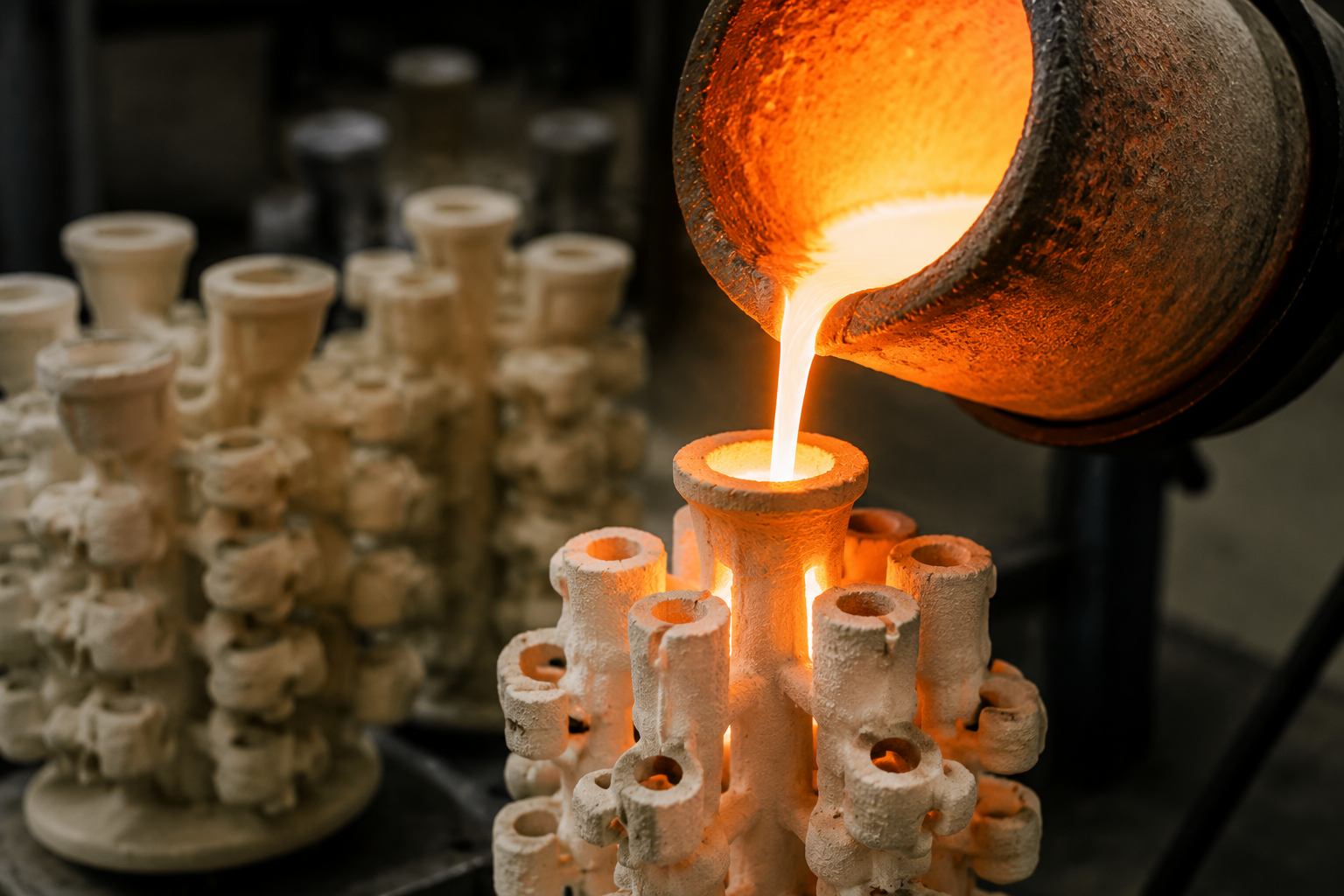
Precision Casting CNC Machining Solution From Prototype To Production
Casting CNC Machining is a hybrid manufacturing process that combines the advantages of metal casting and CNC precision machining.
The casting process creates a near-net-shape metal blank, while CNC machining ensures critical dimensions, tight tolerances, and functional surfaces meet engineering requirements.
For complex metal components requiring strength, accuracy, and cost efficiency, Casting CNC Machining provides an optimized manufacturing solution by combining the design flexibility of casting with the precision of CNC machining. This process reduces material waste and machining time while ensuring critical dimensions, functional surfaces, and assembly requirements meet strict engineering standards.
XY-GLOBAL supports custom casting, CNC machining, surface finishing, and inspection services for industries including robotics, semiconductor equipment, automotive, medical devices, and industrial automation.
Casting CNC Machining Process
The typical Casting CNC Machining workflow includes:
| Process | Description |
|---|---|
| Engineering Review | Analyze drawings, 3D models, tolerance requirements, and production volume |
| Casting Method Selection | Select suitable casting technology based on part structure and quantity |
| Mold & Pattern Development | Create tooling based on casting requirements |
| Casting Production | Produce near-net-shape metal blanks |
| CNC Precision Machining | Machine critical dimensions and functional areas |
| Surface Treatment | Apply anodizing, plating, coating, polishing, or other finishes |
| Quality Inspection | Perform CMM inspection, dimensional reports, and material verification |
Casting CNC Machining vs Different Manufacturing Processes
Choosing the correct manufacturing process depends on part complexity, quantity, material, tolerance, and cost requirements.
Casting CNC Machining vs CNC Machining From Solid
| Factor | Casting CNC Machining | CNC Machining From Solid |
|---|---|---|
| Material Usage | Lower material waste | Higher material consumption |
| Complex Geometry | Excellent for complex structures | Limited by tool access |
| Production Volume | Medium to high volume | Prototype and low volume |
| Lead Time | Longer due to tooling | Faster startup |
| Unit Cost | Lower after production begins | Higher for large quantities |

When To Choose Casting CNC Machining
Choose Casting CNC Machining when:
- The part has complex geometry
- Material removal would be excessive
- Production quantity is medium or high
- Weight reduction is required
- Cost optimization is important
Choose CNC machining from solid when:
- Only a few prototypes are needed
- Design changes frequently
- No tooling investment is acceptable
Casting CNC Machining vs Investment Casting
Investment casting is known for producing complex shapes with excellent surface quality.
However, some precision surfaces still require secondary CNC machining.
| Factor | Casting CNC Machining | Investment Casting |
|---|---|---|
| Shape Complexity | Excellent | Excellent |
| Surface Finish | Improved by CNC machining | Good casting surface |
| Dimensional Accuracy | Higher after machining | Depends on casting process |
| Large Flat Surfaces | Better with CNC machining | More challenging |
| Secondary Machining | Required for critical areas | Sometimes required |

Which One Should You Choose?
Investment casting is suitable for:
- Small and medium complex components
- Thin walls
- Detailed structures
- Stainless steel precision parts
Casting CNC Machining is better when the part requires:
- Tight dimensional tolerance
- Precision holes
- Flat reference surfaces
- Assembly interfaces
Casting CNC Machining vs Die Casting
Die casting is widely used for high-volume aluminum and zinc components.
| Factor | Casting CNC Machining | Die Casting |
|---|---|---|
| Production Volume | Low to high volume | High volume preferred |
| Tooling Cost | Moderate | Higher |
| Material Options | Wide range | Mainly aluminum/zinc alloys |
| Accuracy | Higher after machining | Good casting accuracy |
| Flexibility | Better for customized parts | Less flexible |

Choose Die Casting When:
- Annual quantity is very high
- The design is stable
- The same part is produced continuously
Choose Casting CNC Machining When:
- Production volume is smaller
- Design changes are possible
- Higher precision is required
Casting CNC Machining vs Sand Casting
Sand casting is commonly used for large and heavy metal components.
| Factor | Casting CNC Machining | Sand Casting |
|---|---|---|
| Surface Finish | Better after CNC machining | Rougher casting surface |
| Part Size | Small to medium parts | Suitable for large parts |
| Cost | Higher precision cost | Lower tooling cost |
| Accuracy | Higher | Moderate |

Sand casting combined with CNC machining is often selected for:
- Large mechanical housings
- Industrial equipment parts
- Heavy-duty components
How To Select The Right Casting CNC Machining Solution?
Before choosing a manufacturing process, engineers usually consider:
1. Part Geometry
Complex internal structures and curved shapes often benefit from casting.
2. Production Quantity
| Quantity | Recommended Process |
|---|---|
| 1-10 pcs | CNC machining |
| 10-500 pcs | Casting CNC Machining |
| 5000+ pcs | Die Casting / High-volume Casting |
3. Material Requirement
Different alloys require different casting methods.
Common choices:
- Aluminum alloy → lightweight structures
- Stainless steel → corrosion resistance
- Carbon steel → heavy-duty applications
- Brass → electrical and fluid components
4. Precision Requirement
Casting creates the basic shape, while CNC machining controls critical dimensions.
Typical CNC machining features include:
- Precision mounting surfaces
- Bearing holes
- Threaded holes
- Sealing surfaces
- Alignment features
Why Choose XY-GLOBAL For Casting CNC Machining?
XY-GLOBAL provides a complete manufacturing solution from casting development to finished precision components.
Our capabilities include:
✔ Casting process evaluation
✔ DFM optimization
✔ CNC machining
✔ Surface treatment
✔ CMM inspection
✔ Prototype and mass production support
By integrating casting and CNC machining, we help customers reduce machining costs while maintaining high precision and consistent quality.
Our engineers work closely with customers to select the most suitable manufacturing process based on:
- Part design
- Material
- Quantity
- Cost target
- Performance requirements
FAQ
What is the difference between casting and Casting CNC Machining?
Casting creates the basic metal shape, while Casting CNC Machining adds precision machining operations to achieve tighter tolerances and functional requirements.
Is Casting CNC Machining cheaper than CNC machining?
For medium and high-volume production, Casting CNC Machining is usually more cost-effective because it reduces material waste and machining time.
Can cast parts achieve tight tolerances?
Yes. Critical areas can be CNC machined after casting to achieve higher accuracy.
What casting method is best for CNC machining?
The best method depends on the application. Investment casting, sand casting, gravity casting, and die casting can all be combined with CNC machining.
Does XY-GLOBAL provide prototype Casting CNC Machining?
Yes. We support prototype development, low-volume production, and mass manufacturing


Share:
Investment Casting Materials: How To Choose The Right Alloy For Precision Metal Parts