


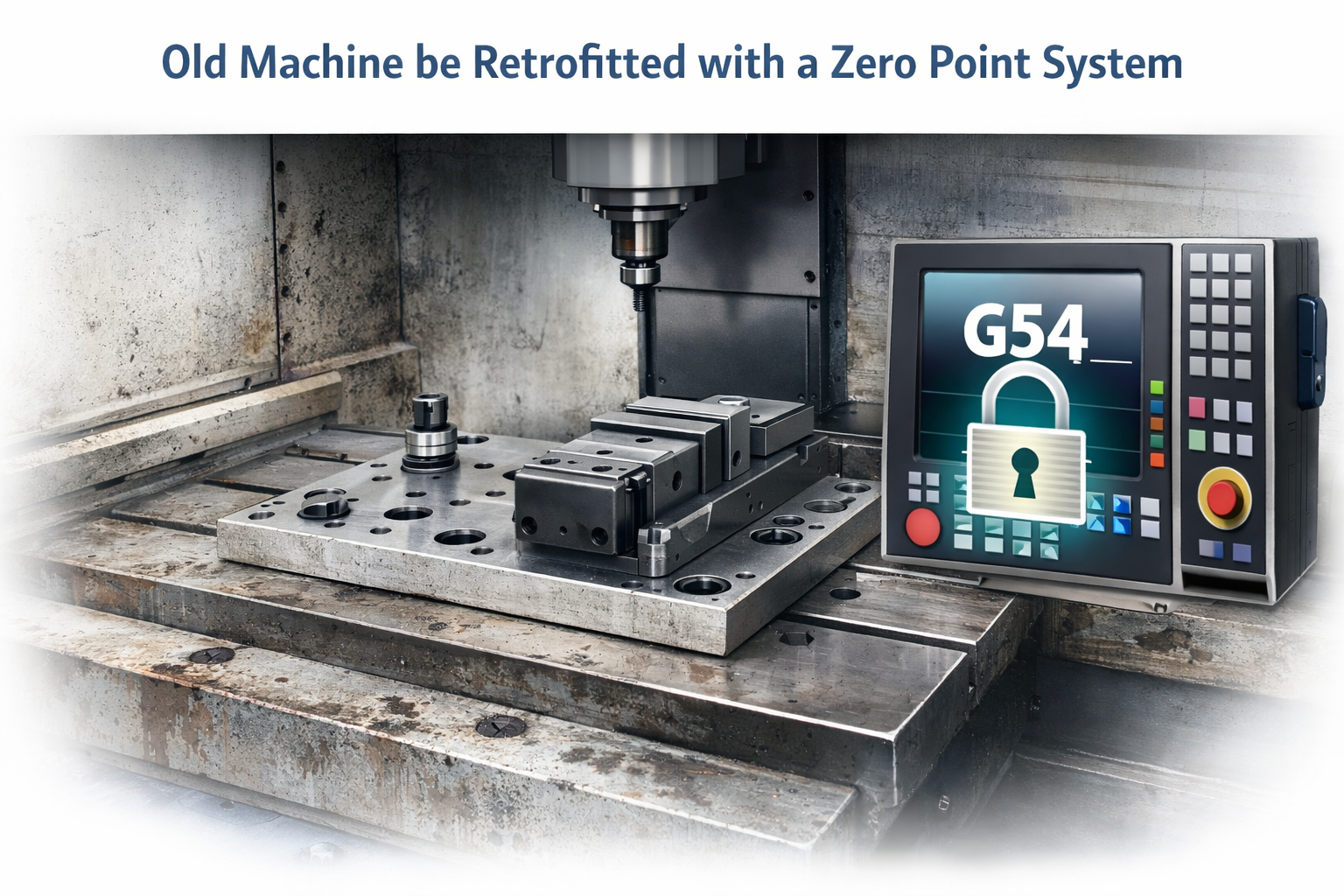
In many precision machine shops, aging CNC centers remain mechanically sound but act as productivity bottlenecks due to excessive manual setup times. As manufacturers shift toward high-mix, low-volume production, the question isn't just about the machine's spindle speed, but how quickly it can switch between jobs.
 Most legacy CNC machines can retrofit a zero point clamping system without rebuilding the machine, provided that the machine can still repeat reliably, the table geometry can be referenced (directly or via a sub-plate), and there is sufficient Z-clearance for the added stack height. By shifting the reference point from a manual alignment to a standardized interface, you can reduce setup times by 90% while achieving less than 0.005 repeatability.
1. What a Zero Point Retrofit Actually Involves
Retrofitting is an interface upgrade, not a machine overhaul. At XY-GLOBAL, we break the process down into four standardized steps to ensure seamless integration:
Step 1: Install the Physical Interface
Mount zero-point plates or modular clamping units directly to the machine table using existing T-slots or threaded grids.
Step 2: Establish a Clean Reference (Sub-plating)
If the original table is heavily worn or scarred, we recommend bolting on a precision-ground sub-plate first. This provides a fresh, flat datum that ensures the zero-point system’s accuracy is not compromised by old machine damage.
Step 3: Standardize Workholding Hardware
Equip your existing vises, fixtures, or pallets with standardized pull studs (clamping pins). This converts your traditional hardware into "plug-and-play" modules compatible with the new interface.
Step 4: Lock the Digital Workflow
Define a permanent master work offset (typically G54) for the zero-point plate. By locking this reference in the CNC control, operators no longer need to touch off every new setup; the machine "knows" exactly where the fixture is every time.

2. What to Check First Before Investing a Zero Point System
Before investing in hardware, you must verify the machine’s physical limits. Use these four technical benchmarks to evaluate your equipment:
2.1 Mechanical Integrity & Repeatability
A zero-point system preserves accuracy; it cannot fix a worn-out machine.
-
The Test: Can the machine currently hold a positional tolerance of ±0.02mm on a simple test pattern?
-
Check: Inspect for axis backlash and table flatness. If the machine cannot repeat reliably today, a high-precision clamping system will have limited value.
2.2 The "Z-Factor" (Stroke & Stack Height)
Zero-point modules add height (typically 30mm–60mm) between the table and the workpiece.
-
Check: After adding the plate and fixture, is there enough Z-travel for your tallest part plus the tool length?
-
Collision Risk: Ensure the spindle nose or tool changer has enough clearance to move at rapid speeds without hitting the new hardware.
2.3 Table Layout & Mounting Options
-
Check: Is the usable area large enough for the plate size you need?
-
Infrastructure: Decide between mechanical systems (actuated by a wrench; ideal for simple retrofits with no air lines) or Pneumatic systems (require dry, stable air; ideal for future automation).
2.4 Business Case (ROI)
-
Part Mix: Do you run repeat jobs or experience 2+ changeovers per shift?
-
Gains: If you spend 10 hours a week on alignment, a retrofit can reclaim about 8 hours of spindle time. Even an old machine becomes a high-margin asset when it spends more time cutting and less time sitting idle.
3. When a Zero Point Retrofit Does Not Make Sense
A retrofit is usually not recommended when:
-
The machine cannot hold tolerance even after basic maintenance.
-
The table is severely damaged and uneconomical to correct.
-
The machine runs one or two long-term jobs with minimal changeovers.
-
A replacement machine is already planned in the near term.
In these cases, zero point systems are better deployed on newer or more flexible machines.
Retrofitting a Zero Point Clamping System is more than just a hardware upgrade—it is a strategic decision to eliminate the "hidden waste" of manual alignment on your shop floor. By transforming your legacy CNC machines from rigid, slow-to-set assets into flexible, quick-change platforms, you effectively gain new machine capacity without the capital expense of a full replacement.
While age is rarely a barrier, success lies in the details of the initial audit. By rigorously checking your machine’s mechanical integrity, Z-axis clearance, and workflow readiness, you ensure that your investment in precision clamping translates directly into higher spindle utilization and predictable profitability.
Ready to modernize your legacy equipment? At XY-GLOBAL, we specialize in integrating high-precision workholding solutions tailored to your existing machine infrastructure. Our team can help you evaluate your specific table layout and part mix to ensure a seamless transition to a zero-point environment.

Frequently Asked Questions (FAQs)
Q: How do I manage coolant and chip buildup on an older machine?
A: Old machines often lack the high-pressure washdown systems found in newer centers. When retrofitting, we recommend zero-point modules with integrated blow-out ports or stainless steel components to resist corrosion from older coolant formulas. Manual cleaning with a compressed air gun during each changeover ensures the clamping pins seat correctly every time.
Q: What is the most common mistake in retrofitting?
A: Ignoring "Stack Height." Always calculate the total height of the zero-point plate + the fixture + the workpiece. Verify that your Z-axis has enough travel to clear your longest tool during a tool change. If clearance is tight, look for "Low-Profile" zero-point modules.
Q: Will the added weight of the system affect my machine's motor life?
A: Generally, no. Most systems use hardened steel or high-strength aluminum. As long as the combined weight of the zero-point plate, fixture, and workpiece remains within the machine table's original rated load capacity, the impact on axis drives and ball screws is negligible.
Q: Do I need to buy new vises or fixtures?
A: Not necessarily. One of the biggest cost-savers is that you can retrofit your existing hardware. By machining a simple bolt pattern into the bottom of your current vises or plates and installing standardized pull studs (clamping pins), you convert legacy tools into "plug-and-play" assets.
Q: Can I use the same pallets on both my old and new machines?
A: Yes! This is a primary benefit of the system. By standardizing the stud pattern (e.g., a 200mm or 52mm grid) across your entire shop, your fixtures become "machine-agnostic." This allows you to move urgent jobs from an old machine to a new one in seconds without re-indicating the part.
Q: Does a pneumatic system require special electronics on a legacy CNC?
A: No. While newer machines can use M-codes to automate clamping, a legacy retrofit can operate via a simple manual air valve mounted to the side of the machine. This keeps the installation inexpensive and avoids the need to mess with old PLC ladder logic.
Q: Can I integrate a zero-point system with my current CAM software?
A: Absolutely. You simply update your machine's digital twin or work offsets in the CAM environment. Once the G54 is fixed to the master plate, your post-processor doesn't need to change—only your workflow becomes faster.


Share:
Why Use a Zero Point Clamping System for CNC Machining?
Aluminum Die Casting Mold Temperature: Practical Guidelines for Stable Production