


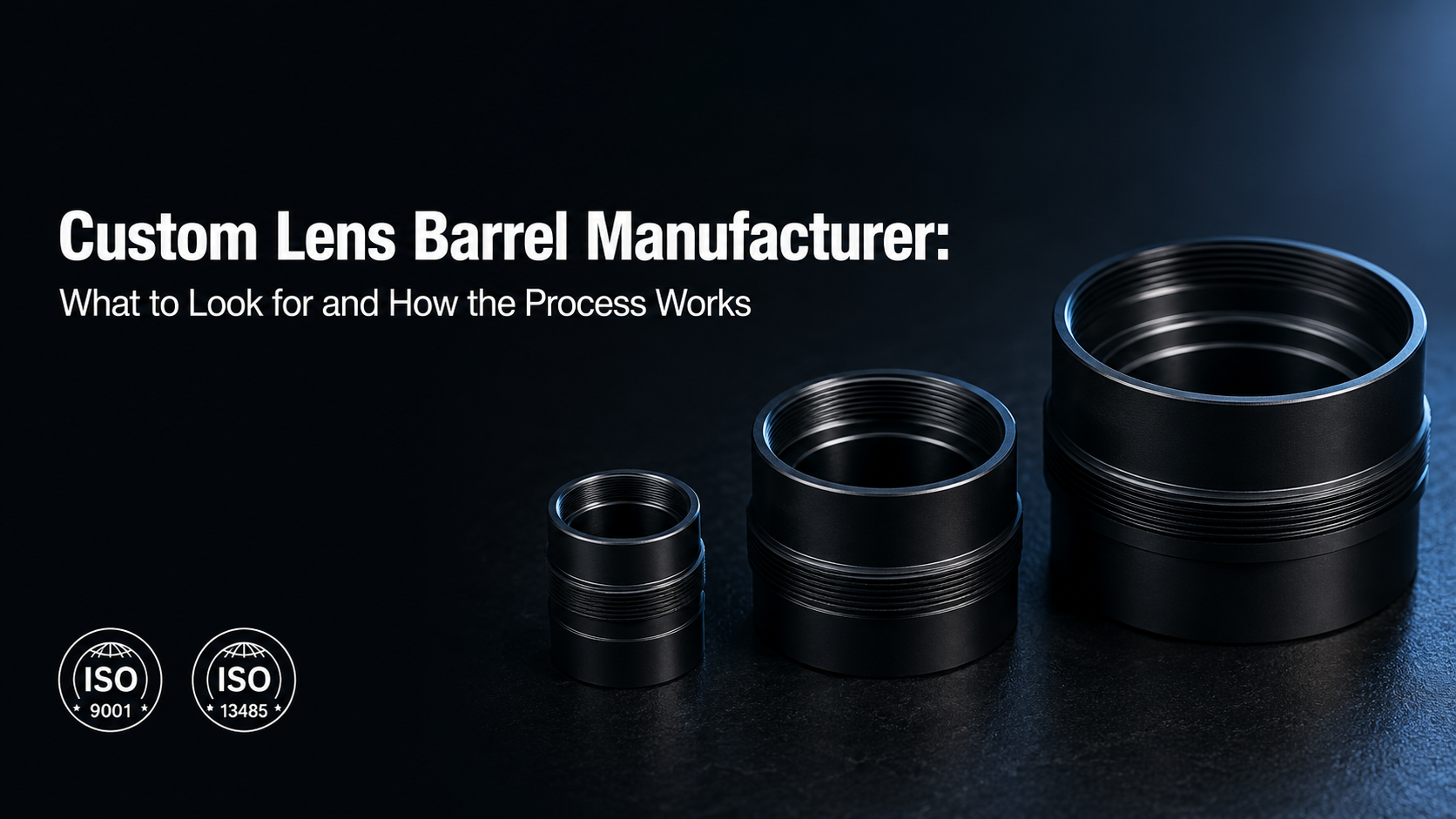
Most precision optical systems require lens barrels that are built to specification rather than selected from a standard catalog. The bore diameter, thread pitch, outer geometry, material, surface finish, and surface treatment of a lens barrel are all determined by the optical design — and the mechanical component must be manufactured to match, not the other way around. That makes the choice of custom lens barrel manufacturer one of the more consequential sourcing decisions in an optical system development program.
The challenge is that not every CNC machine shop capable of turning metal cylinders has the process knowledge, measurement capability, and optical industry experience to produce custom lens barrels that consistently meet specification. At the tolerances required — bore diameters to ±1–3 μm, thread concentricity within a few micrometers, internal surface roughness to Ra ≤ 0.4 μm or better — the difference between a capable and an incapable manufacturer becomes visible in the first prototype batch.
This article explains what a custom lens barrel manufacturer should be able to demonstrate, how the custom process typically works from drawing to delivery, what DFM and specification questions to raise before production begins, and how to evaluate a supplier before committing to a program.

What Is a Custom Lens Barrel?
A custom lens barrel is a precision CNC machined component designed to hold, position, and protect one or more optical elements — lenses, filters, apertures, or spacers — within a specific optical system. Unlike catalog lens barrels, which are produced to fixed standard dimensions, a custom lens barrel is manufactured to the buyer's drawing, with dimensions, tolerances, thread specifications, and surface treatment requirements determined by the optical and mechanical design of the system it goes into.
Custom lens barrels appear across a wide range of applications: camera and imaging systems, laser assemblies, medical optical instruments, machine vision modules, scientific instrumentation, defense and aerospace optical systems, and consumer optical devices. In each case, the barrel is designed around the specific lenses it will hold, the assembly sequence it must accommodate, and the performance requirements of the finished system.
Typical features on a custom lens barrel include a precision internal bore sized to locate lens elements, internal or external threads for retaining rings or mating housings, stepped bores or shoulders to set axial lens positions, fine surface finish on internal optical surfaces, black anodizing or other stray light control treatments, and sometimes external features for mounting, alignment, or assembly indexing. The combination of these features — and the tolerances applied to them — is unique to each design and must be produced correctly for the optical system to perform as intended.
Why Custom Rather Than Off-the-Shelf?
Off-the-shelf lens barrels from optical component distributors are useful for prototyping and for systems designed around standard lens dimensions. For most production optical systems, however, custom lens barrels are necessary for several practical reasons.
Standard catalog barrels are designed for standard lens diameters and may not match the lens geometry, thread specification, or assembly interface of a specific design. A system using non-standard lens diameters, a particular thread pitch for fine focus adjustment, or an unusual outer diameter to fit within a constrained housing envelope will need a custom barrel. Custom barrels also allow the designer to optimize bore fit for the actual lens tolerance band, control retaining ring engagement precisely, and specify wall thickness and external geometry to suit the mechanical envelope of the complete assembly.
For production programs, custom barrels offer better consistency than catalog parts because the manufacturing process is specifically qualified for the drawing. A catalog barrel is produced to a general specification tolerance; a custom barrel produced by an experienced manufacturer to a specific drawing can be held to tighter dimensional consistency across a production batch. For optical systems where performance uniformity across units matters, this consistency advantage is significant.

What a Custom Lens Barrel Manufacturer Should Be Able to Do
Not all CNC machine shops are equally capable of producing custom lens barrels to optical industry standards. The following capabilities distinguish manufacturers with genuine optical component experience from general precision machining suppliers.
Bore tolerance and geometry control. The internal bore of a lens barrel must meet diameter tolerance, roundness, and cylindricity requirements simultaneously. A bore that is within diameter tolerance but out-of-round by 5 μm will seat a lens off-center. A capable manufacturer should be able to demonstrate bore diameter control to ±1–3 μm with roundness and cylindricity well within the tolerance band. This requires appropriate machine capability, cutting parameter control, and in-process measurement.
Thread production for optical applications. Lens barrel threads — whether M-series metric, inch-form, or custom — must be produced with controlled pitch accuracy, thread form, and concentricity to the bore. A thread that runs out by 10 μm relative to the bore axis tilts the retaining ring and, through it, the lens element. A manufacturer experienced in optical lens barrels understands this relationship and produces threads accordingly, not simply to pass a go/no-go gauge.
Internal surface finish control. Internal bore and optical cavity surfaces in lens barrels require surface finishes in the Ra ≤ 0.4 μm to Ra ≤ 0.1 μm range, depending on the application. Achieving these values requires appropriate tooling, cutting parameters, and where necessary secondary finishing operations. The manufacturer should be able to confirm what finish they can achieve on internal surfaces at the bore diameters specified and demonstrate it with surface measurement data.
Anodize allowance and post-treatment dimensional control. Black anodizing is standard for aluminum lens barrels and is critical for stray light control. Anodizing adds material to surfaces, and the bore must be machined to a pre-anodize diameter that accounts for this growth — typically 10–25 μm per surface, depending on process specification — to achieve the correct post-anodize bore dimension. A manufacturer without experience in optical components may not account for this correctly, resulting in finished barrels with undersized or inconsistent bores after anodizing.
DFM capability for optical parts. An experienced custom lens barrel manufacturer will review a drawing before production and identify features that present manufacturing risk — thin walls that may distort, thread dimensions that require non-standard tooling, bore tolerances that are tight relative to the anodize allowance, or surface finish requirements that need secondary operations not initially factored into lead time. This DFM feedback, provided before the first part is cut, reduces prototype failures and shortens development timelines.
Appropriate metrology. Verifying that a custom lens barrel meets specification requires measurement tools matched to the tolerances involved. A manufacturer relying on calipers and standard micrometers cannot verify bore diameter to ±2 μm or thread concentricity to 5 μm. CMM with appropriate styli, air gauging, optical profilers for surface finish, and calibrated thread measurement are the standard measurement infrastructure for custom lens barrel production.
The Custom Lens Barrel Process: From Drawing to Delivery
Understanding how a capable custom lens barrel manufacturer manages the production process helps set realistic expectations for timeline, communication, and what information is needed at each stage.
Drawing review and DFM. The process begins with the manufacturer reviewing the customer's drawing or model. At this stage, a capable supplier should provide feedback on any features that present manufacturing risk, confirm that the specified tolerances are achievable with their process capability, clarify any ambiguities in the drawing, and advise on anodize allowances and their effect on bore dimensions. This review should happen before any production commitment is made.
Material procurement and preparation. For custom lens barrels, the starting material — aluminum alloy bar stock, stainless tube, or other form — is selected to suit the drawing specification. Material certifications are part of the procurement record and are available with the finished parts for traceability.
CNC machining. Custom lens barrels are typically produced by CNC turning for the bore, external diameter, threads, and axial features, with CNC milling for any cross-holes, flats, keyways, or mounting features. 5-axis machining is used for complex geometries that cannot be produced in fewer setups. Setup and fixturing for the first production run are qualified against the drawing before the batch is run.
In-process inspection. Critical dimensions — bore diameter, thread form, surface finish on optical surfaces — are typically checked during machining, not only at final inspection. In-process measurement allows correction of any process drift before it affects a full batch of parts.
Surface treatment. Black anodizing, passivation, or other surface treatments are applied after machining. For black anodized aluminum barrels, post-anodize bore dimensions are verified to confirm the anodize growth was within the specified allowance and the finished bore meets the drawing dimension.
Final inspection and documentation. Finished custom lens barrels are inspected against the drawing before shipment. First article inspection reports, dimensional inspection data, and material certifications are standard documentation for custom optical components and are provided to the customer with the shipment or on request.

DFM Considerations for Custom Lens Barrels
Several DFM topics arise consistently in custom lens barrel programs and are worth addressing with a potential manufacturer before production begins.
Wall thickness and rigidity. Thin-walled lens barrels are common in compact optical designs, but wall sections below approximately 0.8–1.0 mm in aluminum can distort under machining forces or clamping loads if fixturing is not designed appropriately. If a design requires thin walls, confirming that the manufacturer has appropriate fixturing and experience with thin-section barrels reduces prototype risk.
Thread pitch and tooling. Non-standard thread pitches or fine-pitch metric threads (M12×0.5, M15×0.5, or custom forms) may require tooling not in a general machine shop's standard inventory. Confirming that a manufacturer has or can produce the required thread form — and has done so previously on similar barrel diameters — avoids tooling-related delays in prototype production.
Black anodize and bore tolerance stacking. For aluminum lens barrels with tight bore tolerances (±3 μm or better after anodizing), the anodize allowance must be explicitly planned in the pre-machining bore dimension. If the drawing specifies the post-anodize bore dimension, the manufacturer must know the actual anodize growth for their process specification to back-calculate the pre-anodize target. Misunderstanding this is one of the most common causes of out-of-tolerance barrels after anodizing.
Bore step and shoulder accuracy. Stepped bores — where different lens elements seat at different axial positions within the same barrel — require the step diameter, step axial position, and step face flatness to all be controlled simultaneously. The axial position of a step directly affects the air gap between lens elements and, therefore, the system's optical performance. Confirming that the manufacturer understands the functional importance of these features and measures them in final inspection is important for systems where axial position accuracy matters.
Tolerances and Specifications to Discuss with Your Manufacturer
Before committing to a custom lens barrel manufacturer, several specification points should be explicitly confirmed rather than assumed.
Bore diameter tolerance and measurement method should be stated clearly on the drawing and confirmed with the manufacturer. A tolerance of ±2 μm on a 25 mm bore is a different machining challenge than the same tolerance on a 5 mm bore, and the measurement approach (CMM, air gauge, or optical) should be appropriate for the feature size and tolerance level.
Coaxiality between the bore and the external datum — typically the outer diameter used for assembly location — should be specified if lens centration relative to the barrel's mounting axis is important. This tolerance is often omitted from lens barrel drawings and then found to matter at assembly when concentricity errors become visible as image quality variation between units.
Thread concentricity to the bore, thread pitch accuracy, and thread form specification should be confirmed with the manufacturer. For lens barrels used in precision focus mechanisms, thread pitch accuracy directly affects focus travel per revolution and image focus consistency.
Surface finish requirements should specify both the Ra value and the measurement method or location. Internal bore finish, lens seat finish, and thread surface quality may have different requirements and should be specified separately if they differ.
Post-anodize versus pre-anodize dimensions should be explicitly stated on the drawing for aluminum parts. Ambiguity on this point is a common source of rejected first article parts.
Quality Assurance and Inspection for Custom Lens Barrels
Quality assurance for custom lens barrels starts with a measurement infrastructure appropriate for the tolerances involved and extends to documentation practices that support the customer's quality system requirements.
CMM inspection is standard for geometric features — bore diameter, roundness, coaxiality, step position, and flatness. Air gauging provides fast and highly accurate bore diameter measurement for production batch inspection. Surface roughness is measured with contact profilometers or non-contact optical profilers. Thread measurement may use calibrated gauges or CMM thread cycles depending on the thread specification.
For custom lens barrels supplied into medical device or defense programs, first article inspection reports, material certifications, and dimensional records for each production batch are standard quality deliverables. ISO 9001 certification is a baseline quality system requirement for most industrial optical component sourcing. ISO 13485 certification is required for manufacturers supplying into medical device supply chains.
Process capability data — Cpk values for critical dimensions — is increasingly requested by customers placing repeat production orders for custom lens barrels. A manufacturer who has produced a barrel design across multiple batches and can provide capability data is demonstrating that their process is in statistical control, not just that individual batches passed inspection.

Questions to Ask a Custom Lens Barrel Manufacturer
When evaluating a custom lens barrel manufacturer for a new program, the following questions help separate manufacturers with genuine optical component capability from general precision machining shops.
What bore diameter tolerances can you hold in production, not just in a first article? What measurement method do you use to verify bore diameter at that tolerance level? Have you produced lens barrels at similar bore diameters and tolerances previously, and can you share reference data?
How do you handle anodize allowance on tight-tolerance bores? Do you measure post-anodize bore dimensions as part of your standard inspection, or only pre-anodize? What anodize build-up does your process specification produce, and what is the variation in that build-up?
What thread forms do you produce, and how do you verify thread concentricity to the bore? Do you have tooling for the specific thread pitch and form on this drawing, or will tooling need to be procured?
What certifications do you hold — ISO 9001, ISO 13485? Do you provide first article inspection reports with dimensional data as a standard deliverable? What is your process for DFM review before production starts?
What is your typical lead time for prototypes at this complexity level? What is your minimum order quantity for production, and how does pricing scale with volume?
Why XY-GLOBAL for Custom Lens Barrel Manufacturing
XY-GLOBAL is a custom lens barrel manufacturer with CNC machining capability specifically developed for precision optical mechanical components. We produce custom lens barrels in aluminum, stainless steel, titanium, and brass from single prototypes through production volume, with bore tolerances to ±1 μm, internal surface finish to Ra ≤ 0.1 μm, and thread production for standard and custom optical thread forms.
Our standard process for new custom lens barrel programs includes DFM review before production, anodize allowance planning for aluminum barrels, and first article inspection with dimensional data. Black anodizing, passivation, and bead blasting surface treatments are available in-house with dimensional verification after treatment.
XY-GLOBAL holds ISO 9001 and ISO 13485 certifications, supporting custom lens barrel supply into industrial, scientific, and medical optical device programs. Material certifications and batch traceability documentation are standard with production orders. Production start is within one day of drawing confirmation, and free prototype support is available for new custom lens barrel designs.
If you have a custom lens barrel requirement — from a first prototype to an ongoing production program — contact XY-GLOBAL with your drawing or design brief for a DFM review and quotation.
FAQ
What information does a custom lens barrel manufacturer need to provide a quote?
A 2D drawing or 3D model with all critical dimensions and tolerances specified is the standard basis for a custom lens barrel quotation. The drawing should specify material, surface treatment, post- or pre-anodize dimensions for aluminum parts, thread form and pitch, and any inspection or documentation requirements. If a drawing is not yet finalized, a preliminary design with key dimensions and tolerance requirements allows a manufacturer to provide a budgetary estimate and early DFM feedback.
What is the typical lead time for custom lens barrel prototypes?
Lead time for custom lens barrel prototypes depends on part complexity, material availability, thread tooling requirements, and surface treatment. Simple barrels in aluminum with standard threads can often be produced quickly; complex geometries, non-standard thread forms, or tight tolerances requiring process qualification take longer. XY-GLOBAL can provide specific lead time estimates after DFM review of the drawing.
Can a custom lens barrel manufacturer work from a design concept rather than a finished drawing?
Yes. An experienced custom lens barrel manufacturer can provide DFM input during design development, not only after drawing release. Engaging the manufacturer early — particularly on wall thickness, thread pitch selection, bore step geometry, and anodize allowance — often prevents issues that would otherwise appear at first article inspection. XY-GLOBAL offers DFM review at no charge for new programs.
What is the minimum order quantity for custom lens barrels?
Custom lens barrel manufacturers with CNC machining capability can typically produce quantities from one unit upward. There is no minimum order requirement at XY-GLOBAL for custom lens barrels. Pricing is naturally volume-dependent, with per-unit cost decreasing as quantity increases due to setup amortization. Free prototype support is available for new designs.
Do custom lens barrel manufacturers provide inspection reports?
A capable custom lens barrel manufacturer should provide first article inspection reports with dimensional data as a standard deliverable for new designs. Material certifications and batch inspection records are standard for production orders. For medical device supply chains, inspection documentation must meet ISO 13485 quality system requirements. XY-GLOBAL provides first article inspection reports, material certifications, and batch traceability documentation as standard on all custom lens barrel programs.
Conclusion
Selecting the right custom lens barrel manufacturer is a decision that affects every stage of an optical system development program — from prototype timeline to production yield to long-term supply reliability. The capabilities that matter most are bore tolerance and geometry control, thread production for optical applications, internal surface finish achievement, correct anodize allowance management, DFM capability, and measurement infrastructure matched to the tolerances involved.
A manufacturer who can demonstrate these capabilities — through reference parts, inspection data, and clear answers to technical questions — is a significantly lower-risk partner than one who simply confirms they can turn metal cylinders. For custom lens barrel programs where first-time-right prototype results and consistent production quality matter, the investment in finding the right manufacturing partner pays back quickly.
XY-GLOBAL provides custom lens barrel manufacturing from prototype to production with the process capability, quality system, and optical industry experience that precision optical system programs require. Contact us with your drawing or design requirements to begin.


Aktie:
XY-GLOBAL nimmt Produktion nach dem chinesischen Neujahr wieder auf | Präzisions-CNC-Bearbeitung & Druckguss