


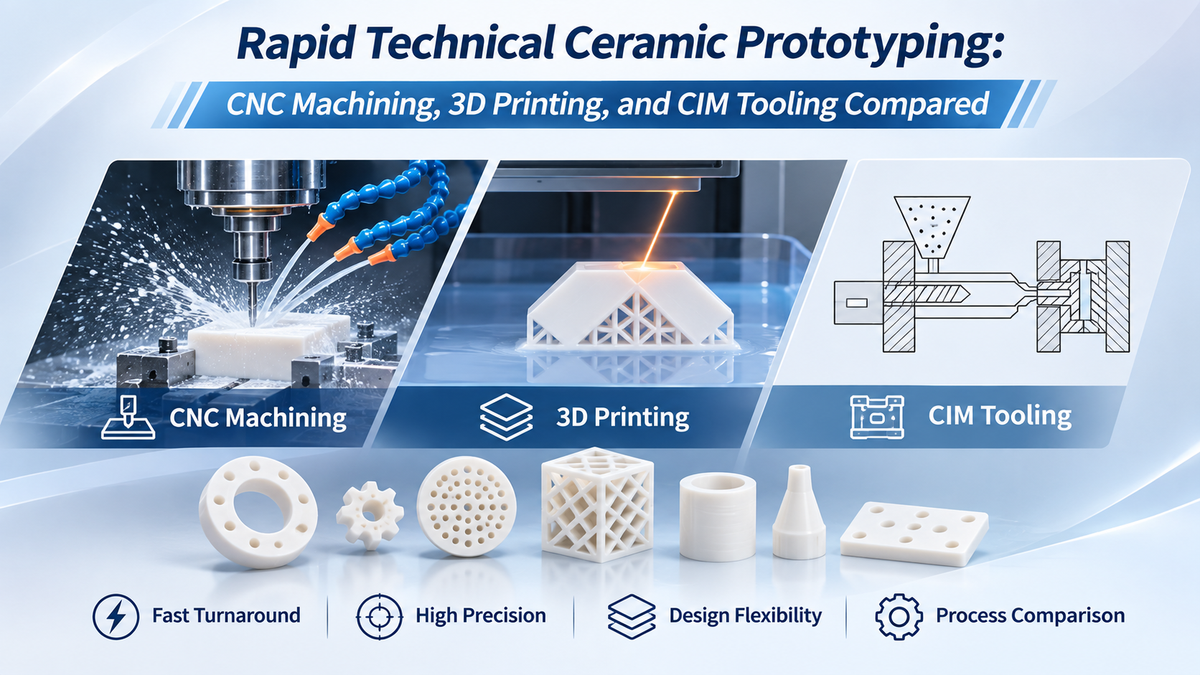
Let’s say you need a ceramic part for a new product, but the design is still changing. You don't want to invest in a production mold befroe you know the design will work.
This is the problem rapid technical ceramic prototyping solves. It lets you make a real, testable part early—so you can check the fit, material performance, and manufacturability before committing to production tooling.
But here is the thing: there is more than one way to make a technical ceramic prototype. CNC machining, ceramic 3D printing, and ceramic injection molding(CIM) rapid tooling can all get you there. The right choice depends on the part geometry, quantity, tolerances, and how close the prototype needs to be to the final production process.
Founded in 2010, XY-GLOBAL brings over 15 years of expertise to produce precison ceramic components with consistent quality from fast prototyping to mass production. We help customers choose the right way based on actual goal with our hands-on experience over the years: a functional prototype, a precision part, or preparing for repeatable production.

What Is Rapid Technical Ceramic Prototyping?
Rapid technical ceramic prototyping is the process of making a functional ceramic part quickly so engineers can test the design before committing to expensive production tooling.
It is not just about making something that looks like the final part. A good prototype should answer real questions: Will it fit? Will it survive heat, wear, or electrical loads? Can it be manufactured reliably at a larger volume?
Think of it as a bridge between a CAD model and a production-ready component. The prototype lets you find design problems early—when changes are still relatively easy and inexpensive.
Where Technical Ceramic Prototypes Are Used?
Technical ceramic prototypes are used across industries where metals and plastics reach their limits.
In semiconductor equipment, ceramics are used for insulators, wafer-handling components, gas distribution parts, and wear-resistant components. These applications often need a combination of electrical insulation, chemical resistance, and dimensional stability.
In medical devices, ceramics can be used for sterilizable components, insulating supports, and precision wear parts. Their biocompatibility, hardness, and resistance to corrosion make them useful in demanding environments.
In aerospace and energy, ceramics are used for high-temperature fixtures, insulators, and components that must survive thermal cycling. Their low weight and resistance to heat can make them a strong alternative to metals.
In industrial automation, ceramics are common in wear guides, locating pins, seals, nozzles, and precision fixtures. These parts often see repeated contact, abrasion, heat, or corrosive media.
In electronics and photonics, ceramics are used for substrates, heat sinks, insulators, and precision mounting components. Their electrical insulation and thermal properties make them valuable in compact, high-performance systems.
CNC Machining vs. Ceramic 3D Printing vs. CIM Rapid Tooling
Most technical ceramic prototypes are produced by CNC machining, 3D printing, and ceramic injection molding(CIM) rapid tooling. None is automatically “better” than the others. You can take a closer look at the table below to know them more:
| Factor | CNC machining & grinding | Ceramic 3D printing | CIM rapid tooling |
| Best for | Functional, precision prototypes | Complex internal geometry | Pre-production validation |
| Typical quantity | 1–10+ pieces | Usually 1–10+ pieces | About 20–500+ pieces |
| Tooling | Not required | Usually not required | Simplified aluminum or pre-hardened steel mold |
| Lead time | Often 3–7 days after DFM approval, depending on part complexity | Often days to weeks, plus debinding and sintering | Typically 2–4 weeks, including molding, debinding, and sintering |
| Geometry | Limited by tool access and machining strategy | Excellent for complex internal features | Requires draft angles, parting lines, and demolding design |
| Material performance | Strong when the same ceramic grade and sintering route are used | Depends on feedstock, debinding, and sintering control | Best for validating the intended CIM production process |
| Surface finish | Excellent with grinding, lapping, and polishing | Often needs post-processing | Good after sintering; critical surfaces may still need finishing |
| Design changes | Easy: revise CAD and remachine | Easy to revise the digital model, but post-processing still takes time | More costly after the mold has been made |
| Production transition | Strong for machining-based low-volume production | May require further process development | Direct bridge to CIM mass production |
CNC Machining: The Practical Choice for Functional Ceramic Prototypes
Ceramic CNC machining is a computer-controlled, subtractive manufacturing process. Instead of building a part layer by layer, it removes material from a ceramic blank, preform, or sintered component to create the required shape. Depending on the part and material condition, the process may include CNC milling, drilling, grinding, lapping, and polishing.
For many technical ceramic components, CNC machining and diamond grinding are the most practical starting point.
Why? Because it does not need a mold. Customers can send a CAD file, review the design with an engineer, and start machining a real ceramic part. That makes CNC especially useful when the design is still changing or when customers only need a few pieces.
Moreover, CNC machining can work with a wide range of technical ceramics, including alumina, zirconia, aluminum nitride, silicon carbide, silicon nitride, Macor, and boron nitride. It can also produce precise holes, flat sealing surfaces, locating features, threads, and tight-tolerance dimensions.
For a prototype that needs to be tested in the real world, this matters a lot. A CNC-machined ceramic part can be made from the intended material and finished to the tolerances needed for functional testing. It is often the best option when the prototype needs to prove more than just “the shape looks right.”

Ceramic 3D Printing: Best for Complex Geometry
Ceramic 3D printing, also called ceramic additive manufacturing, builds a part layer by layer from a digital CAD model. Instead of cutting material away from a ceramic blank, it uses a ceramic-loaded slurry, powder, or paste to form the shape directly.
Common methods include vat photopolymerization, such as SLA and DLP, as well as binder jetting and material extrusion. In many processes, the printed part is not yet a finished ceramic part. It is a green part that still needs cleaning, debinding, and sintering to remove binders and develop the final ceramic properties.
Still, ceramic 3D printing has a clear advantage: it can make shapes that would be difficult, slow, or impossible to machine, such as internal channels, lattice structures, thin walls, and complex curved surfaces.
This makes it a useful option when the geometry is the main challenge. It is especially interesting for early design exploration, lightweight structures, and parts where traditional cutting tools cannot reach the required features.

Ceramic Injection Molding (CIM) Rapid Tooling: A Bridge to Production
Similar to metal injection molding(MIM), ceramic injection molding, or CIM, is a near-net-shape injection molding manufacturing process for technical ceramics.
CIM rapid tooling is different from CNC machining and 3D printing because it is not only about making one prototype. It is about validating the production process.
With ceramic injection molding, or CIM, ceramic powder is mixed with binders to create a feedstock. That feedstock is injected into a mold, forming a green part. The part then goes through debinding and sintering to remove the binder and develop the final ceramic properties.
For rapid tooling, the mold is usually simplified and made from aluminum or pre-hardened steel rather than hardened production steel. This can reduce upfront tooling cost and lead time. A single-cavity mold is common for early samples because it keeps the tool simpler and easier to modify.
That said, ceramic injection molding rapid tooling is not automatically faster than CNC for one or two parts. The mold still needs to be designed and machined, and the ceramic parts still need debinding and sintering. Its real value shows up when the design is relatively stable, and you need enough parts to test assembly, run pilot production, or validate how the CIM process will behave at scale.

Which Route Should You Choose for Rapid Ceramic Prototyping?
Here is a simple way to think about it.
Choose CNC machining and grinding when you need a functional prototype quickly, need tight control over critical dimensions, or want to test real material performance without building a mold.
Choose ceramic 3D printing when the geometry is the main challenge—especially if the part has internal channels, thin walls, or complex shapes that cannot be reached with cutting tools.
Choose CIM rapid tooling when the design is stable, you need a larger sample quantity, and the final product will be made through ceramic injection molding.
And sometimes, the best answer is not just one process. A project might start with 3D printing to explore a complex geometry, move to CNC machining for precision features and functional testing, then use CIM rapid tooling before scaling into full production.
Common Mistakes in Ceramic Prototype Design
Ceramic prototyping goes more smoothly when the design considers both the material and the manufacturing process.
One common mistake is putting tight tolerances on every dimension. In ceramics, that usually increases cost and machining risk. It is better to identify the dimensions that affect assembly, sealing, alignment, or performance—and tolerance those carefully.
Another issue is ignoring shrinkage and distortion. Ceramics change size during sintering, and the amount of movement depends on the material, geometry, wall thickness, and support during firing. A design that looks simple on screen may behave differently after sintering.
Sharp internal corners, sudden wall-thickness changes, and unnecessarily thin sections can also create problems. These features can concentrate stress and increase the risk of cracking or chipping.
Deep blind holes, small holes, and features that are hard to reach with a cutting tool should be reviewed early. Sometimes a small design change can make the part much easier to machine without affecting its function.
Finally, do not treat appearance and function as the same thing. A part may need a clean surface for sealing or optical performance, but it may not need a perfect cosmetic finish everywhere. Separating those requirements can save time and cost.
What Affects the Cost and Lead Time of a Ceramic Prototype?
The fastest prototype is not always the cheapest one. The final cost and lead time depend on more than just the manufacturing method.
Material is a big factor. Macor, for example, is often easier to machine than fully sintered alumina or silicon carbide. Zirconia, aluminum nitride, and silicon carbide may require different tooling, cutting strategies, and finishing processes.
Part geometry matters too. A simple block with a few holes is very different from a thin-walled part with deep pockets, small holes, or tight internal features. The more material that needs to be removed, the more time and tool wear are involved.
Tolerances and surface finish also affect cost. If only a few dimensions affect assembly or sealing, it is usually more cost-effective to leave non-critical surfaces as-sintered and reserve precision grinding for the features that matter.
Quantity changes the equation as well. For one or two parts, CNC machining is often the fastest route. For 50 or 100 parts, ceramic injection molding rapid tooling may become more economical because the mold cost can be spread across more pieces.
Finally, post-processing matters. Grinding, lapping, polishing, cleaning, inspection, and packaging all add time. A part that needs a mirror-like surface or a certified inspection report will take longer than a basic functional prototype.
From Prototype to Production: What Happens Next?
A prototype is not the end of the project. It is the point where you decide what the next step should be.
If the design is still changing, CNC machining or ceramic 3D printing may be the best route. Both allow you to revise the CAD model and make a new version without committing to a production mold.
If the design is stable but the quantity is still low, CNC machining can continue into low-volume production. This is often a practical option for precision parts, custom geometries, or applications where tooling is not justified.
If the volume is growing and the part is suitable for injection molding, CIM rapid tooling becomes more relevant. At this stage, the goal is no longer just to make a prototype. It is to validate the molding, debinding, sintering, and inspection process that will be used in production.
That is why it helps to work with a supplier that can look beyond the first article. The right prototype strategy should support the next stage of the project—not just the first sample.
Partner with XY-GLOBAL for Rapid Ceramic Prototyping
As a ceramic part manufacturer with over 15 years of experience, XY-GLOBAL supports high precision and quality custom ceramic components from raw material preperation to surface finishing, and inspection under ISO 9001 and ISO 13485 certifications.
Since its establishment, the strict quality commitment is the important reason for XY-GLOBAL to gain customer trust.
For rapid ceramic prototypes, we help with choosing the suitable and cost-effective solution between ceramic CNC machining, ceramic 3D machining, and ceramic injection molding(CIM) rapid tooling based on your actual requirements.
Besides, our technical team can review your 2D drawings and 3D CAD files, check geometry and tolerance feasibility, and provide free DFM feedback before production to help reduce the risk of chipping, cracking, and machining problems—especially for thin walls, small holes, sharp corners, and complex features.
Request a Quote for Rapid Ceramic Prototyping
Still unsure which ceramic prototyping route is right for your project? Send us your drawing, CAD file, or even a photo of an existing part for a free DFM review and a competitive quote. Whether you need a single ceramic prototype or a small batch for testing, our team is ready to help you find the right prototyping solution.
Frequently Asked Questions for Rapid Technical Ceramic Prototyping
1. Can you sign an NDA before I send my drawings?
Yes. We understand that ceramic prototypes often involve new product designs, proprietary geometries, or confidential application information. We can review confidentiality requirements before you share detailed drawings or CAD files.
2. Can you work from a sample, sketch, or incomplete drawing?
Yes. If you do not have a complete 2D drawing, we can often start from a 3D CAD file, a physical sample, or a basic sketch. Our engineering team may ask for additional information about the application, mating parts, tolerances, and operating environment before quoting.
3. Can you help me choose the right ceramic material?
Yes. If you are not sure which ceramic grade to use, share the operating temperature, load, wear condition, chemical exposure, electrical requirements, and target quantity. We can recommend a suitable material and explain the tradeoffs between cost, machinability, and performance.
4. What if my prototype fails during testing?
Prototype failures are part of the development process. If a part does not perform as expected, we can review the design, material, tolerances, surface finish, and manufacturing route to identify possible causes. Then we can recommend design changes or an adjusted prototyping approach.
5. Can I change the design after the first prototype?
Yes. CNC machining is especially suitable for design iterations because it does not require a mold. After reviewing the test results, we can update the CAD model and manufacture a revised prototype.
6. Is there a minimum order quantity(MOQ) for ceramic prototypes?
No. XY-GLOBAL supports ceramic prototypes starting from a single part. We also support low-volume and repeat production as the project moves from validation to production.
7. What inspection reports can you provide?
Depending on your requirements, we can provide dimensional inspection reports, surface roughness reports, material certificates, certificates of conformance, and first-article inspection records. For critical parts, we can also discuss additional testing or documentation before production.
8. Can you make ceramic prototypes for regulated industries?
Yes. We have ISO 13485 and ISO 9001 certifications. Plus, we can discuss material traceability, documentation, inspection, and quality requirements for applications in medical, semiconductor, aerospace, and other regulated industries. Specific certification and documentation requirements should be confirmed during project review.
9. Can you make ceramic prototypes with threads, thin walls, or small holes?
Yes, but these features need early review. Threads, thin walls, small holes, and deep pockets can affect machinability, strength, tool access, and the risk of chipping or cracking. We can assess feasibility and suggest design improvements during DFM.
For more info, you can also read:
https://xy-global.com/pages/ceramic-cnc-machining-services
https://xy-global.com/blogs/knowledge/ceramic-cnc-machining
https://xy-global.com/blogs/knowledge/8-keys-to-ceramic-cnc-machining

Aktie:
Custom Metal Parts Manufacturing Services for OEMs: Processes, Materials, and Quality Control